
In the intervals of listening to Matthew Parris and John Carey, we escaped to the local hamlet of Stanshope, where there is a good Georgian front to an earlier house:

Poppies in the gardens:
In the intervals of listening to Matthew Parris and John Carey, we escaped to the local hamlet of Stanshope, where there is a good Georgian front to an earlier house:
Poppies in the gardens:
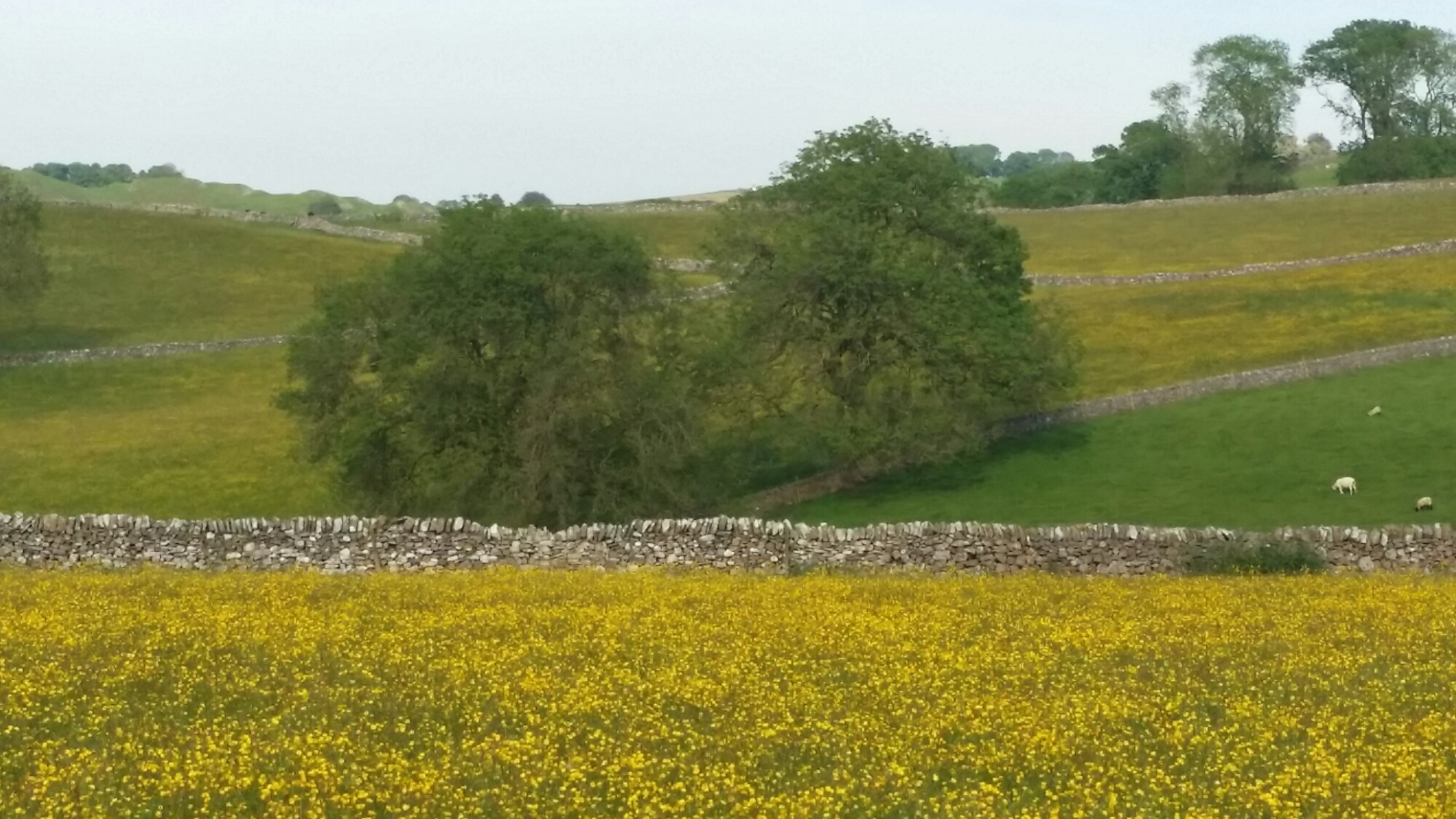
We first came to Dovedale about five years ago. We were amazed how well preserved it is, a pocket of deep countryside, stone walls, steep wooded valleys and old field systems, the first of the National parks, with no postwar buildings. Since then, we have been coming regularly to the Dovedale Arts Festival, which was held four years ago in a barn and two years ago in a local hotel. This year, it is again being held in a barn in open country north of Ilam. We arrived as the sun was going down:

It’s finished ! At least, she says it’s finished. This morning there was more inspection from afar, more pursed lips and slight narrowing of the eyes. Half way through, I was told ‘it’s nearly there’, then that my chin had been resolved, then that there were at least five portraits on top of one another, then, just before time, I was told it was all over and I was released into the outside world. No more sittings. But I still haven’t been allowed to see the final result. I have to wait.
I thought my portrait was finished. It isn’t. I was called back for another sitting yesterday, as has Hannah Rothschild. There was a great deal of inspection of the nearly finished portrait from near, from afar and as seen in the large mirror behind the easel, which enables me nearly to see a reflection of the portrait, but not quite. The back tape round its edge was gradually stripped off. I asked why. She said that she’ll tell me one day. At one point, she applied a large dab of bright yellow pigment which looked dangerous and wholly unnecessary. I had thought that my very severe haircut might be a disadvantage, as had she. It’s not long now that the invisible college of her sitters – the dealer, the gardener, the film director and literary agent, but not the Duchess of Cornwall – will be revealed on the walls of the National Portrait Gallery. We might finally all meet.
Here is what the artist looks like from the viewpoint of the sitter:

I don’t go to the Foundling Hospital as often as I ought to. I was invited to a so-called VIP evening, but after the third person asked me who I was and what I was doing there, I thought that perhaps I had been invited in error. Anyway, it enabled me to revisit the Court Room, which is more or less all that survives of the original Jacobsen building and to see and admire the wonderful terracotta bust of Handel by Roubiliac, done in preparation for his full-length statue in Vauxhall Gardens:

The purpose of the party is mainly to encourage people to buy the works. But it has the ancillary benefits of a performance by the Kaiser Chiefs, oceans of champagne, a parade of long-legged models, and assorted celebrities. There are at least six television crews and hundreds of photographers, so any additional photographs are redundant:


Today’s the day when buying begins at the Summer Exhibition Preview party. Everyone is going round clutching their little red books and checking out the prices. I am doing it myself. There’s a nice Michael Craig Martin print of an iPhone. Only £960. I really like the Ackroyd and Harvey photograph of their grass portrait (they work in grass). It’s £5,000. Too much for me. Frank Bowling has got some great work in the exhibition, but it’s way beyond my means. I hope someone will buy the Sean Scully, the price of which is on application. There’s a really good set of prints by Stephen Chambers narrating the The Life and Loves of Casanova. £6,000. Part of the point of the exhibition is that there’s something for everyone.
The references in the annual dinner speech to Tom Monnington have pricked my interest in him. He was President of the Royal Academy from 1966 to his death in 1976. The revival of the Academy’s fortunes is normally attributed to Hugh Casson, but I suspect Monnington was important as well. He had turned himself from being a painter of dry mural paintings as in the Allegory in the Tate (see his A Director Announcing Bank Rate in the Bank of England’s collection) and of racy realism in the war into an abstract artist after the war. One thing which gives an indication of the style of his Presidency is that in 1972 he asked Bryan Kneale, then a new RA, to put together an exhibition of his generation of sculptors, including Tony Caro and Phillip King, and allowed him to paint the walls white and block out the doors. I attach a picture of the selection committee for for Summer Exhibition in 1967 (note the pipe):

The annual dinner is the highlight of the RA’s year, an opportunity to celebrate the annual exhibition, for the RAs and the art world more generally to sport their plumage. This year the speaker was Mervyn King, who is not only a former Governor of the Bank of England, but also a former Trustee of the National Gallery. He spoke of the democracy of the annual exhibition in encouraging new collectors into the field and of the work of Tom Monnington in reviving the fortunes of the RA, as well as painting murals for the Bank of England. The most moving fact of the evening was that El Anatsui, a new Honorary RA, had come over especially from Nigeria for the evening.
Today was non-members varnishing day, when those who have entered the Summer Exhibition come to see where their works have been hung. It begins with a church service when we stop the traffic, process down Piccadilly led by a steel band, and attend a church service in St. James’s. It must be one of the more secular occasions of the church year, conducted with vim by Lucy Winkett. Then everyone goes back to the RA to eat strawberries, judge the hang, and hear who has won the prizes.

 | Charles | Saumarez | Smith |
You must be logged in to post a comment.