Adam Dant

I went to see Adam Dant’s exhibition called The Budge Row Bibliotheque (Budge Row was a city street in Walbrook which has since disappeared), held in the Bloomberg Space at the corner of the Bloomsberg Building in Finsbury Square.   The exhibition is based round the fact that Bloomberg is moving to a new building designed by Richard Rogers which will occupy the city block which has opened up in Walbrook, next door to St. Stephen’s Walbrook.   It will be on the site of a Roman Mithraeum, where Bucklersbury House used to stand and St. Antholin, a Wren church demolished in 1875 to make way for Queen Victoria Street and whose spire was removed to Sydenham.   I like the way Dant is so deeply knowledgeable about the history of London, its mythologies and folklore, and is able to depict the different layers of excavated history.

PS The exhibition closes on Sunday.

Standard

Vital Signs

We went this evening to an exhibition held on the top floor of the corporate headquarters of Clifford Chance, not the most accessible of gallery spaces at the tail end of Canary Wharf, but with an unusually thoughtful and serious exhibition of prints, watercolours and drawings by a generation of painters, most of whom were at the Slade, post School of London, who are now connected as ‘Gli Amici Pittori di Londra’ of Lino Mannocci, one of the co-organisers of the exhibition.

Standard

William III

I took a different route to work yesterday and stopped to admire the equestrian statue of William III which sits on a grass traffic island in the middle of St. James’s Square.   I couldn’t understand why it was that such a grand statue had been erected to his memory nearly a century after his reign.   The answer is that a statue was first planned in 1697 when ‘the kings statue in brasse’ was ‘ordered to be sett up in St. James’s square, with several devices and mottoes trampling down popery, breaking the chsins of bondage, slavery, etc.’   Then it was going to be a statue of George I.   In 1724, money was bequeathed by Samuel Travers for an equestrian statue of William III, still of recent memory.   It was eventually commissioned by the Trustees of the Square in 1794 and sketches were made by John Bacon Senior.   He died in 1799 and the finished work is by his son, John Bacon Junior, probably based on the sketches or a model made by his father:-

image

image Continue reading

Standard

Marlene Dumas

On the day that Marlene Dumas was inducted as an Honorary RA, she gave a tour of her exhibition at Tate Modern.   She started abstract, but became figurative, not based on portraits, but remembered images, sometimes based on film and photography.  Tenderness and the Third Person is a good description of her work as a whole:  images of people half known, recorded through sketches and photographs, sometimes darkly and with political intent, as well as tenderly.   They concern the abstraction of emotion, including pornography and tears.   Afterwards, we presented her with her diploma:-

image

Standard

Travellers Club

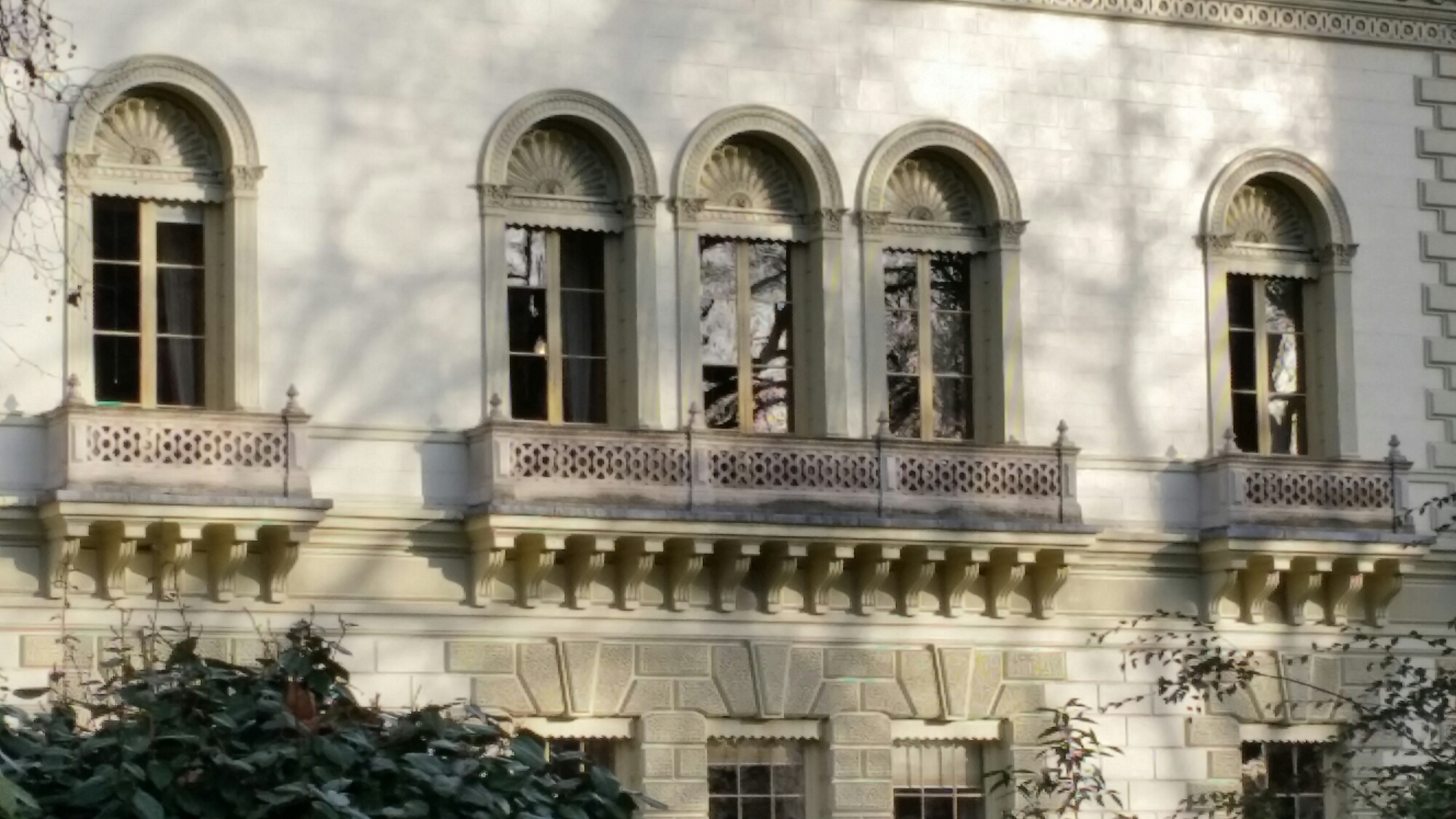
I walked past the back of the Travellers Club yesterday and admired, as I often do, the rhythm of the three round-arched windows of its library looking out to its private garden.   It was designed by Charles Barry in the late 1820s and established the Italian palazzo style as the model for schools, banks and warehouses all over England.   But few later designs, including Barry’s later Reform Club next door, are as suave and sophisticated as the Travellers Club’s behind:-

image

Standard

Richard Diebenkorn (2)

The question asked at tonight’s private view was why it is that an artist who is so well represented in American collections (he currently has an early work hanging in the White House) should be so ill represented in British collections (one print in the Tate).   The answer is that our view of American art is refracted through the New York galleries, who preferred the work of first generation Abstract Expressionists;  and that the work is in short supply because it was bought early by Californian collectors, so that when Nick Serota and Richard Morphet went in search of good examples in the early 1990s, it was either not available or too expensive.

Standard

Richard Diebenkorn (1)

I have spent the day preoccupied by, and enjoying, the work of Richard Diebenkorn, whose work is so unfamiliar this side of the Atlantic and which I have only ever seen properly in the exhibition at the Whitney in 1997.   It is shown to great and calm effect in the Sackler Galleries, which have recovered their original pristine appearance.   Diebenkorn’s paintings hover between figuration, collage and abstraction with a sense of the space and light of New Mexico, where he was a student under the GI Bill, Berkeley, California where he lived in the 1950s, and later in Ocean Park, LA.   A key influence on the current generation of RAs, as is evident in Ian McKeever’s thoughtful piece in the current issue of the RA magazine, he was made an Honorary RA in 1992, the year before his death and following an exhibition at the Whitechapel Art Gallery.

Standard

Burlington House

In recent weeks, I have been preoccupied by the floor in the entrance hall of Burlington House. One of our donors pointed out that it didn’t seem quite right for the space, too shiny, as if it belonged to a 1930s bathroom rather than the entrance hall of what was originally a seventeenth-century urban mansion. It crossed my mind that it might indeed have been put in during the 1930s by someone like Albert Richardson. The answer, as so often, comes from our archivist. The RA’s annual report for 1899 states:- ‘Another great improvement which has been successfully carried out is the alteration and decoration of the Entrance Hall. The common red and black tiles with which this Hall was paved had long been in a very bad condition, and at the end of 1898 the Council determined to repave it with black and white marble slabs after the pattern of the old pavement in the hall of Burlington House, as seen in the entrance passage of the Keeper’s House. Early in the following year the attention of the Council was called to some paintings by Angelica Kauffman, R.A., which formerly decorated the ceiling of the Council Room in Somerset House, and subsequently at Trafalgar Square, but which , since the removal of the Academy to Burlington House, had lain neglected in the basement. After inspecting them it was resolved that they should be cleaned and relined, and Mr. [T.G.] Jackson [R.A.] was asked to make a design for having them put up in the Entrance Hall ceiling. This he did, and it was approved and ordered to be carried out in the Autumn at the same time as the repaving of the Hall’. So, the entrance hall – ceiling and floor, including the installation of the paintings by Angelica Kauffmann – is the work of T.G. Jackson, whose architectural style is known as Anglo-Jackson, architect of the Examination Schools in Oxford and Treasurer of the Royal Academy from 1901 to 1912.
Standard

John Singer Sargent RA

We went to an evening viewing of the wonderful exhibition, Sargent: Portraits of Artists and Friends, organised by Richard Ormond at the National Portrait Gallery to show Sargent’s relative informality and modernity when painting the circle of artists and writers who were his friends in Paris, London and, to a lesser extent, in the United States where he painted murals for the Museum of Fine Arts in Boston and the Boston Public Library.   I had never seen the portrait of the children of Édouard Pailleron, so strange, intense and adult, as if drawn from the pages of The Turn of the Screw.   What was his relationship to the Royal Academy ?  He exhibited his portrait of Dr. Pozzi at Home in the Summer Exhibition in 1882, his Carnation, Lily, Lily, Rose was bought by the Trustees of the Chantrey Bequest in 1887, but he only became an ARA in 1894 and a full RA in 1897.   Did they resent his wealth, his success, his American-ness or his support for the New English Art Club ?  He became a dutiful RA, taught Vanessa Bell in the Schools, and was invited to stand as President in 1918.   Following his death, he had a Memorial Exhibition which led to the review by Roger Fry which destroyed his reputation.

Standard

Warburg Institute (2)

I have been reading with the utmost interest an article written by Adam Gopnik about the current issues surrounding the Warburg Institute (http://www.newyorker.com/magazine/2015/03/16/in-the-memory-ward). He quotes liberally from a conversation held over our dinner table in the autumn. The thing which I had only half known was the extent to which Kenneth Clark was influenced by Aby Warburg. I knew that Clark had attended a lecture given by Aby Warburg at the Biblioteca Hertziana in Rome on 19 January 1929, because it is referred to (with the wrong year) in his autobiography. I knew that his book, The Nude, is very evidently influenced by Warburgian ideas. I also knew, which Gopnik does not refer to, that it was always said that, on his one and only visit to the Warburg, Clark was turned away because he did not have a reader’s ticket. What I did not know, and have never seen referred to, is that Clark gave the Slade Lectures in Oxford in 1961/2 on the subject of ‘Motives’, that these lectures still survive in the Tate archive where Gopnik was able to read them, and that they are, as one would expect from the title, an exposition of Warburgian beliefs.

Standard