
As a small postscript to my recent post on the Hopkins’s work on Manchester City Art Gallery, it is probably worth adding that they had been involved in museum projects for a long time before they renovated the Manchester City Art Gallery in 2002.
First, as I have already mentioned, they drew up a Master Plan for the development of the V&A in 1987, following the creation of the Board of Trustees as a result of the National Heritage Act in 1983. This was the beginning of a big change in the way the national museums operated in which they were required to manage (and fund) their buildings. I am not sure how much remains of the Hopkins’ Master Plan, but I suspect that it was very important in a number of ways: in treating the complex of buildings as a totality; and developing a Master Plan for its future development for the first time. The only bit I remember being done was the opening up of the so-called Index Corridor which runs east-west beyond the entrance hall with prominent graphics by Pentagram, which was symbolically important in helping visitors navigate their way round the building, but the total renovation of the V&A has continued to be guided by an overall Master Plan, greatly to its benefit.
The second huge project they were involved with was a project to develop the Royal Academy in the late 1990s. They won a competition in 1998 when Philip Dowson was President to connect the main building to the building in Burlington Gardens which had been the Museum of Mankind and which the Royal Academy was negotiating to buy. It was a hugely ambitious project which survives in the model held by the Royal Academy:-
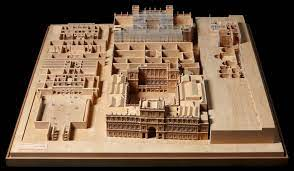
The idea was to connect the two buildings with a glass atrium between the two (there is a drawing in the RA Collections which is reproduced in Nicholas Savage’s excellent book on Burlington House: Home of the Royal Academy of Arts). The costs of the project grew to (from memory) £89 million and the Heritage Lottery Fund turned down the application for funding, which killed the project, much to Michael Hopkins’s frustration. But I suspect that some of the thinking helped inform the work they did so successfully in Manchester.
 | Charles | Saumarez | Smith |