We tried out the new farm café today. It opened last week and was PACKED, hardly surprising at 1 o’clock on a lovely, sunny Saturday. It was a long wait for a bacon sandwich, but delicious when it came.
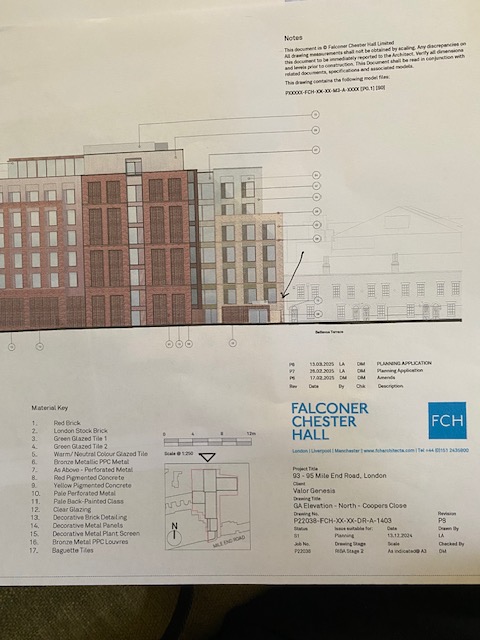
As the eagle-eyed may have spotted in my Comments section, I have kindly been forwarded the marketing information for the Blue Anchor Brewery site on the Mile End Road.
This is a remarkable proposal and I feel badly that I was entirely ignorant of it:-
John Charrington established the Blue Anchor Brewery in Stepney in 1757. His younger brother, Henry, lived in the house next door to us and presumably supervised the work on site. It was the second largest brewery in London, but closed down in 1975 after Charrington had merged with Bass to create a conglomerate. The brewery was then demolished and developed as an unlovely retail park, most of it devoted to a car park. It is a very big and important site and how it is developed will have important consequences for the area, particularly since it is nearly next door to the Genesis Cinema also being developed.
What is currently proposed by AHMM in the outline planning is very similar to the development next to the London Hospital: big buildings set back from the road alongside newly created courtyards.
The obvious question is whether or not Queen Mary University have considered it as a possible site for student housing and additional teaching facilities. It is not very far away and they are keen to connect to the neighbourhood. It might lead to a less generic design.
The biggest risk in the development of the Genesis Cinema is going to be to the character and sense of seclusion of Bellevue Place, which runs up to the side wall of the Cinema and is currently not overlooked. This is one of the more charming and best preserved bits of Stepney, a group of early nineteenth-century workers’ cottages tucked behind what was Spiegelhalter’s department store:-
For anyone interested in the work of Rachel Reckitt as a result of seeing War Paint, there is plenty of her work to see in churches in Somerset and Devon in the area where where she lived at Golonscott on the edge of Exmoor and there was a recent exhibition in the Museum of Somerset:-
We went last night to see Margy Kinmonth’s latest film, War Paint: Women at War, a brilliant study of the role of women artists in depicting and recording the horrors of war. The earliest was Dame Laura Knight who painted Ruby Loftus Screwing a Breech-ring, a memorable image from the Second World War. I didn’t know about Rachel Reckitt, who was Penelope Lively’s aunt and did what looked like wonderful and little known constructivist wood engravings of Whitechapel during the blitz. There was also film footage of Linda Kitson doing drawings during the Falklands War and interviews with Maggi Hambling, Rachel Whiteread and a Ukrainian artist making bread out of stones. I don’t think it is on general release, but is being shown in lots of cinemas round the country (https://www.conic.film/films/warpaint#screenings).
This is Rachel Reckitt’s picture of A Sleeping Family in a London Underground Station:-
One of the best of the local amenities in Stepney is the Genesis Cinema, a building with a long history, stretching back to when there was a music hall at the back of a pub in the 1840s. In the 1880s, after a fire, it was reconstructed by Frank Matcham, architect of the Hackney Empire, and re-opened in May 1885 as the Paragon Theatre of Varieties.
In 1938, it was again rebuilt as the Empire Cinema, with additional entertainment provided by the Kray Twins in their club, the Kentucky, across the road:-
Here is the interior as it was in the 1970s, now Screen 1:-
In 1998, it was bought by Tyrone Walker-Hebborn and turned into Genesis, a wonderful independent cinema – for a long time the host of the Tower Hamlets Film Festival.
Now we have just discovered that it is subject to a planning application. It is going to be demolished and the site used for ‘student accommodation’:-
A cinema is planned in the basement, but hardly the five stately screens there are currently.
The big problem, apart from the loss of the cinemas, is the damage it will do to the charming and atmospheric Bellevue Place, tucked in behind it.
They said there would be a cinema in the big new development next to the London Hospital. It makes it easier to get planning permission, but then during construction the plans change.
The architect-turned-architectural photographer, David Valinsky, has been posting the photographs he has taken for my book on Instagram. He did an amazing job, taking a vast number of photographs at speed last October and as I went through the final copy-editing last week, I realised, once again, how much they enhance the book, giving a sense of the vastness of Blenheim, as well as its details. The designer, Mark Thomson, has used many of them as double-page spreads which help to illuminate the long process of Blenheim’s design.
This was one of the photographs he posted today, showing the beautiful colour of the stone which made such an impression on Bob Venturi when he went to visit Blenheim on his first day in Europe in July 1948 (he docked in Liverpool on 9 July 1948 and then must have travelled to London, visiting Oxford and Blenheim the following day):-
The embargo on commentary on the newly configured Sainsbury Wing was lifted at noon today. I was pleased to be able to read Ben Flatman’s immensely careful and scrupulous account of what has been done online, as below. Two things are clear: the first is that Annabelle Selldorf and both Alasdair Travers and Jon Wright of Purcell approached the task with immense care – I had not known that Jon Wright went to Philadelphia to talk to Denise Scott Brown about the project; and that it is currently unclear exactly what the effect is of the changes to the entrance hall apart from making it very much more spacious and may not be until the building opens to the public on Saturday, the 201st. anniversary of the foundation of the National Gallery.








 | Charles | Saumarez | Smith |
You must be logged in to post a comment.