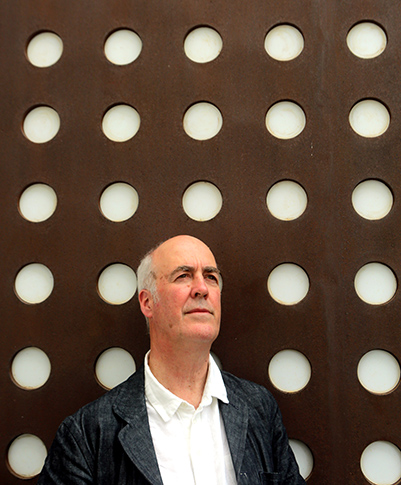
I have been alerted by my friend, Adam Bennett, to the death of Roger Cooper, with whom we stayed in Tehran in the summer of 1973. There are obituaries in the Times and Telegraph.
At the time, we understood him to be the BBC Correspondent in Teheran. Peter Avery, the Persian scholar at King’s, had told him and his younger American wife, Cherie, that four Cambridge undergraduates needed somewhere to stay. They fed us with mountains of the finest caviar from the Caspian Sea, made us feel enormously welcome, taught us a lot about the customs of Iran, and invited us to attend the Summer Festival in Shiraz which he was possibly covering for the BBC. So, from Teheran, we travelled southwards by bus through Qom to Isfahan and on to Shiraz. For some reason, Roger and Cherie were at least as interested in contemporary Polish culture as they were in Persian and they were friendly with visiting groups of Polish actors and musicians who were also invited to stay. It was Roger and Cherie who suggested we should cross the border into Afghanistan, which they told us was by a long way classed as the poorest country in the world. I’m glad we did because we saw Herat before it had been much touched by the modern world with tribesmen on horseback on the main street.
We lost touch with Roger after we left Iran. After the fall of the Shah, Roger would have lost his job, came back to London, but went back to Iran ostensibly on business, where he was arrested as a spy and spent six years in an Iranian jail, playing chess with his jailor. He wrote Death Plus Ten Years in which he described his remarkable sang froid, made possible by the experience of having been educated in a British boarding school.
He was released in 1991. Adam Bennett’s father discovered that he was going to speak about his experience at Chatham House. We went to hear him. What I remember of what he said in conversation was how incredibly shocked he had been at arriving back in Britain by how much it had changed during the six years he had been in prison. He left what he described as a post-war society in which much of the urban fabric was still war damaged, people lived in comparative poverty and drove bashed-up, second-hand cars. But when he came back everyone was driving big, smart, new cars. He didn’t like it and retired to Spain to run a holiday business.
 | Charles | Saumarez | Smith |
Hi Charles
Thanks for sharing your experience with Roger and Cherie.
I was also in Tehran in 1973, travelling with little money but lots of time. I worked for a while at the Tehran Journal to build some savings for the next leg of my travels, back to Afghanistan where I went in July / August of that year. I met Roger when he came into the TJ offices to deliver a segment of a series of articles he wrote on Towlah, and occasionally saw him and Cherie around town.
I also attended the Shiraz / Persepolis Festival in 1973 as correspondent for the Tehran Journal and covered the event with a Persian journalist, Janet Lazarian, whose knowledge of arts was profound but capacity in English was limited. As an ‘official correspondent’ I attended several events that required better clothing than my time- and travel-worn jeans, and Roger lent me a jacket, tie and pants on various occasions, such as the opening of the ballet Golestan at Persepolis.
After the Festival, Roger and Cherie invited me to stay at their house which I did while completing my time at the TJ. I stayed in a room at the back of the garden for a month or so, perhaps where you might have stayed.
Yes, Roger was a wonderful and generous host, a great character, and a lover of all things Persian. I was shocked when he was arrested, then convicted, and then pleased when he was released after several years. His book is a great account of all that. I never had personal contact with him after leaving his home in 1973 much to my regret.
Dear Richard, We must have been at the Shiraz Festival at the same time. I did try and contact Roger recently, but without success. Charles