
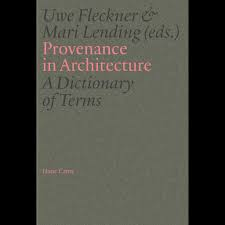
I sadly missed the launch of the book Provenance in Architecture: A Dictionary at the Warburg Institute last Friday, but have been dipping into my copy whenever possible over the weekend (I contributed the entry on Craft).
It is essentially the handbook to an approach to architecture which focuses not on authorship or style, the traditional concerns of architectural history, but the trajectory of buildings through their history, not just through an examination of the complexity of their origins, but their subsequent life through changing ownership, use, adaptation and, sometimes, destruction. It is an intellectual history as much as an architectural one: very Warburgian in ethos.
Each of the entries is not really an examination of a linguistic term, but a mini-architectural or thematic case study, so it is much more readable than the average dictionary.
Uwe Fleckner, the Director of the Warburg Haus in Hamburg (and much else) and Mari Lending of the Oslo School of Architecture have done an astonishing job in commissioning, editing and overseeing the book, which has been handsomely produced by Hatje Cantz.
 | Charles | Saumarez | Smith |