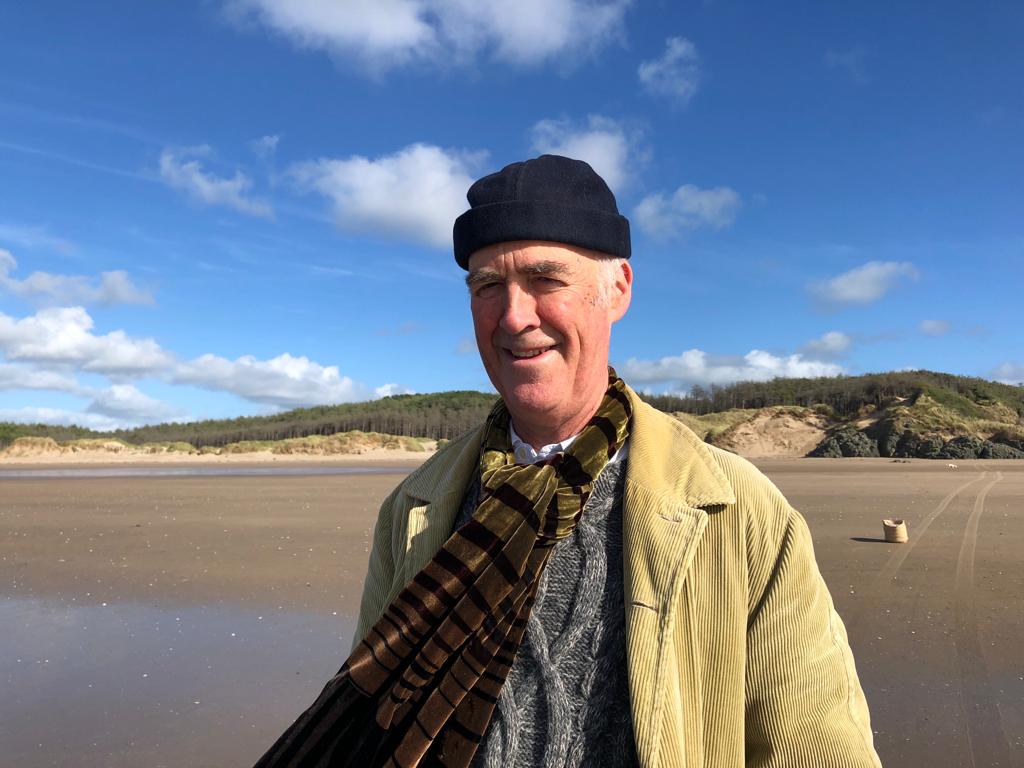
I have been looking forward to reading Otto’s obituary of Mark Girouard, which has now appeared online (see below) and catches his multi-faceted character, the quality and range of his writing and the way, having been born into the purple of country house life, spending Christmases at Hardwick Hall, he was able to write about them with deep expertise and, also, a certain cerebral detachment. I also particularly like the picture of him, bald and with glasses, staring through the gates, with Colin Amery, bald and with glasses, the gladiators who were responsible for saving Spitalfields:-
Author Archives: Charles Saumarez Smith
John Wonnacott (5)
I always enjoy going to see John Wonnacott in Chalkwell-on-Sea, particularly today having spent much of the early stages of lockdown studying – and writing about – his work based on what I thought was a comprehensive archive of his work online (https://johnwonnacott.co.uk).
But then, I hadn’t registered his powerful Portrait with Three Scars (2011-12), painted after he had been in hospital:-
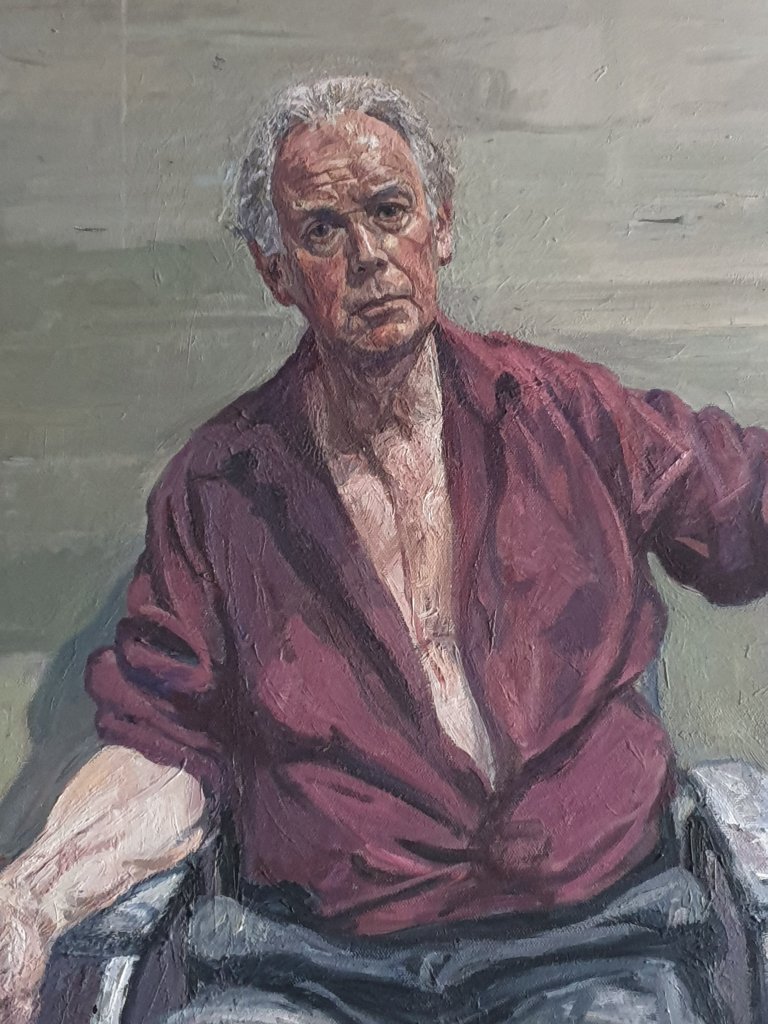
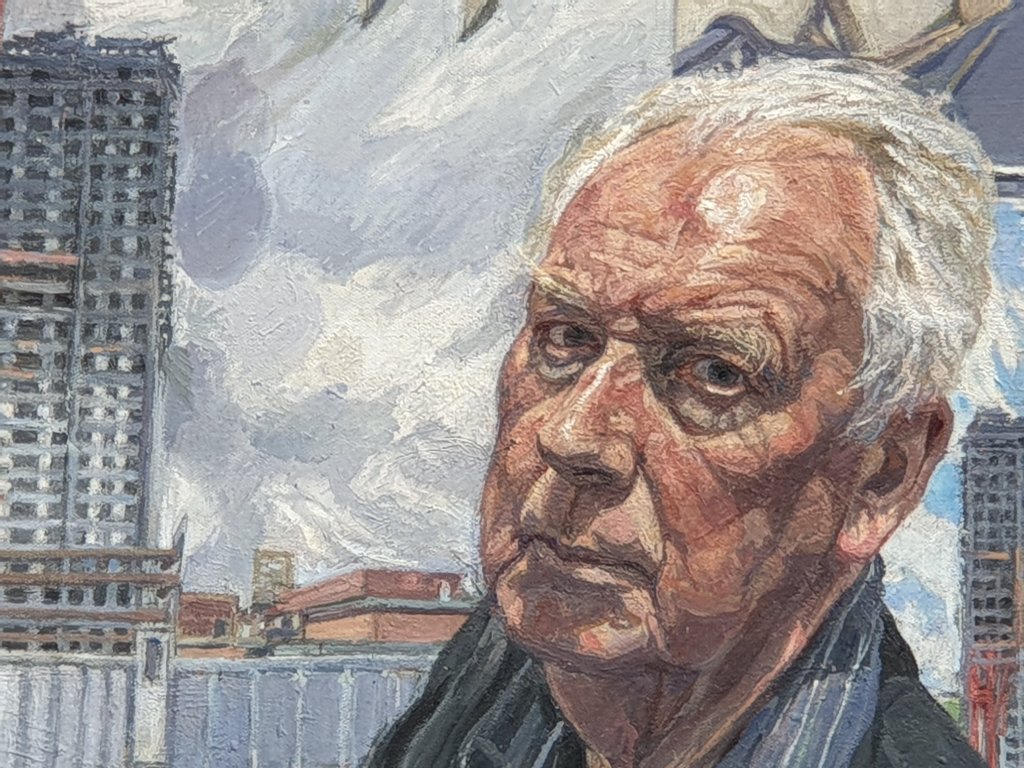
There was another recent – and very strong – Self-portrait, painted, I presume, during lockdown:-
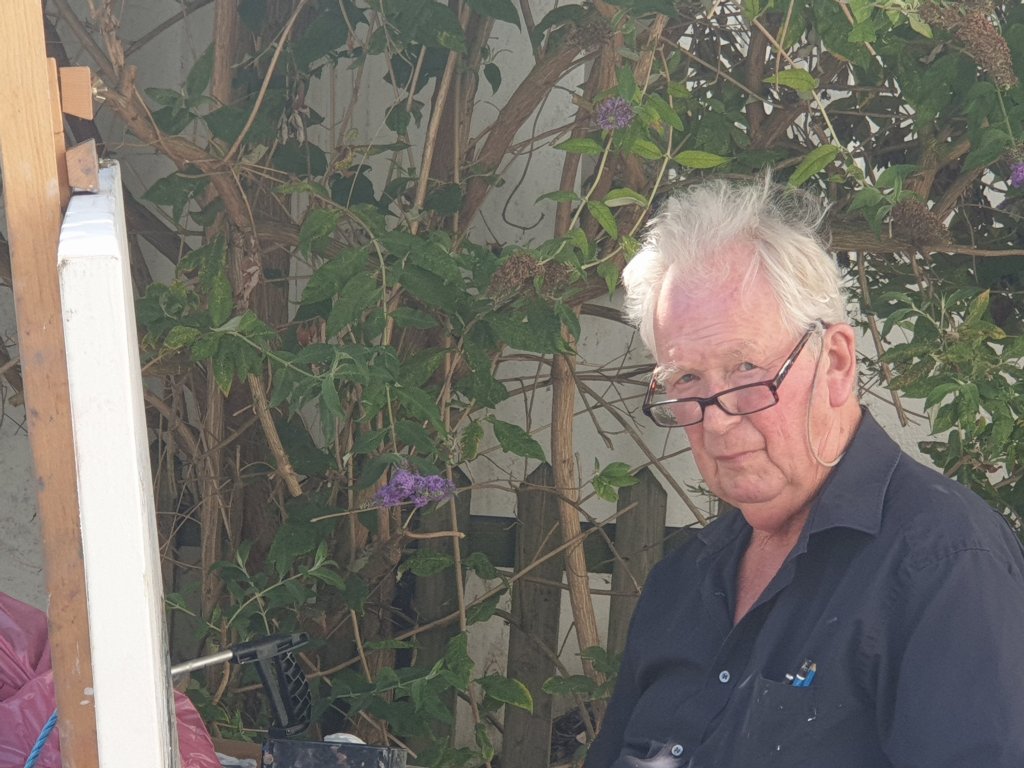
And here is John himself, painting in the garden:-
The Slab (2)
The Twentieth Century Society has just posted an image of the proposed new development by Make on the South Bank nearly next door to the National Theatre:-
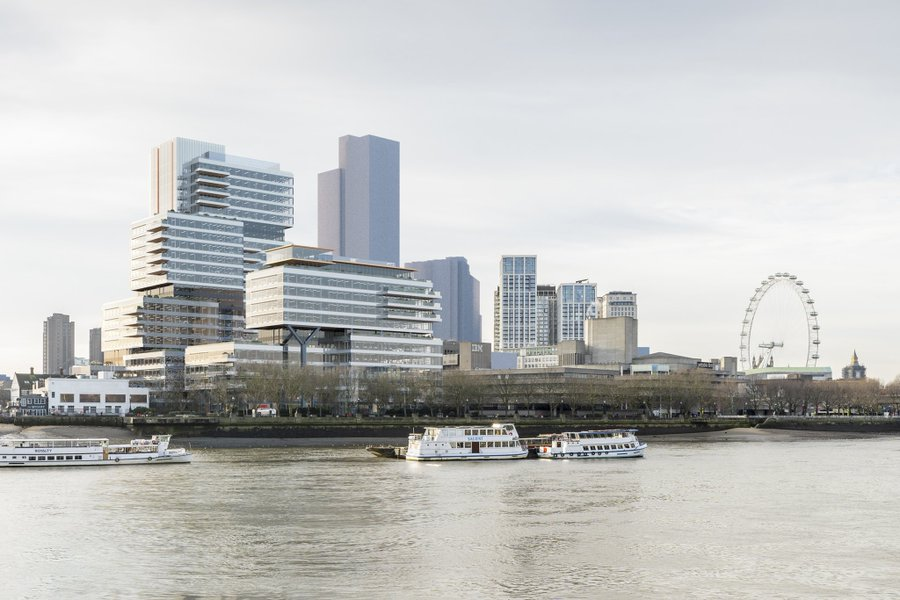
Every time I look at it, I think: how on earth could this possibly be allowed ? It is not one building, but four or five piled on top of one another, a small city which will dwarf the human scale of the river walk and make the Houses of Parliament look insignificant, let alone the poor National Theatre which will look paltry.
Also, am I not right in finding the photograph profoundly dishonest ? It shows it surrounded by a cluster of other tower blocks, but so far as I am aware these do not yet exist. So, it is pretending that the south bank opposite the Houses of Parliament is tower block city, like Wandsworth. But, it’s not. At least not yet, until Lambeth City Council and the architects, Make, have had their way.
I am also reposting my article on the topic:-
https://thecritic.co.uk/new-development-will-ruin-the-national-theatre/
The Slab (1)
I’m very sorry to see that Sadiq Khan has decided not to do anything about the planned monster new development on the South Bank nearly next door to the National Theatre which will dominate all views of the River Thames between the Palace of Westminster and St. Paul’s. The local community is very hostile to it – understandably as it will dwarf the housing round Coin Street. The National Theatre is hostile to it because it will make Denys Lasdun’s building look puny. The architectural press has been very hostile to it, led by Simon Jenkins. But the Mayor decides that there is no reason to intervene, presumably because his planning department are in thrall to the big international developers, Mitsubishi and CO-RE. This is at a time when there is a colossal amount of vacant office space, more than at any time for the last 15 years, the equivalent of sixty Gherkins. So, there is a risk that this huge building not find tenants. We will regret it. But by then it will be too late.
Mark Girouard (1)
For some reason, I was able to read the accompanying obituary of Mark Girouard without the paywall and was pleasantly surprised to find a) a good photograph of Girouard, taken at the time of the Elder Street sit-in when the activities of the newly established Spitalfields Trust made the front page of the Times b) a quote from me which I had totally forgotten, except that I have been a long-time admirer of his writings after attending by accident the first of his Slade lectures at Oxford in January 1976 on ‘The Powerhouses: Changing Forms and Functions in English Country Houses, 1400-1930’, subsequently published in the TLS (27 February 1976) and which became the first chapter of Life in the English Country House, which established the social history of architecture as a legitimate subject of study.
I wish I had known him better: he always struck me as quite shy – thoughtful and not at all pushy, which is presumably why Columbia didn’t hire him to replace Wittkower; half a scholar, half a man-of-letters and all the better for the quality of his writing, including two recent more personal books, which the obituary leaves out.
Rainham
I went to Rainham. I’ve been before. It still has vestiges of the remote Essex village it once was, before Dagenham made it all industrial.
The hall is sweet, a doll’s house dated 1729 for a sea captain, slightly later than I thought with no vestige of Palladianism:-


Then, we bicycled across the marsh, slightly surreal, alongside vast lorries going to the land fill, with the A13 on a viaduct in the distance, half no-man’s land, half nature reserve, to the RSPB building at Thurrock where you can have an all-day breakfast:-


Partition
We have been watching the two-part film about Partition on Channel 4 – ‘India 1947: Partition in Colour’. It was much more shocking and, to be honest, disturbing than I had imagined.
My father was there – I thought in Delhi, but I now realise in Calcutta, presumably in Government House, so was much less involved than he would have been had he stayed in Delhi in the negotiations round Partition and why I never heard talk of Mountbatten’s personality, attitudes and behaviour which seem to have been so key to how it happened.
He was, I think, and remained friendly with Christopher Beaumont, the civil servant who worked with Cyril Radcliffe, the chairman of the Boundary Commission. But I did not know the full scale of the bloodshed and I don’t remember it being discussed at home, not that much about his time in India, and the details of its fraught politics, was.
He left Calcutta on Friday 15th. August 1947 by flying boat, so was not there to see the consequences of Partition. It was all treated as if it was about the orderly transfer of power, a delusion, not the deaths that resulted.
Rheum
I know I’ve already posted more than enough today (but after a long patch when I couldn’t think of anything to post about), but as I was writing about Norman McBeath’s admirable photographs of dying leaves taken during lockdown when our sensibilities were heightened by confinement, my eye was caught by a plant in a tub which I thought was dead, but has sprouted a single intensely orange-red leaf. It is apparently rheum, a non-edible form of rhubarb and used to treat rheumatism according to Lisa Jardine:-

Perdendosi (1)
I have just been sent the latest production by Hazel Press, a small independent press started during lockdown whose publications are only available by mail order or from the London Review Bookshop. This one is special. Photographs of leaves by Norman McBeath, a photographer based in Edinburgh, interpreted in short, suggestive haiku-like texts by Edmund de Waal. They will be exhibited at Zembla, a small private gallery in Hawick, in September. I wish I could make it to Hawick. Meanwhile, the little book is a beautiful substitute.

The 1970s
There is a discussion on twitter about what, if anything, was good about the 1970s, the era of my youth. It has made me think. In 1970, I was sixteen. I did a lot of hitchhiking, which was a good way to get around the country. I was picked up between Oxford and Swindon by a travelling salesman who said that he had a book in the back which would cause a revolution. It was The Female Eunuch. Of course, I remember the three-day week, sitting in rooms with only candles burning worrying about Northern Ireland and Ted Heath.
It has always seemed to me a bit problematic for periodisation that quite a lot of what one thinks of as the 1960s actually happened in the early 1970s: the Garden House riot took place on 13 February 1970. And quite a lot of what one thinks of as particular to the 1980s also happened in the 1970s – John Casey took over editing the Cambridge Review in 1975.
So, what was good ? Hitch-hiking was good; so were many, if not all, of the liberal freedoms; no student fees, definitely. Michael Baxandall published Painting and Experience in Fifteenth-Century Italy in 1972. That was good. I’m afraid I think that the end of doctrinaire modernism and the rise of architectural conservation was good. The Spitalfields Trust was established in 1977. Small landmarks, but important.


You must be logged in to post a comment.