Whitechapel Bell Foundry

I missed Rowan Moore’s sensible and well informed account of the arguments surrounding the Whitechapel Bell Foundry in yesterday’s Observer. As he says, the new plans make efforts to retain some elements of its former use as a tourist attraction. But this is not the same as retaining a stronger sense of the long history of bell making in the area and the fabric of the building in its original form.

https://www.theguardian.com/artanddesign/2019/mar/03/whitechapel-bell-foundry-plans-royal-college-of-pathologists?CMP=Share_AndroidApp_WordPress

Standard

Olympic Park

I had arranged to go on another Architecture Foundation tour, this time to the Olympic Park with two architects from Allies and Morrison, who have been involved with the project from its beginning when it was no more than a gleam in the eye of Ken Livingstone and Tessa Jowell – a moment, in retrospect, of national optimism when we were able to deliver a massive infrastructure project with relative effectiveness – and cross-party support. Of course, there were many others involved in the design of the park, including HOK turned Populous who designed the stadium and Hargreaves, the American landscape architects.
The key ideas behind the masterplan were: first, joining east London to west, encouraging housing and other development east of the River Lea; second, making the project sustainable, so that everything was designed with an eye to its future use. Much of what Allies and Morrison did was urban knitting, including the design of 35 bridges.

This is an aerial view of the park as was, with railway tracks, the River Lea and Yardley’s perfume factory:-

This is the site which will become the so-called East Bank, previously known (by Boris) as Olympicopolis:-

New housing south of the site:-

Zaha Hadid’s Aquatics Centre which has worn well:-

And the stadium:-

In the park, I felt, as I always do, that there is a horror vacui, as if we can no longer allow empty space, which was, and is, the essence of the other public parks, green fields without too many gizmos.

This is what it replaced – the industrial mess of Hackney Wick:-

Standard

Madrid

My last post from Madrid is more miscellaneous, consisting of no more than things seen in walking through Chueca, the densely built streets north of the Gran Via.

The building opposite the Palace Hotel which was covered in netting last time I was in Madrid and still is:-

A bright red doorway:-

The wonderful entrance portico to the Hospicio de San Fernando, built for the poor in 1722 by Pedro de Ribera in a wild baroque style:-

And the entrance to a nearby fire station:-

Standard

Balthus

I was pleased to see the Balthus exhibition at the Thyssen Museum (it was previously at the Beyeler in Basel) because it is unlikely that there could be an exhibition in Britain owing to disapproval of his subject matter. But what comes across is how serious he is as a painter, the child of an art historian, encouraged by Rilke, trained by his studies of Piero della Francesca in 1926.

The Street (1933) from MOMA mixes surrealism with Piero:-

His pictures are intended to be disturbing, and they are, as in Thérèse dreaming (1938) from the Met:-

There is an uneasy mix of sensuality and narcissism, as well as the constant theme of adolescent sexuality. Is it the faux naiveté which is so unsettling?

It’s odd to discover that in 1961 he was appointed Director of the French Academy in Rome and spent fifteen years restoring its villa. And had a retrospective at the Tate in 1968.

Standard

Palacio Longoria

I called in at the Palacio Longoria which must be one of the maddest, as well as the most magnificent pieces of pure art nouveau, built for a banker, Javier Gonzáles Longoria, and now the home of the Society of Authors. It was designed by a Catalan, José Graces Riera, in a style which mixes Guimard and Gaudí:-

Standard

Museo Geominero

I was told that if I only went to one museum in Madrid, I should go to the Museo Geominero, Spain’s geological museum, founded as a result of its Comisión para formar la carta geológica de Madrid y la general del Reino.
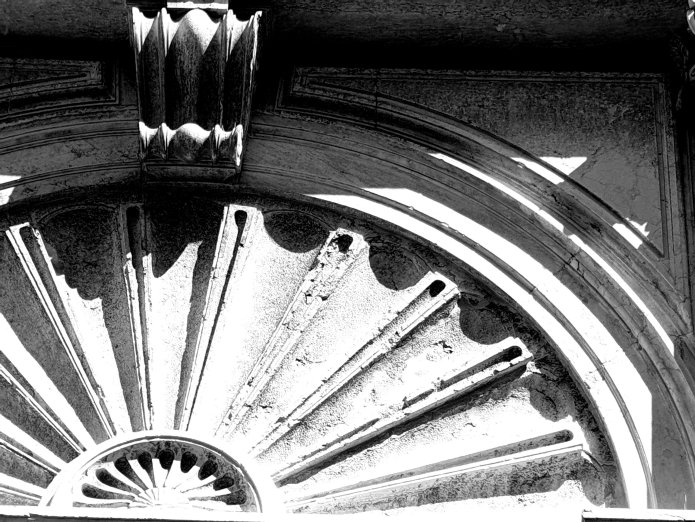
It preserves in a very pure form the idea of a museum as an instrument of scientific classification and knowledge:-

Standard

Edmund de Waal

I went to see Edmund de Waal’s exhibition Breath at Ivorypress. At the heart of the project is a single book, which is a homage to Paul Célan.

It starts with a complete case:-

This converts into a reading desk:-

Then the book itself is bound in vellum (Shepherds):-

The text done by Book Works, uses different papers, first Japanese, then English, then German (the poems are printed on German paper overlaid by Japanese):-

It’s a big, complex, and very beautiful collaborative project involving poetry, print, bookmaking, typography, binding and craft:-

Next door are works inspired by Zurbarán and Lorca. One piece in marble, porcelain and aluminium:-

Standard

Factum Arte

It was a pleasure to be back in Factum Arte, whose Foundation has put in the bid jointly with the United Kingdom Historic Building Preservation Trust (UKHBPT) to run the Whitechapel Bell Foundry. The place was humming – evidence, if evidence is required, that it is perfectly possible to run an efficient and profitable foundry and art workshop (it happens that two other foundries have also put in bids to run Whitechapel, so the idea that it cannot be retained as a foundry is absurd):-

Standard

Factum Fetishes

I visited Factum Arte in an eastern suburb of Madrid in order to see Factum Fetishes, an exhibition of fine photographs by Mariana Cook. They are based on the objects and tools she encountered in the Factum workshops – a painter’s vest, a plastic bucket, a rubber glove – all rendered with the surreal precision which is now possible with the highest standards of digital printing on a dense aquatint base, such that the artefacts float free in pictorial space:-

Standard

Private Museums

I went to a forum at ARCO in Madrid about the topic of ‘Art Museums in the Public Realm’. It began with Dani Levinas, the chairman of the Phillips Collection, founded in 1921, a private museum surrounded by the state museums of the Smithsonian; then Marcela Guerrero of the Whitney, which I don’t really think of as a private museum, except in so far as it doesn’t receive any public funding, so technically is; Jeremy Strick, the Director of the Nasher Museum; and Margaret Conrads, the Curatorial Director of Crystal Bridges. What became clear is that private museums which may begin out of the private passions in individual collectors, like Patsy and Ray Nasher, quickly develop ambitious public responsibilities, as at Crystal Bridges, which has very ambitious programmes of showing work by women artists (up to 40% of the collection) and native Americans.

Standard