The Slab (8)

A very fine piece of polemic by Simon Jenkins about the Slab has just appeared online.  He is right that it poses a problem as to what Labour Party policy should be.  Surely not so free market, Singapore-style abolition of planning controls as the current government has favoured, whatever it says to the contrary. 

So much damage has already be done to the fabric of the city that it will be hard to knit it back together.  What happens to Smithfield Market will be a test of future policy making.  And whether the destruction of Liverpool Street Station is approved.  It was Ken Livingstone and John Prescott who liberated controls on tall building, so policy on London has been cross party.

I sometimes wonder whether it might be worth re-establishing The Royal Fine Arts Commission which had an advisory function in issues of national planning.  But it was the Blair government which abolished it because they couldn’t bear Norman St. John Stevas, its chair.  But nothing effective has replaced it.

Before the Blair government came in, Mark Fisher and Richard Rogers published A New London on what architectural policy should be, a thoughtful and influential book which is what is needed now.

https://www.theguardian.com/commentisfree/2024/feb/08/slab-london-monument-ugly-expensive

Standard

The Slab (7)

I see that Michael Gove stops a long way short of saying that the Slab will make a positive contribution to its surroundings. In fact, of course, it will disfigure them forever, encouraging other big new development in the area as has happened in Nine Elms.

If he is so lukewarm about it, why did he approve it ?

Money, money, money.

https://www.theguardian.com/politics/2024/feb/06/michael-gove-approves-the-slab-development-south-bank

Standard

The Slab (6)

Yesterday was a sad day for London. After it seemed as if Michael Gove might have half a spine when it comes to big new developments in London, he signed the approval for the so-called Slab, the biggest of them all. I suppose he is thinking of the forthcoming election and all those developers and city financiers who will have to bankroll their campaign. He will have been lent on by a host of lobbyists. At every fundraising dinner, party donors will have sidled up to him and made clear that they expected to be able to count on his support. So, I hope with a quivering hand, he will have signed the approval for the biggest development of them all – a set of towers which will overwhelm not just the local neighbourhood and the National Theatre, but will change the relationships of scale in buildings between the Houses of Parliament and St. Paul’s and including especially Somerset House on the other side of the river. It will be too big, full of offices which may no longer be needed. But Gove will be long gone. Gove Towers. It will be a monument to the end of effective planning controls.

Standard

Warburg Institute (4)

No sooner had I returned from my visit to the Warburg’s exhibition at the Architectural Association than I was sent a link to a project by the Factum Foundation to recreate digitally the statue of the Hermes Kriophoros which was lent by the Earl of Pembroke and used to stand in the Warburg’s entrance hall (The Statue: A Wilton-Warburg ‘Kriophoros’ | The Warburg Institute (sas.ac.uk)).

It is planned that the replica should stand in an equivalently prominent position in the new entrance hall which is expected to open in September, reconfigured as part of the admirable project, led by Bill Sherman as the Institute’s Director and with Haworth Tompkins as architects, to renovate the building as a whole. 

Here is the ground plan of the reconfigured ground floor which will have a new lecture theatre at its symbolic heart:-

If you want to support the project, this is the link (Resurrecting the Ram-Bearer: The Wilton-Warburg Kriophoros Restoration Campaign | The Warburg Institute (sas.ac.uk)). It’s a very good cause. 

Standard

Warburg Institute (3)

I revisited the exhibition at the Architectural Association which demonstrates the changing form of the Warburg Institute, originally housed in luxury in a suburb of Hamburg, next door to Warburg’s house (the exhibition closes March 7):-

Then briefly in Thames House on Millbank in a layout designed by Godfrey Samuel of Tecton:-

Then, from 1937 to 1958, in the Imperial Institute:-

Finally, in Woburn Square:-

It tells one a lot about the relationship between a library, the nature of reading, and the history of ideas.

Standard

Whitechapel Bell Foundry (117)

Otto SS has sent me the attached advert for the Bell Foundry with a nicely abstracted view of the bells of Liverpool Cathedral, installed in the 1930s. The Bell Foundry tends to be associated with historic bells – the city churches, St. Paul’s, the Liberty Bell, Big Ben. It’s nice to see an image of its twentieth-century incarnation.

Factum Foundation is making bells – but not at the Bell Foundry because Historic England thought it was more exciting for the Bell Foundry to be turned into a boutique hotel than remain a Bell Foundry.

It’s what they call ‘adaptive re-use’. The only problem is that the boutique hotel hasn’t happened. So, they have allowed – and indeed encouraged – a historic building to decay, not what I regard as their statutory function.

Standard

Whitechapel Bell Foundry (116)

I keep being asked what is happening to the Whitechapel Bell Foundry.

The answer appears to be nothing. It was put on the open market over a year ago either for rent or possibly to buy, but so far there is no evidence of anyone having acquired it, which would almost certainly require fresh planning permission which ought to be granted only on the same stringent conditions as the previous approval, including a requirement to reinstate a working foundry.

Meanwhile, the hotel scheme seems dead as the option to buy the land on which to construct it has lapsed.

So, a major historical asset – of exceptional significance – is being allowed to rot without anyone so far able to provide a workable solution or to intervene.

https://www.theguardian.com/news/audio/2024/jan/31/from-the-archive-the-bells-v-the-boutique-hotel-the-battle-to-save-britains-oldest-factory-podcast?CMP=Share_AndroidApp_Other

Standard

Bletchley Park (2)

There is, of course, an important lesson to Bletchley Park, which may be perfectly well known in the secondary literature and which I have been thinking about overnight: that when war came, the authorities decided to replicate the atmosphere of a Cambridge college, specifically King’s, with as many free-thinking, independent-minded intellectuals packed into nissen huts and given creative freedom to crack the codes which they did: they were trained at least as much as classicists, historians and linguists as pure mathematicians. So, it’s a lesson in how to foster code-breaking thinking: not with a bunch of computer scientists, but a group of crossword puzzle experts who had been trained in the grammar of classical languages.

Standard

South Asian Miniatures

The Milton Keynes Art Gallery (MK) had an absolutely excellent and fascinating exhibition which mixed very fine Indian miniatures from the British Museum and Royal Collection with modern work, some of it very obviously inspired by miniatures, some like the work of Bhupen Khakar less so: an exhibition which demonstrated that miniature painting is unexpectedly alive and well.

It was the last day, so to see it you have to go to the Box in Plymouth, opening 17th. February.

Well worth it.

Standard

Bletchley Park (1)

We went to visit Bletchley Park this afternoon, the rather dreary late Victorian country house which was bought for a song in 1938 (£6,000) to house the Government Code and Cypher School. I don’t know anywhere which is so redolent of the curious mixture of abstract intelligence which enabled the likes of Dilwyn Knox to crack the Enigma Code and at the same time the air of slight amateurism – the huts, the bicycles, the general discomfort.

I realise that quite a few people who were around at King’s, Cambridge when I was an undergraduate had been posted there: Christopher Morris, a genial historian who edited the Journeys of Celia Fiennes for the Cresset Press in 1947 had worked in Hut 5. John Saltmarsh, an eccentric, white-haired medievalist, worked in Hut 3. Jack Plumb, another Fellow of King’s at the outbreak of the war, was in Hut 8.

A key figure was Mavis Batey, one of the pioneers of garden history, who worked on the Italian Enigma Machine.

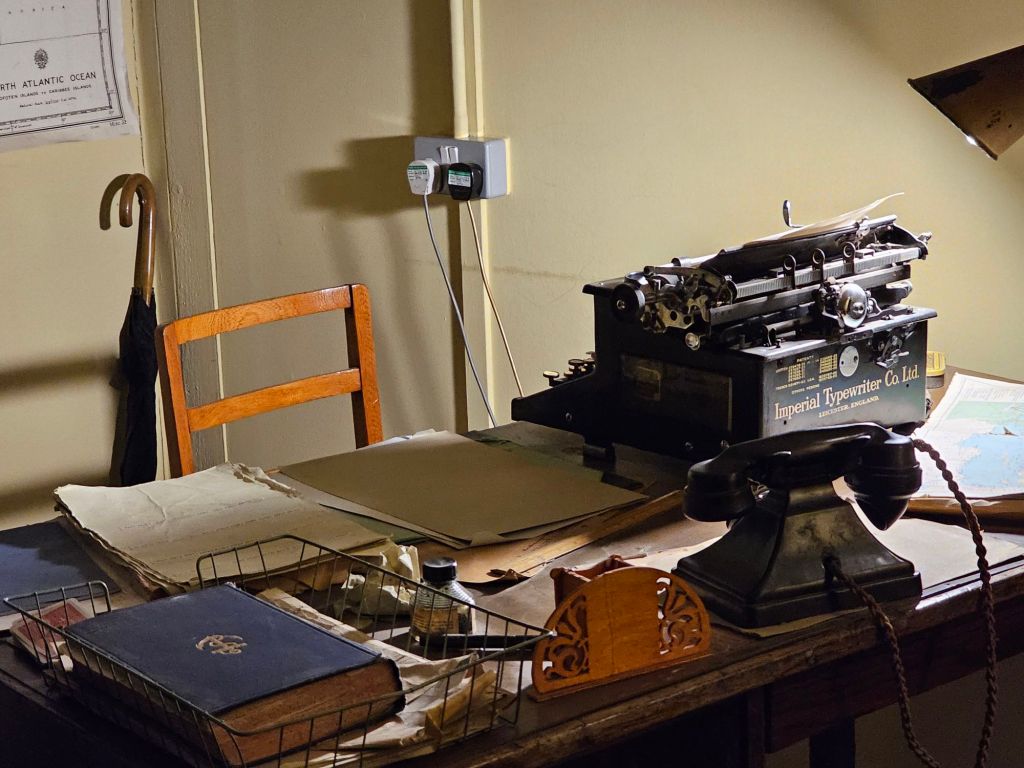
So, it wasn’t just mathematicians like Alan Turing. This is Turing’s desk:-

Standard