Some time ago, I visited Culham Court Chapel, shown round by its architect, Craig Hamilton. I was impressed by it, although it’s unlike – perhaps because it’s so unlike – most contemporary architecture in being Catholic, private and essentially commemorative. I wrote it for the August/September issue of The Critic and the article has just appeared online:-
By chance, it coincides with the announcement of Martin Jennings as sculptor of the commemorative statue of the Queen on the Mall (actually just off the Mall in the entryway to St. James’s Park). It’s not clear whether it will be equestrian, as suggested in Norman Foster’s competition entry. Not an easy commission.
We went last night to a performance of How to be a Dancer in Seventy-Two Lessons at Sadler’s Wells East. I am not going to pretend that I am an aficionado of contemporary ballet, having so seldom been, but the work was amazing, very excitingly danced and if there are tickets left for tonight’s performance – there probably are because it’s a big theatre – I strongly recommend it.
Things are hotting up in terms of my forthcoming Vanbrugh book with the release of a podcast by Ambrose Gillick, called A is for Architecture.
He asks me a whole series of interestingly searching questions about Vanbrugh as an architect – his life, and the links of the world of the theatre to his work as an architect which you can feel me sometimes struggle to answer.
I don’t come across as knowing the answers, but I hope that makes it interesting, if you have the patience to listen to the end:-
In talking to Rowan Moore about Nick Grimshaw, I was asked about his musical interests. Then I spotted on Instagram an interview he did some time ago with Gramophone magazine and reproduce it as an important aspect of his character.
I went last night to a discussion about the forthcoming London Museum which is due to open some time next year – they are sensibly cagey as to when because it has obviously been a long and immensely complicated building project and there is still much to do, including the installation of all the displays.
I was very impressed. Asif Khan spoke first about the importance and interest of the site which is clearly of great importance, the site of a meat market since the 10th. century and of Bartholomew Fair. Paul Williams of Stanton Williams talked about the long process of the design of the new museum which will occupy two of the old buildings of Smithfield Market: the General Market to the west, apparently with a view through to the railway line, designed by Sir Horace Jones and built between 1879 and 1883; and the Poultry Market to the east which was burnt down in 1958 and reconstructed in a completely different way by Sir Thomas Bennett. They were originally going to occupy the Fish Market to the south, plus the General Market, but this didn’t provide enough space, so the Fish Market has been refurbished and is due to be let through open competition. The Poultry Market part of the project will not open till 2028.
The third speaker was Mell Allwood from Arup who spoke about issues of sustainability. In general, I have not been impressed by the City’s approach to sustainability, but this project has obviously been all about retaining the character and fabric of the existing buildings, led by the conservation architect, Julian Harrap, who, as I know from long experience, is very brilliant.
The fourth speaker (or commentator) was Deyan Sudjic, the former director of the Design Museum who spoke more generally about the changing character of museums.
Two things came across: the scale and ambition of the project; and the fact that it will be very different from a conventional museum, partly because the existing shops round the side of the building have been retained and will be let to partner organisations and because, like the V&A East Storehouse, it will be all about discovery and not so much about traditional display of the collection.
I thought that I might be nostalgic for the old Museum of London, but going into a late 1970s building which has not been occupied for several years was pretty gloomy and I was completely persuaded that the buildings of the new museum have been refurbished with the utmost sensitivity.
Here is an aerial view of the two buildings (Poultry Market to the right):-
This is West Poultry Avenue between the two buildings which will be the point of entry and has been retained as an internal street:-
I am immensely sad that the architect, Nick Grimshaw, has died.
I always viewed him as a friend, as well as my employer when he was President of the Royal Academy. He was responsible for recruiting me and asked me the first question at my interview. ‘Did I have any experience of the art world ?’ At the time, I was Director of the National Gallery, so wasn’t sure what to reply.
I always found him thoughtful, decent and humane. We used to meet every Tuesday afternoon for quite a long time in which we would run through a list of what needed to be done. It would be the same list – a long list – until things could be ticked off. This was his approach: always systematic. I assume that it was his approach to architecture and to the management of his firm as well: focusing on the essentials, paring things down, quietly systematic.
I admired him very much and enjoyed working with him. There is no doubt more to say about his architecture, but he was a fine person as well as a fine architect.
Here he is in his office at the RA, which he redesigned to suit himself:-
On my return from Herefordshire, I found Chris Ridgway’s wonderful new book on Castle Howard waiting for me:-
It’s not cheap, but very sumptuous and illustrated by spectacular photographs, mostly taken by Mattia Aquila, an Italian architectural photographer, but with a portfolio of exceptionally beautiful photographs by Nick Howard, many taken with a drone and in magically misty weather conditions.
Chris Ridgway’s text is not intended to be the scholarly monograph which I hope he will write next, but is deeply informed throughout by his knowledge of the Castle Howard archive and other secondary sources, including a number of traveller’s descriptions which are new to me. It’s as good an introduction to the house, its history and the garden as it’s possible to be, as well as a visual record of the new work which has been done in the house by Remy Renzullo and Francis Terry recently.
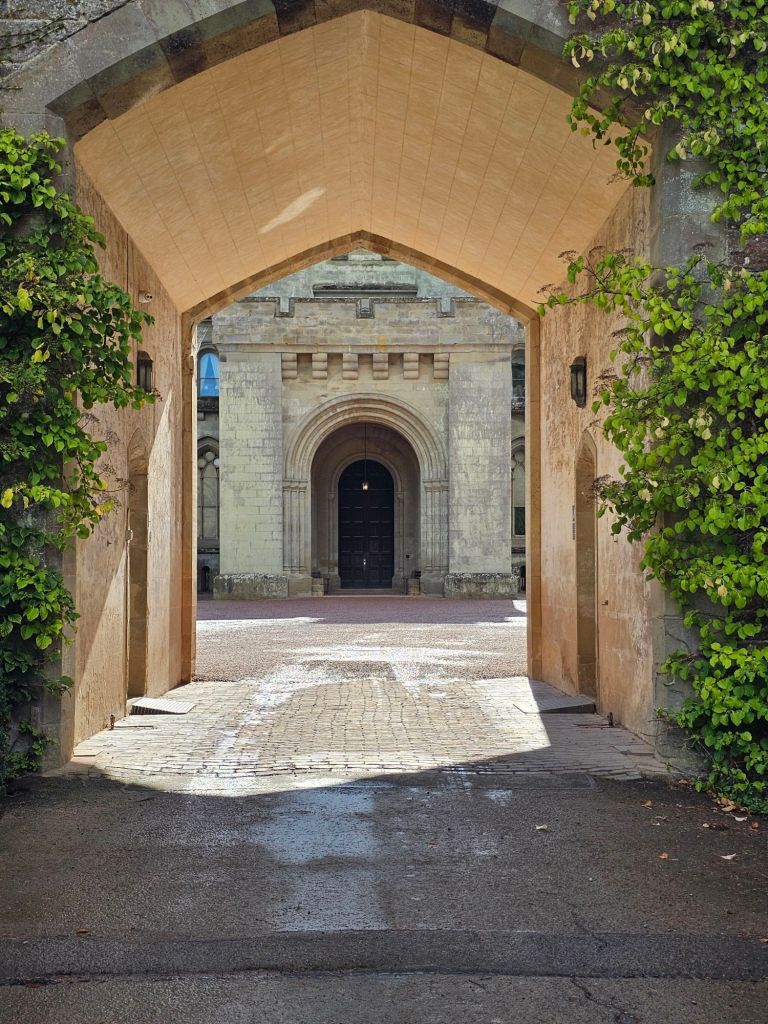
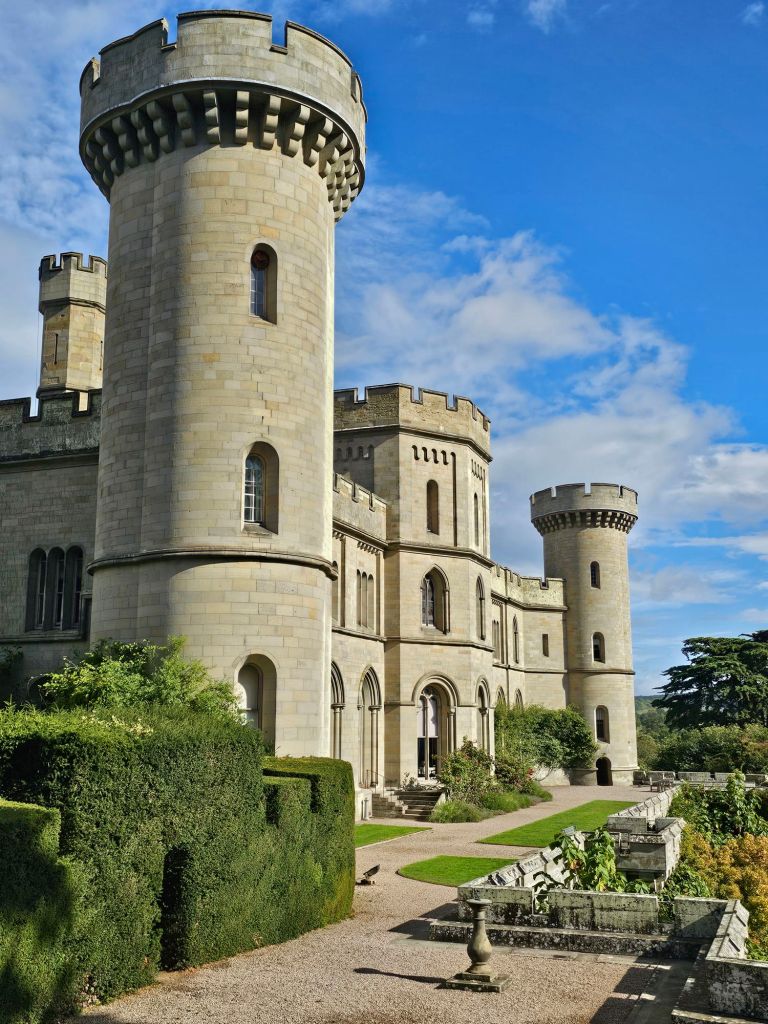
I spent yesterday at Eastnor Castle, Robert Smirke’s impressively fortified Regency castle east of Ledbury:-
Smirke had travelled widely in Europe, including Athens, where he was deeply upset by the damage being done to the Parthenon by the removal of its friezes, recording how the removal of each stone ‘seemed like a convulsive groan of the injured spirit of the Temple’.
But his first work was not Greek Revival, but castellated, Lowther Castle for William Lowther, Lord Lonsdale.
At Eastnor, his client was John Cocks, Baron Somers, who had been MP for Reigate before succeeding his father in the House of Lords in 1806, a Whig, but an independent-minded country Whig: ‘The true old Whig principle of our ancestors, if I apprehend it rightly, is mine. It avoids both extremes, and in many cases will not fear a coalition of extremes in order to produce the happy medium’. Smirke went down to Herefordshire in February 1812 to discuss plans.
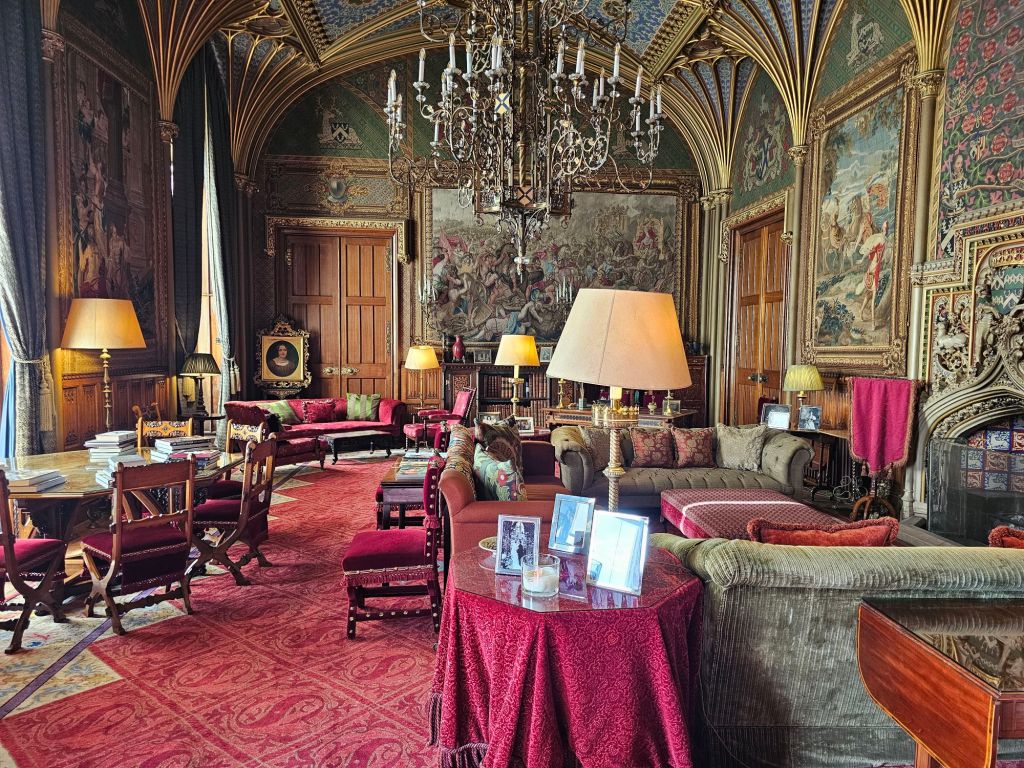
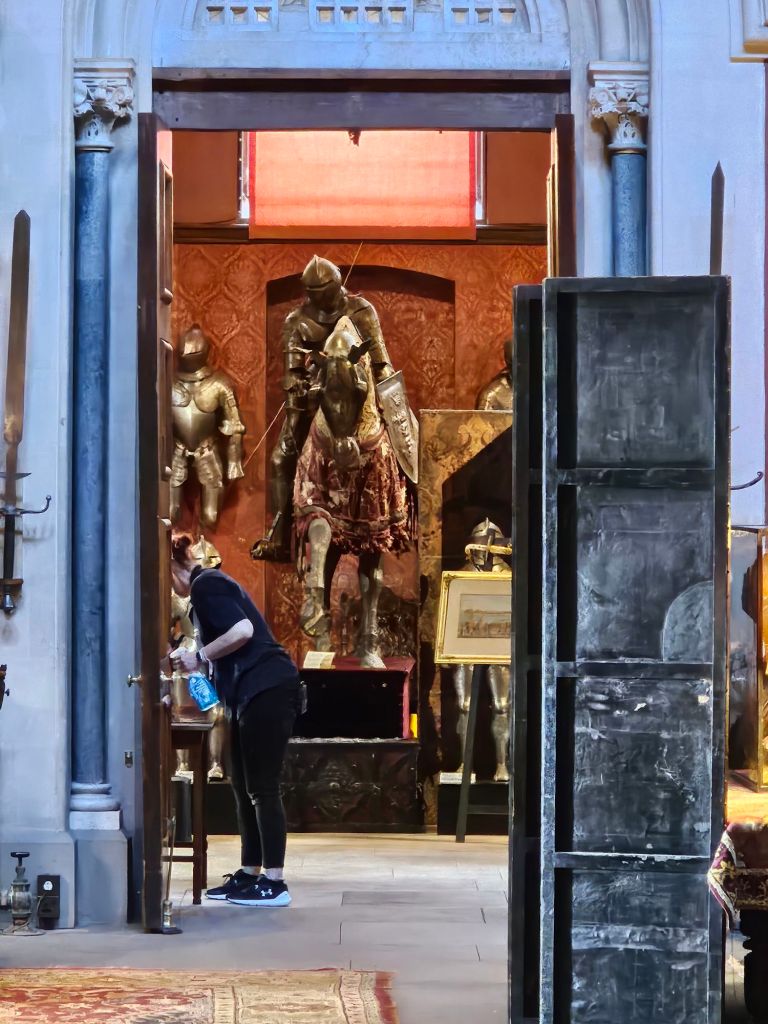
Inside is extraordinary and unexpected, much less austere than Smirke intended. The second Earl Somers commissioned Pugin to do up the drawing room, which he did as if it was the House of Lords:-
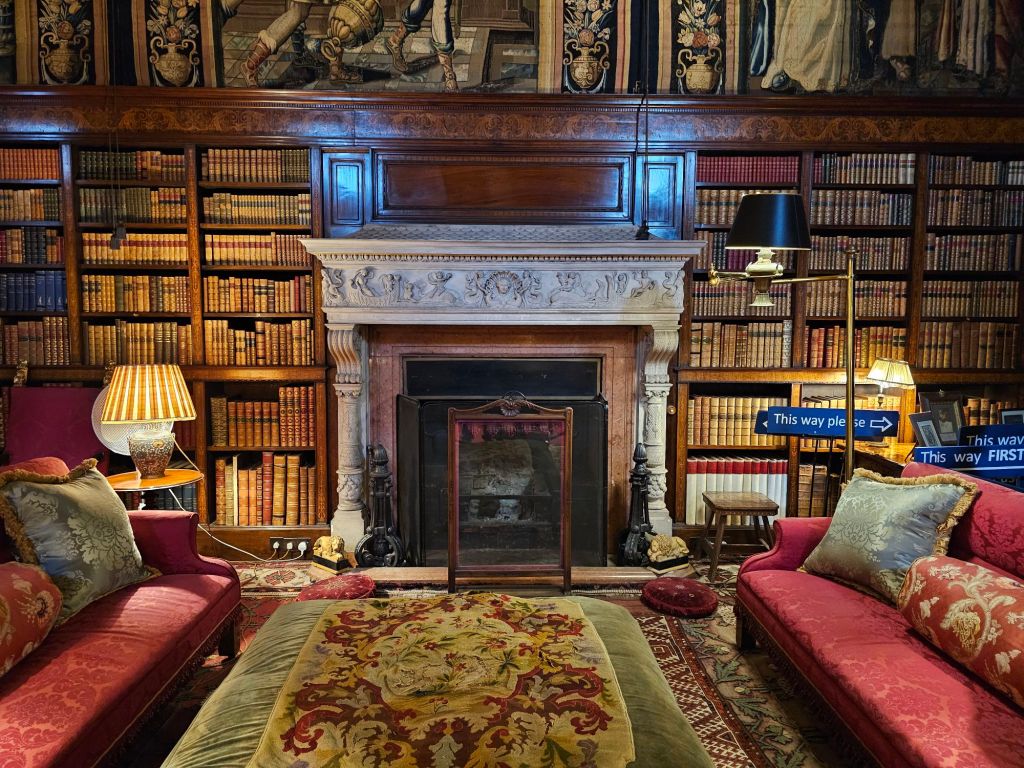
His son, Charles Somers-Cocks, the third Earl, married Virginia Pattle, the sister of Julia Margaret Cameron. He remodelled the castle, employing George E. Fox and was responsible for the wonderful Long Library:-
It is due to his marriage that one of the turret rooms is full of photographs by Julia Margaret Cameron:-
The house was apparently occupied by the army in the War and then very adventurously refurbished after James and Sarah Hervey-Bathurst took over the house from his mother in 1988, employing Bernard Nevill, the Professor of Textile Design at the Royal College of Art to advise them.
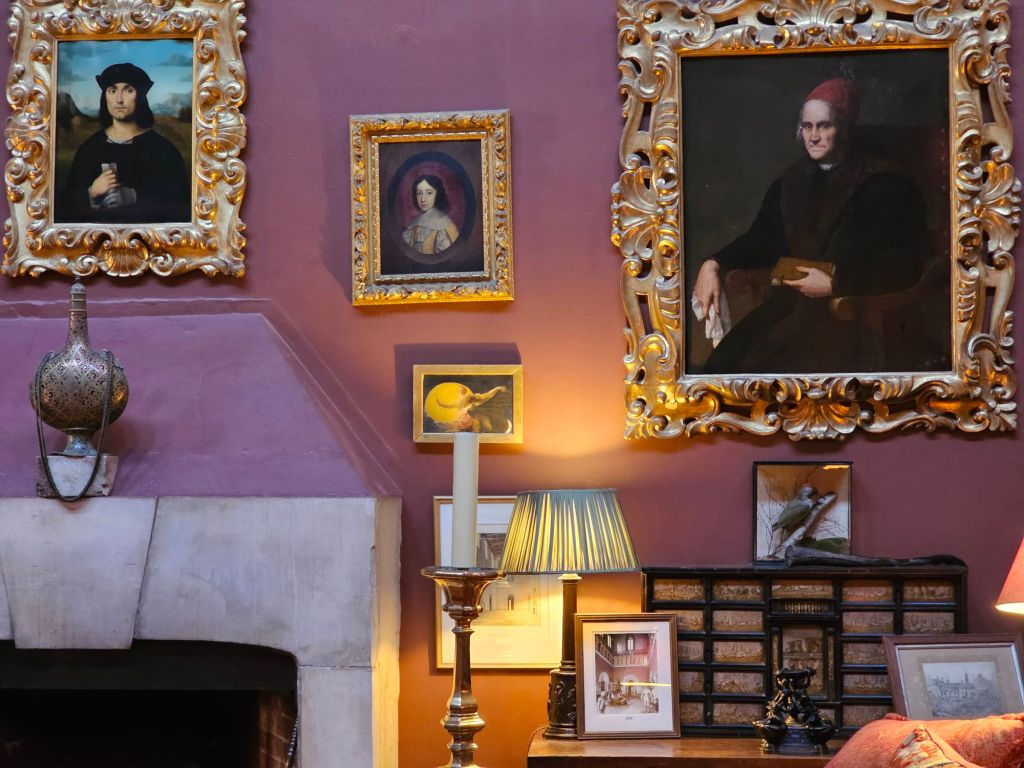
The results are magnificent:-
Sorry, this is an unusually long entry because I forgot to read the guidebook.






 | Charles | Saumarez | Smith |
You must be logged in to post a comment.