Elizabeth Esteve-Coll (1)

I have somehow managed to gain access to the obituary of Elizabeth Esteve-Coll in yesterday’s Daily Telegraph, a well-informed account of her which must have been written with personal knowledge.

I knew some, but certainly not all of her history – her schooling in Darlington and her time at Trinity College, Dublin, but not the amount of time she spent at sea with her Spanish husband.

The obituary perhaps does not convey how charismatic as well as energetic she was when she arrived as Keeper of the National Art Library in 1985, which was why the senior staff supported her appointment as Director in 1987 (this may have been forgotten).

She was recruited to reform the museum’s management.  More of her thinking will become clear when the recordings in National Life Stories are released.

I owe her a lot.  She was a remarkable person, ahead of her time, and she remained very active behind-the-scenes at the Wolfson Foundation and Sainsbury Centre after having to stand down as Vice Chancellor of the University of East Anglia because of her MS.

https://www.telegraph.co.uk/obituaries/2024/09/17/elizabeth-esteve-coll-victoria-and-albert-roy-strong-art/

Standard

Goldsmiths’ Fair

Each year, a highlight of Romilly’s year is the annual Goldsmiths Fair which opens next Tuesday at Goldsmith’s Hall, close to St. Paul’s. 

It is an opportunity to see not only her work, but the work also of two of her ‘translators’ and many other jewellers.  You can even get half-price tickets if you follow the link.

Here is a preview:-

https://mailchi.mp/09fe82669a43/goldsmiths-fair-2024-16517460?e=9dc0f9b85b

Standard

St. Barnabas, Hackney

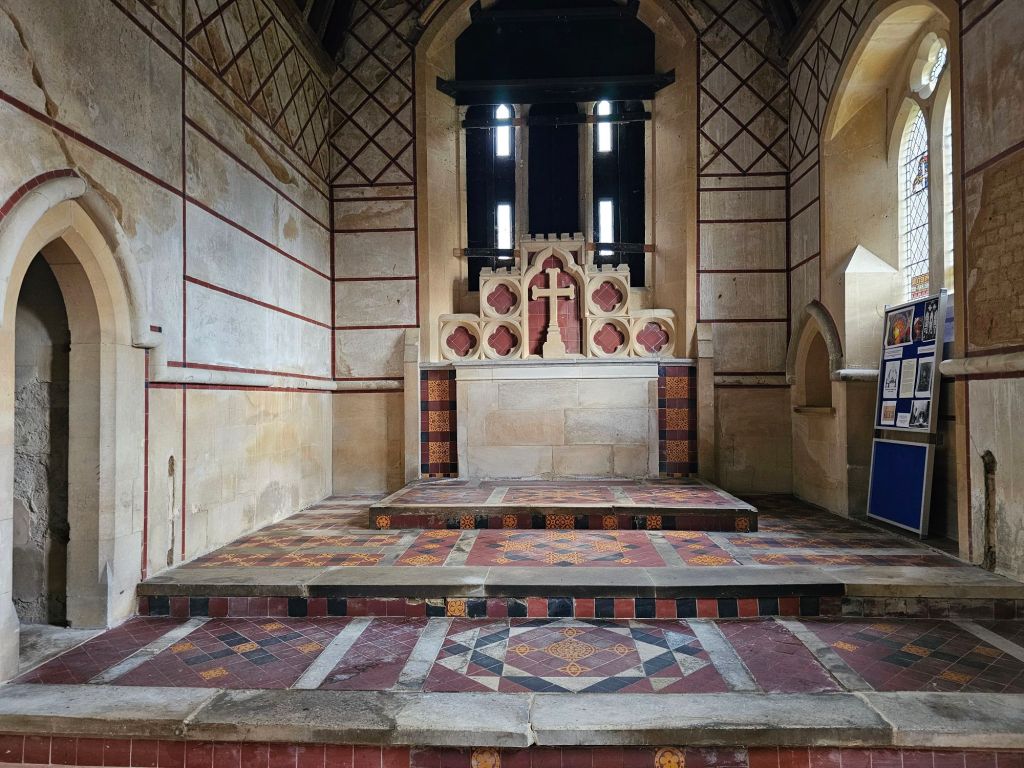
My second excursion prompted by Open House was to St. Barnabas, Hackney which I had somehow overlooked in Nairn’s London ‘the inside is the best church of its date in London’.  I am not sure that there are many churches of its date in London, just before the First World War, when Charles Reilly was already established as Professor of Architecture in Liverpool.  It’s a sort of stripped down, brick-and-concrete version of Torcello:-

Standard

St. Anne’s, Limehouse (7)

There is an excellent opportunity to visit St. Anne’s, Limehouse over the next fortnight when the church is open every day from 10 to 4 for Open House, made the more interesting by having an exhibition on the long history of the six surviving Hawksmoor churches, including material about the near demolition of St. Mary Woolnoth in the nineteenth century and their rediscovery and reappraisal by Elizabeth and Wayland Young in the 1950s.  There are some disarmingly salacious communications from John Betjeman to Elizabeth Young who he obviously fancied like mad and in those days made no effort to conceal.  The church was used as a backdrop for a Vogue fashion shoot in 1962 and there is a very informative video of Nicholas Serota talking about the Whitechapel’s exhibition on Hawksmoor in 1976, which must have led to the establishment of the Friends of Christ Church, Spitalfields in 1977.  And there are big wall mounted photographs by Hélène Binet first shown at the Venice Biennale.

The church could not have looked more beautiful in the September sun:-

Standard

Space House

I never thought that I would enjoy visiting Space House in a side street off Holborn.  But it is totally remarkable, not least as a current project of attentive renovation, every detail of its original design thoughtfully preserved apart from the petrol station on the ground and the car parking below.

Designed by George Marsh under Richard Seifert for Harry Hyams, built 1964 to 1968:-

Standard

A.S. Byatt (4)

I had never heard till yesterday A.S. Byatt’s own response to her portrait by Patrick Heron, with which Edmund de Waal ended his tribute to her in yesterday’s memorial service (nor was I able to find it in the unexpectedly terse entry on the NPG’s website):-

‘When it was finished, I did not know what to think for a moment. We both stared. I had a curious experience of it settling into shape, becoming itself, as I looked at it. The energy, the brashness, the uncompromising splashes of primary colour represented what I had wanted in an abstract portrait by a great colourist. … They were a painting of the writer, of how I feel when I start work, a vanishing, watching body in a sea of light and brilliance!’

Standard

Timothy Hyman RA (2)

In looking up more about Tim Hyman, I have now seen his statement on drawing on the Royal Drawing School’s website:-

My own principal reason for going out drawing is to renew my sense of space, of being in the world; if I stop drawing for several weeks, I find my spatial invention goes dead in my paintings, and my art becomes schematic. But I also draw because the specific – a friend’s face, a familiar London Street – has appeared before me as a moment of seeing, as an epiphany, to which I must somehow respond. As a teacher, I hope to transmit the instability and flux and surprisingness of visual experience – for example, the unmeasurable counterpoint of crowd and traffic, moving against the stillness of architecture. I can’t teach drawing as a “skill”, since I often flounder. Two favourite Bonnard quotations: Drawing is ‘The Transcription of the Adventures of the Optic Nerve’; and a definition of art – ‘Many little lies for one big truth’.

Standard

Timothy Hyman RA (1)

I am immensely sorry to hear of the death of Tim Hyman, an intensely serious, thoughtful and independent-minded artist, who was unusual in being as highly respected as a writer on art, including on Sienese paintings, as he was a painter.

He leaves out of his online CV, but not of his entry in Who’s Who, that he was at the Hall School and Charterhouse; which might not be relevant except that by the time he arrived at the Slade in 1963 he had, as he describes it, ‘already ingested a huge dose of 14th and 15th century Italian painting’ which ‘afforded me a kind of protection’: that is, protection from the orthodoxies of twentieth-century painting.  It is what made him such a good writer, but such an awkward figure in terms of art practice.

For some reason which I never understood, he and Judith were friends of the stage designer, Maris Björnson.  He also introduced me to the work of Bhupen Khakhar and I think it was thanks to Tim Hyman that the National Portrait Gallery acquired its portrait of Salman Rushdie by Khakhar in 1995.

He was a key figure in the foundation of the Royal Drawing School.  He certainly did a lot of teaching for it and was a member of its Academic Advisory Board.  I hope his views and ideas on drawing have been recorded because he was a properly intellectual practitioner.

Standard