
So, who was Anna Maria Garthwaite? Born in Leicestershire, the daughter of the Rector of Harston, she moved to Spitalfields in the late 1720s with her recently widowed sister. From her house in what was then known as Princes Street (now Princelet Street) she supplied floral designs in watercolour, many of them dated, to the local silkweavers to be made up into elaborate silks which were either sold in the grand drapers in the Strand or exported to America. She died aged 75 on 24 October 1763, having been described in Malachy Postlethwayt’s Universal Dictionary of Trade and Commerce as a designer who had ‘introduced the Principles of Painting into the loom’. I like to think of her as one of two elderly ladies living in the corner house in Princelet Street, producing beautifully bold drawings of plants and flowers for adaptation as brocade.
Natalie Rothstein
In writing about Anna Maria Garthwaite yesterday, I could not help but think of, and remember, the late Natalie Rothstein, the former Deputy Keeper of the Department of Textiles at the V&A, who devoted the best part of her long career at the V&A to the study of Anna Maria Garthwaite’s textile designs. The granddaughter of Lenin’s ambassador to Persia and daughter of ardent North London socialists, she joined the staff of the V&A as a Museum Assistant straight from Oxford in 1952. She wrote a long and magisterial Master’s dissertation on the ‘The Silk Industry in London 1702-1766’ which should really have been published and was always said to have been an enthusiastic scooter rider, having ridden motorcycles in her youth.
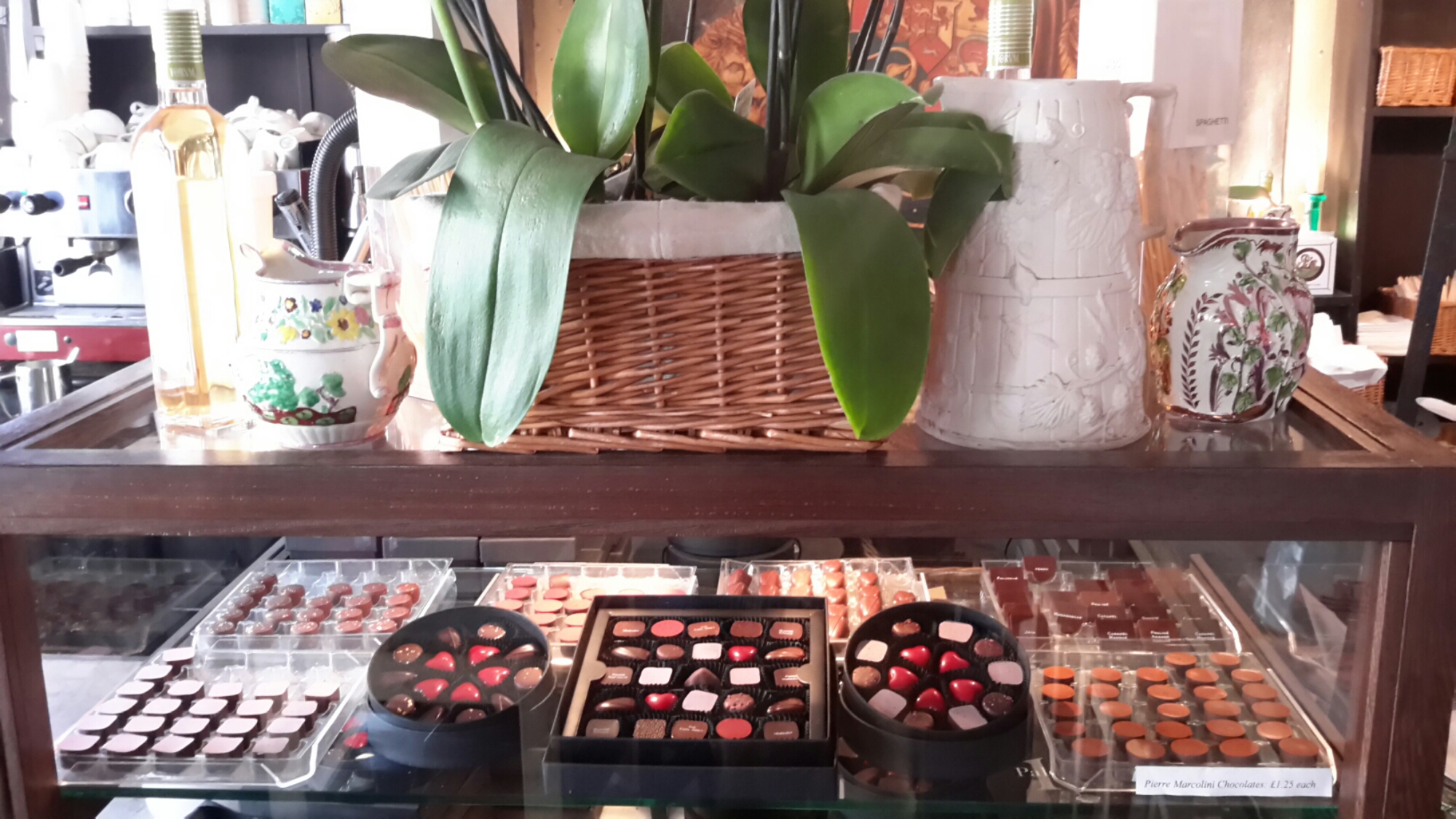
Verde & Company
No visit to Spitalfields is complete without a trip to Verde & Company, run by Harvey Cabaniss, and the only supplier – so far as I know – of Pierre Marcolini chocolates in London, the best chocolates in the world, as well as of assorted baskets, knicknacks, silver teapots and Yorkshire Parkin:-

Princelet Street
I was a bit early for my appointment with Miss. Willey, so I took the opportunity of taking some photographs in Princelet Street with my I-pad since my camera phone seems to have conked out. It’s the street where Anna Maria Garthwaite lived and did her beautiful textile designs, different according to the season. This is her house:-


Old Town
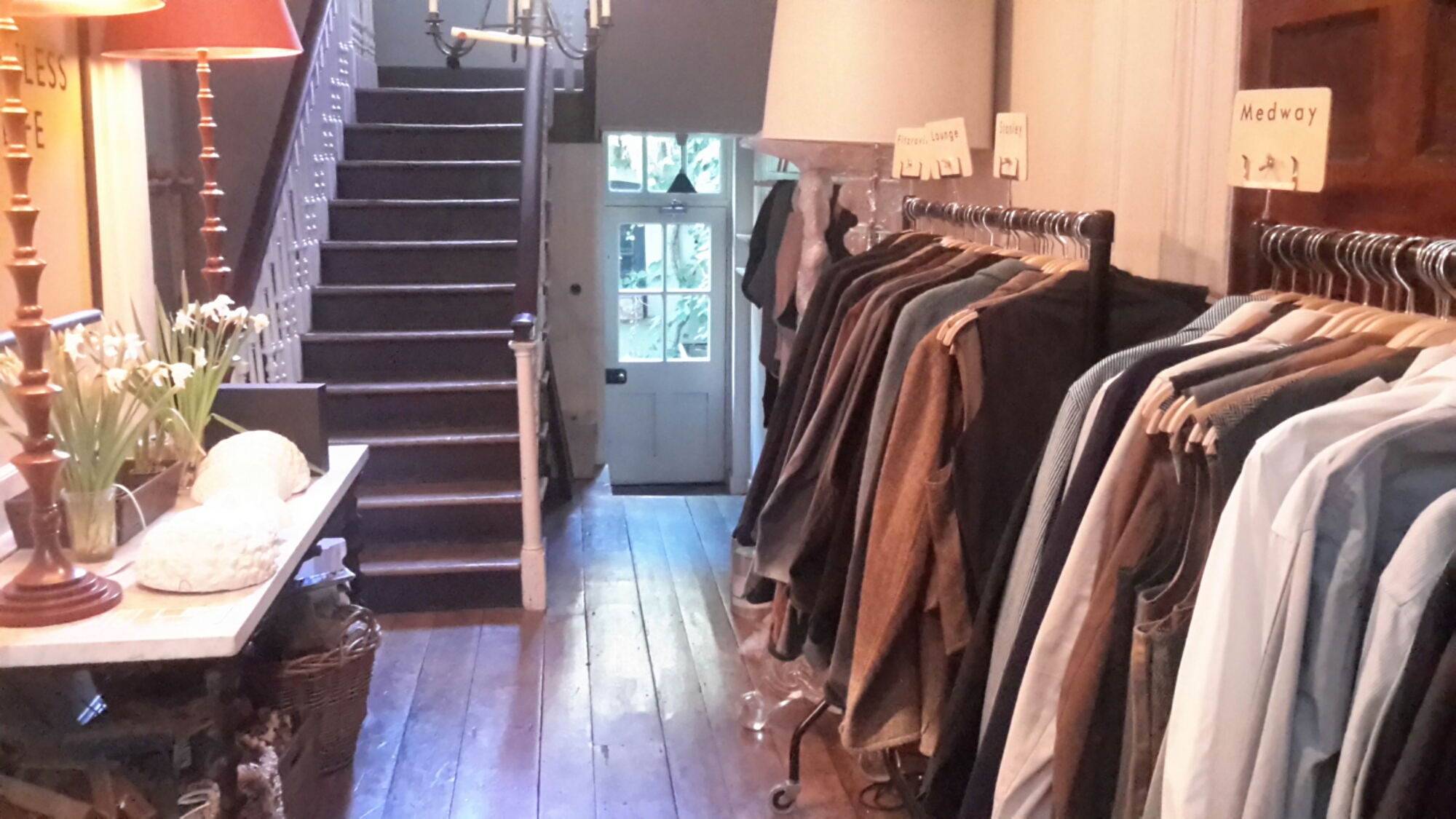
I was nearly first in the queue for the annual visit of Old Town, the mail order tailors, down from Holt in Norfolk to take up temporary residence in Fournier Street. I dearly love Miss. Willey, sometimes known as Marie, who runs the business with great briskness and always remembers what I have bought the year before. I tried on a shirt in a broom cupboard:-

Adam Dant
I went to see Adam Dant’s exhibition called The Budge Row Bibliotheque (Budge Row was a city street in Walbrook which has since disappeared), held in the Bloomberg Space at the corner of the Bloomsberg Building in Finsbury Square. The exhibition is based round the fact that Bloomberg is moving to a new building designed by Richard Rogers which will occupy the city block which has opened up in Walbrook, next door to St. Stephen’s Walbrook. It will be on the site of a Roman Mithraeum, where Bucklersbury House used to stand and St. Antholin, a Wren church demolished in 1875 to make way for Queen Victoria Street and whose spire was removed to Sydenham. I like the way Dant is so deeply knowledgeable about the history of London, its mythologies and folklore, and is able to depict the different layers of excavated history.
PS The exhibition closes on Sunday.
Vital Signs
We went this evening to an exhibition held on the top floor of the corporate headquarters of Clifford Chance, not the most accessible of gallery spaces at the tail end of Canary Wharf, but with an unusually thoughtful and serious exhibition of prints, watercolours and drawings by a generation of painters, most of whom were at the Slade, post School of London, who are now connected as ‘Gli Amici Pittori di Londra’ of Lino Mannocci, one of the co-organisers of the exhibition.
William III
I took a different route to work yesterday and stopped to admire the equestrian statue of William III which sits on a grass traffic island in the middle of St. James’s Square. I couldn’t understand why it was that such a grand statue had been erected to his memory nearly a century after his reign. The answer is that a statue was first planned in 1697 when ‘the kings statue in brasse’ was ‘ordered to be sett up in St. James’s square, with several devices and mottoes trampling down popery, breaking the chsins of bondage, slavery, etc.’ Then it was going to be a statue of George I. In 1724, money was bequeathed by Samuel Travers for an equestrian statue of William III, still of recent memory. It was eventually commissioned by the Trustees of the Square in 1794 and sketches were made by John Bacon Senior. He died in 1799 and the finished work is by his son, John Bacon Junior, probably based on the sketches or a model made by his father:-


Marlene Dumas
On the day that Marlene Dumas was inducted as an Honorary RA, she gave a tour of her exhibition at Tate Modern. She started abstract, but became figurative, not based on portraits, but remembered images, sometimes based on film and photography. Tenderness and the Third Person is a good description of her work as a whole: images of people half known, recorded through sketches and photographs, sometimes darkly and with political intent, as well as tenderly. They concern the abstraction of emotion, including pornography and tears. Afterwards, we presented her with her diploma:-

Travellers Club
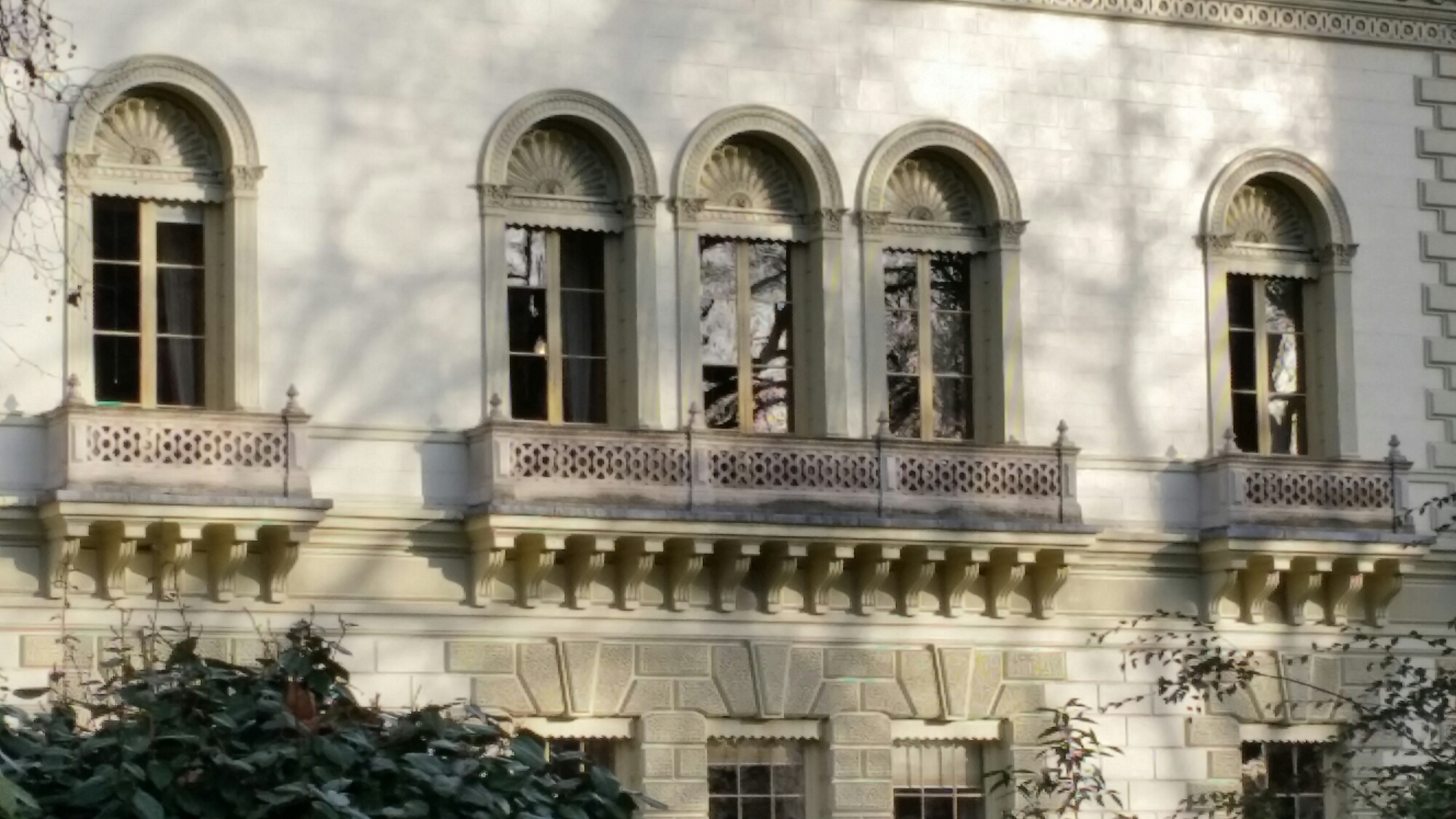
I walked past the back of the Travellers Club yesterday and admired, as I often do, the rhythm of the three round-arched windows of its library looking out to its private garden. It was designed by Charles Barry in the late 1820s and established the Italian palazzo style as the model for schools, banks and warehouses all over England. But few later designs, including Barry’s later Reform Club next door, are as suave and sophisticated as the Travellers Club’s behind:-
 | Charles | Saumarez | Smith |
You must be logged in to post a comment.