
Last day tomorrow.
11-4.
It is hard to think of anyone more significant in international architectural practice than Frank Gehry who died yesterday.
In his memory, I have looked up what I wrote about the early gestation of the Guggenheim, Bilbao for my book, The Art Museum in Modern Times. Here it is (at least, this is the version I wrote before it was edited):-
The Guggenheim Bilbao emerged from a set of loose sketches by Gehry done back in his hotel bedroom after visiting the site on 7 July 1991, which were then worked up into a model so that he could ‘carve it in my head’ and then developed further through multiple sketches, based on his memory of the form of his previous projects and on the ways in which a building might replicate the movement of a fish or a boat sailing in the wind.[1] Gehry’s fluent conceptual drawings were then interpreted by his office on their new CATIA (Computer Aided Three-dimensional Interactive Application) programme, which had been developed for the design of aeroplane wings. The final result, which evolved and was refined during 1992 and 1993, was the product of three people who worked well together and shared intellectual and creative ambitions.
The first was Gehry himself. He had had a long apprenticeship, experimenting with ideas, falling out with clients, using new materials, regarding himself as much as a sculptor as an architect, shaping forms and using materials much more casually and arbitrarily than would be normal for an architect, treating architecture as a product of free invention, much influenced by his friendships with artists not just in the local Los Angeles community, but including Jasper Johns and Robert Rauschenberg in New York as well. By the time he came to design the Guggenheim Bilbao, he was in his early sixties; he had won the Pritzker Prize in 1989, which had given him the confidence to be viewed as a member of the international architectural establishment; in November 1989, he had been appointed as architect for the Walt Disney Concert Hall in Los Angeles; and, as a result of winning the Disney Hall commission, he had had to enlarge and professionalise his office, appointing two partners, Jim Glymph and Randy Jefferson. The Guggenheim Bilbao was, by the standards of the Concert Hall, a much simpler project; and he was able to use all the experience of the difficulties of the Concert Hall to produce a very pure, free-standing, relatively economical project for Bilbao, a distillation of his belief in the value of free-form design.
The second key figure was Krens, who was, like Gehry, a left-field figure, trained not as an art historian, like most directors of art museums, but as an artist. He was in his early forties, very ambitious, and more than happy to do things differently from his peers. After Gehry had won the commission, Krens wrote a long letter outlining in detail the various concerns of the committee and from that point onwards, he flew to Los Angeles twice a month to work with Gehry on the details of the design. It was Krens who insisted that there were six relatively conventional, rectilinear gallery spaces which Gehry’s team called the ‘stodgy’ galleries, but which allowed the building to be used for the display of art.[2]
The third key figure was Ignacio Vidarte, the head of the authority which was created to be responsible for the building’s delivery and who shared a belief in its symbolic significance — for the city, as a symbol of its revival after a long period of industrial decline (the building of the museum coincided with a number of other major capital projects) and as a way to attract foreign visitors, and for Basque culture more widely, giving confidence to the region. He became the first Director of the Museum and was later appointed as Krens’s Deputy Director of Global Strategies.
The Guggenheim Museum represented a paradigm shift in the way that people think about museums. It has been successful not so much for its contents — no-one thinks of it in terms of its collection, although it has been very successful in its temporary exhibitions — but, instead, as a great and grandiose civic monument, attracting visitors by its adventurous architectural form, shimmering under its titanium skin. Some parts of the inside are visually exciting as well, including the grand entrance atrium and a huge gallery containing a Richard Serra sculpture. But what is most exciting is the view of the building from outside as a feature in the surrounding city.
[1] The design process is described in detail in Coosje Van Bruggen, Frank O Gehry: Guggenheim Museum (New York: Guggenheim Museum, 1997), pp.31-94.
[2] Van Bruggen, p.112.
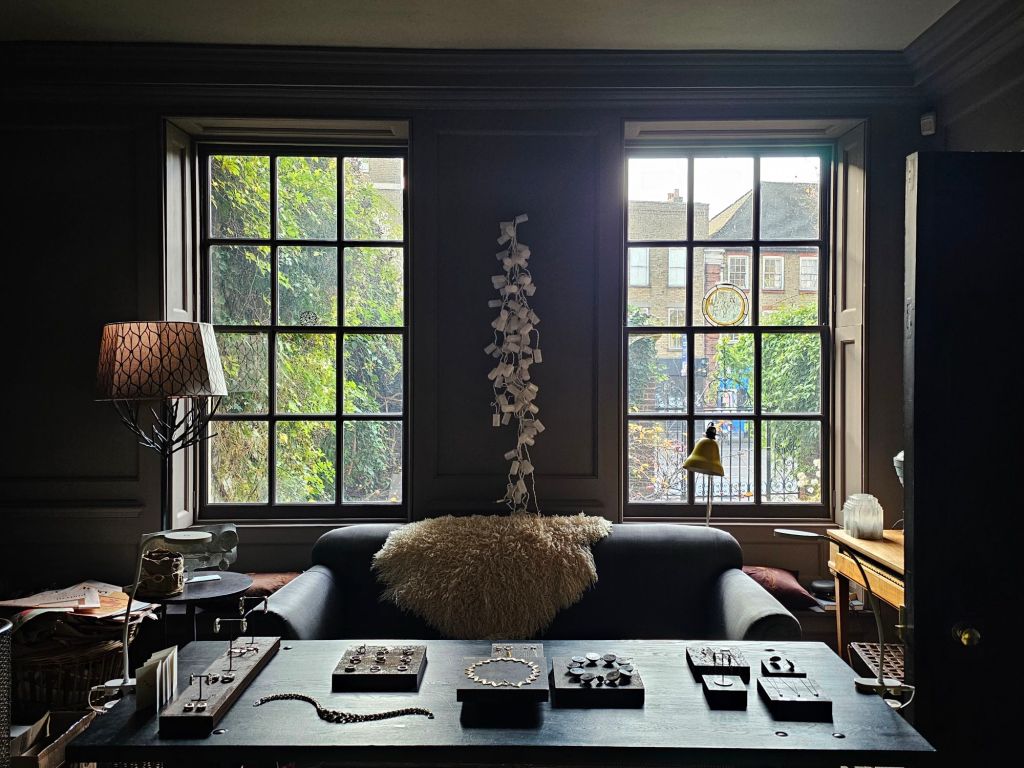
If like me you’re stuck for what to buy for Christmas, then Romilly and the seven jewellers she works with are holding a small exhibition in our house at 135, Mile End Road today and tomorrow from 11 to 6, and on Sunday from 11 to 4.
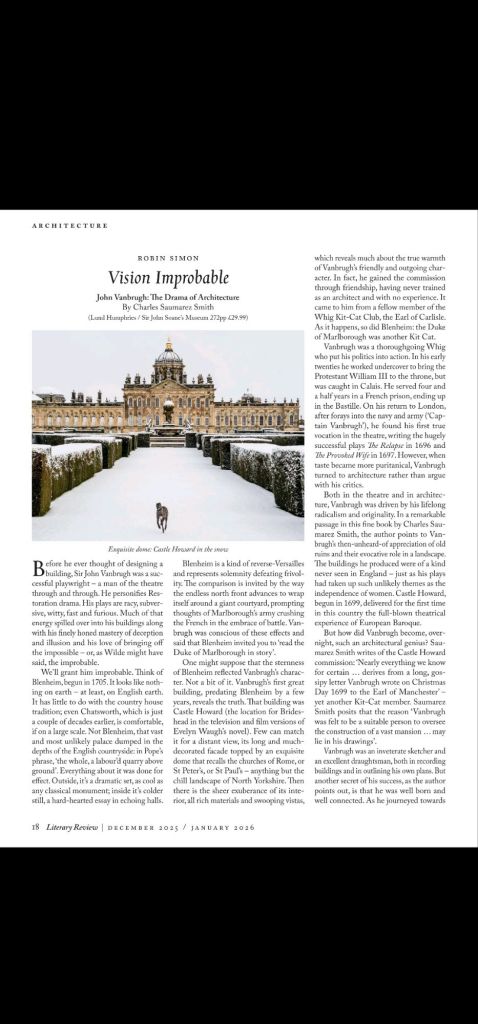
I had been tipped off that a very enjoyable conversation I had a couple of weeks ago with John Goodall, the architectural editor of Country Life would go live today on the podcast he does more normally with Clive Aslet. It is now online on https://www.ypompod.com/. John is wonderfully well informed about all aspects of country houses, including their medieval history, and I hope it makes for lively Christmas listening, covering all aspects of the origins of both Castle Howard and Blenheim, how they came about and the nature of the relationship between the circumstances of their commission and the character of their design. Also, quite a bit at the end about Vanbrugh’s influence on Bob Venturi and Denise Scott Brown.
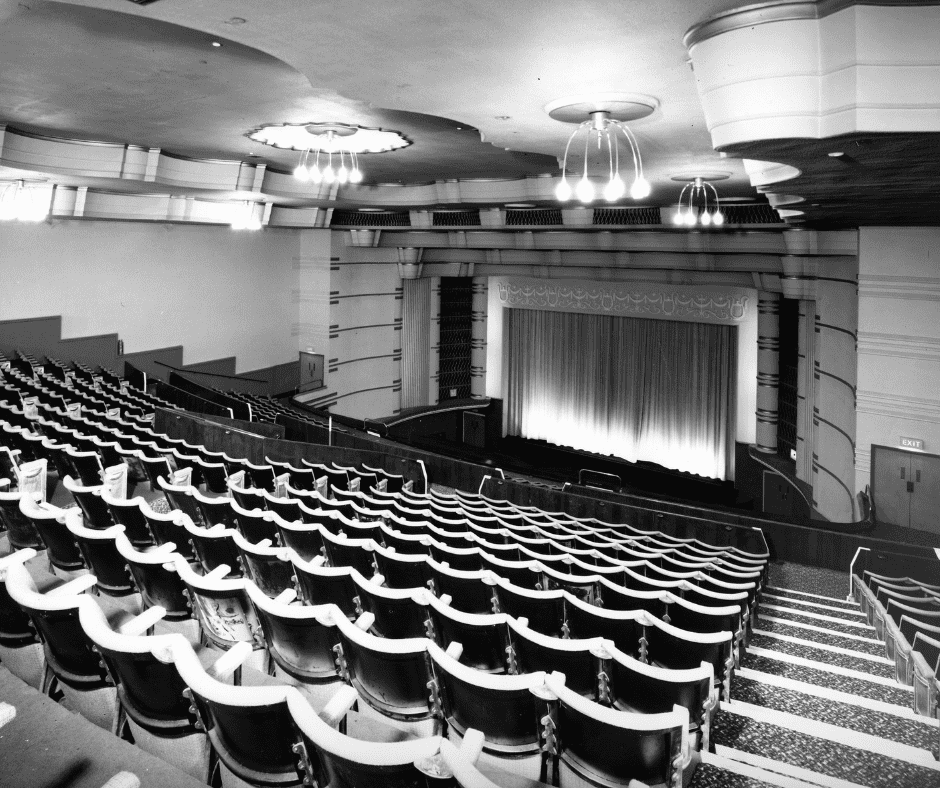
I have kindly been alerted to the fact that – very surprisingly – Tower Hamlets has decided to turn down planning permission for the redevelopment of the Genesis Cinema (see Comments).
Tyrone Walker-Hebborn who owns the cinema and runs it very successfully as a local independent cinema has claimed that, since COVID, audiences have meant that he has run it at a loss. The only alternative was to redevelop the site with a bigger building mostly devoted to student accommodation, with a new smaller cinema in the basement. The new building would have dwarfed its surroundings, particularly the charming Bellevue Place which lies immediately behind what used to be Wickhams Department Store and immediately adjacent to the proposed new tower block.
So, the question was: was Tyrone Walker-Hebborn a cineaste making efforts to protect a local amenity ? Or was he a property developer maximising the development potential of a building he owned to the detriment of the local neighbourhood ?
Surely the answer to this quandary should have been, might still be, to make more of an effort to consult the local community, to design it with more of the character of a civic amenity and less as a vast rabbit hutch of poky student rooms.
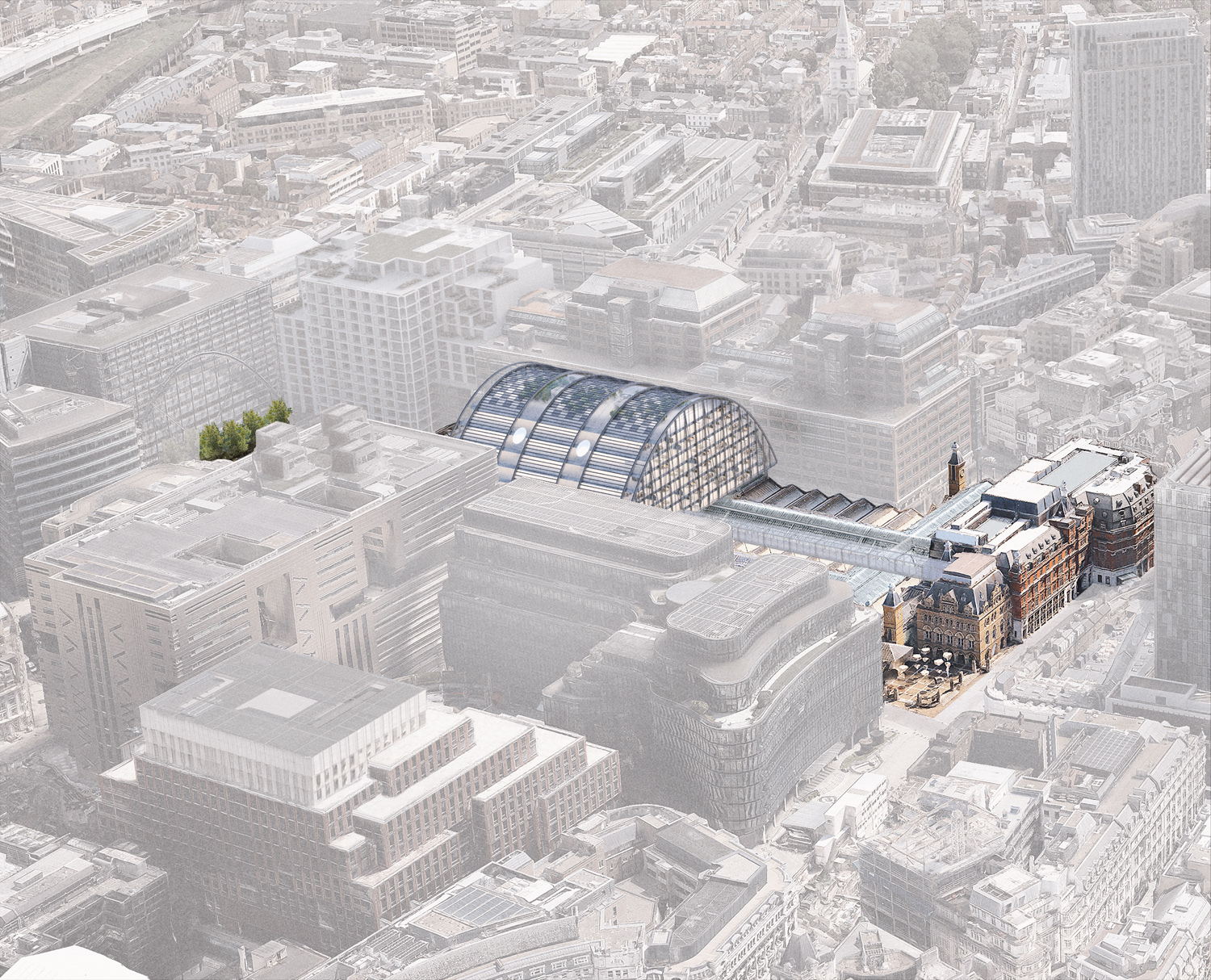
It is a long time since I have posted anything about Liverpool Street Station, partly out of a sense of relief that Herzog and de Meuron had withdrawn what always looked like a terrible plan – to build a tower block on top of a listed Victorian hotel.
Now I am pleased to see that John McAslan who did the development of King’s Cross in a very successful way has come up with a plan which looks obvious: to concentrate the new development above the glass train sheds in such a way as to retain, indeed enhance, the full scale of the sheds to public view. I just hope that Network Rail will see the clarity and logic of this approach and adopt it so as to avoid the versions of a towering inferno which have been proposed:-
I am posting information about the Vanbrugh Tour that Martin Randall has organised and I am leading in July in case there is someone, besides me, who would like to see all of Vanbrugh’s major houses in the space of a week.
I know it looks expensive, but then hotels are expensive.
I once went to Castle Howard, Seaton Delaval and Grimsthorpe over a long weekend. It was pretty memorable:-
https://www.martinrandall.com/tours/vanbrughs-greatest-houses
Thanks to the National Lottery Heritage Fund funding the celebrations of Vanbrugh’s tercentenary next year, the Georgian Group has just launched a website which will make it possible to find out what is planned, including events at each of his major houses. It blows up the Kneller Kit-Cat portrait as its frontispiece, with a backdrop of the frontispiece of the plays and the façade of Castle Howard from Vitruvius Britannicus. There is already a lot planned for next year and more to come:-
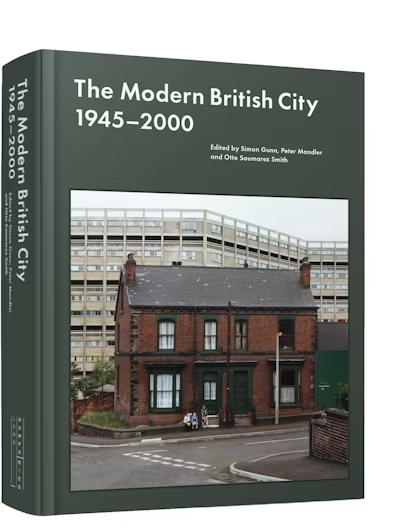
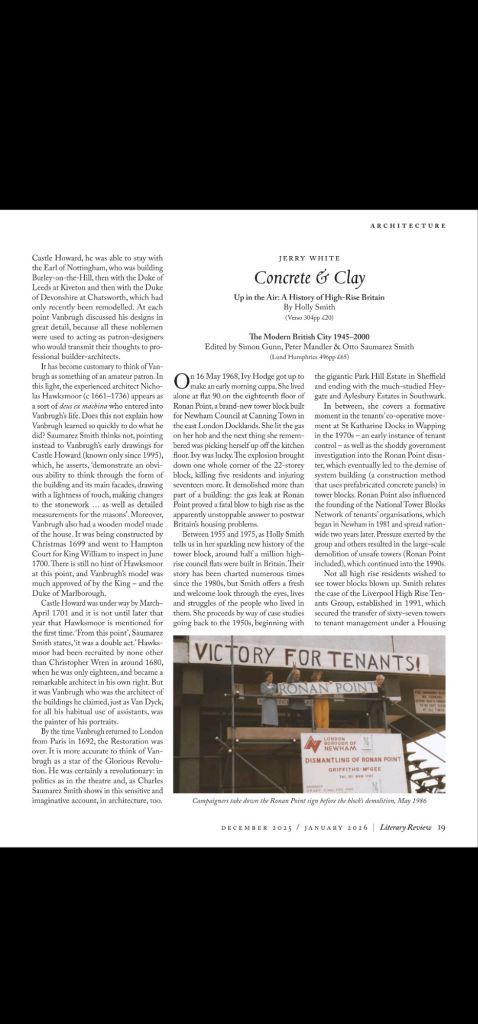
This week sees the publication of The Modern British City 1945-2000, edited by Simon Gunn, Peter Mandler and Otto Saumarez Smith, also published, like John Vanbrugh: The Drama of Architecture, by Lund Humphries. It consists of nearly 500 pages of articles on all aspects of the post-war city from a social, political and planning perspective, hard to summarise, although Peter Mandler does a good job in doing so in his ‘Afterword: The Five Phases of the Modern British City’: less about the utopian grand plans for new cities and more about cities as they actually were; constrained by restrictions on new development during the 1950s; only really undergoing radical redevelopment in the 1960s; already subject to a new interest in conservation and heritage in the 1970s; developing post-2000 through the rise in the number of students who attended the new universities and then often stayed. There is a lot about the ambiguities of gentrification, particularly in the 1960s.
It’s a rich read:-
 | Charles | Saumarez | Smith |
You must be logged in to post a comment.