
It is hard not to give thought to Scotland this morning and to the implications of the vote. I’ve been trying to work out how Scottish I am. My mother always claimed to be part Scottish through the Buchanan Wollastons which gave us a right to wear the hideous Buchanan tartan. And my father was part Leslie, a better tartan I always thought. So, I suppose that, like many of the British, I feel a sense of long histories intertwined and a mild sense of relief that the Union has been preserved.
Tag Archives: England
London Design Festival
Ben Evans took me on a whistlestop tour of those elements of the London Design Festival housed at the V&A. There is an astonishing and beautiful installation like a silver aeroplane wing by Edward Barber and Jay Osgerby in the Raphael Cartoon Court:

I liked the irregularity of a line of blown glass jars by Jeremy Maxwell Wintrebert:

Reimagining Mayfair
I have spent much of today thinking about, and chairing a set of presentations about, a project organised by the RA’s architecture programme and Architects’ Journal called Reimagining Mayfair. The idea of the project was to invite architectural practices to imagine how those parts of Mayfair which surround the RA could be reanimated and reinvigorated through an inventive use of art, new streetscape and architecture. One project by EPR with Kate Malone uses flags, umbrellas and hot-air balloons to draw attention to the area. Andrew Phillips has reimagined it as a Roman ruin. DK-CM used Pablo Bronstein to create the idea of a May Fair, animated by ephemeral pavilions. And Weston Williamson invited Yinka Shonibare to turn Burlington Gardens into a souk by the use of a batik awning. I hope the projects will encourage Westminster City Council to think creatively as to how the grid of streets round Burlington Gardens could be turned into a cultural neighbourhood like Chelsea in New York, by a) encouraging the art galleries to open on Saturday b) reducing the perennial traffic jam, and c) improving the quality of street surfaces and pavements.
National Portrait Gallery
It’s a long time since I’ve been back to the National Portrait Gallery and glided up the grandest escalator in western Europe to the restaurant overlooking the roofs of the National Gallery and down Whitehall. I remember the moment when Jeremy Dixon and Edward Jones triumphantly described how they had persuaded a warder to let them out onto the roof, which I had never done, and discovered the greatest possible view of the institutions of British goverment to match the portraits below. I was always a bit sceptical that people would find their way up to the top of the building for a cup of tea, but I was quite wrong.

Virginia Woolf
A trip to the National Portrait Gallery to hear Catherine Goodman in conversation with Rachel Campbell-Johnston gave me an opportunity to see the exhibition of Virginia Woolf portraits, not a wholly easy subject because there are not so many of them, mostly photographs, the best of them (and best known) taken when she was 20 by George Beresford, supplemented by studio portraits by Man Ray in 1934 and Gisèle Freund in 1939. But Frances Spalding has done a good job in giving a sense of her life as a whole, her family and friends, all of them intellectual and intense, dominated by Virginia herself with her fragile beauty and thyroid eyes.
Jock McFadyen
We had a meeting and studio visit in Jock McFadyen‘s studio in darkest Hackney underneath the railway arches off Mare Street. It was wonderful to see his epic paintings of urban decay as seen from a car window in Dagenham. They belong to an imagery of the 1980s east London picturesque, alongside Patrick Wright, who once wrote a column called London Fields, and Iain Sinclair, the poet of the A13. I also like and admire Jock’s meditations on the theme of Walter Sickert, inspired by an exhibition at Somerset House and updated for the 21st. century.
Andrea Rose
I went to Andrea Rose’s leaving party last night. It was held not in the British Council, where she has been the long-standing Director of Visual Arts (she joined the British Council in 1979), but just outside, with hordes of the art world present. It seemed appropriately symbolic, since there were many references to the fact that she was a formidable member of staff and not always in agreement with official policy. She will be a great loss.
Linnaeus in London
I was interviewed on Japanese television this morning about eighteenth-century gardens. I was asked if I knew about the response to Linnaeus when he visited London. I didn’t. The answer is that he came to London in July 1736 to visit Sir Hans Sloane, the founder of the British Museum, and Philip Miller, who was chief gardener of the Chelsea Physic Garden. Apparently neither of them was impressed by Linneaus’s new system of classification, since it was too obviously sexual. They preferred the taxonomy of John Ray. Thomas Knowlton, who was Lord Burlington’s gardener at Londesborough, thought the Linnaean system ‘altogether whimsicall and ridiculous’. But I could find no confirmation of the suggestion that Linnaeus called a particularly prickly plant after Miller in revenge.
Whitstable
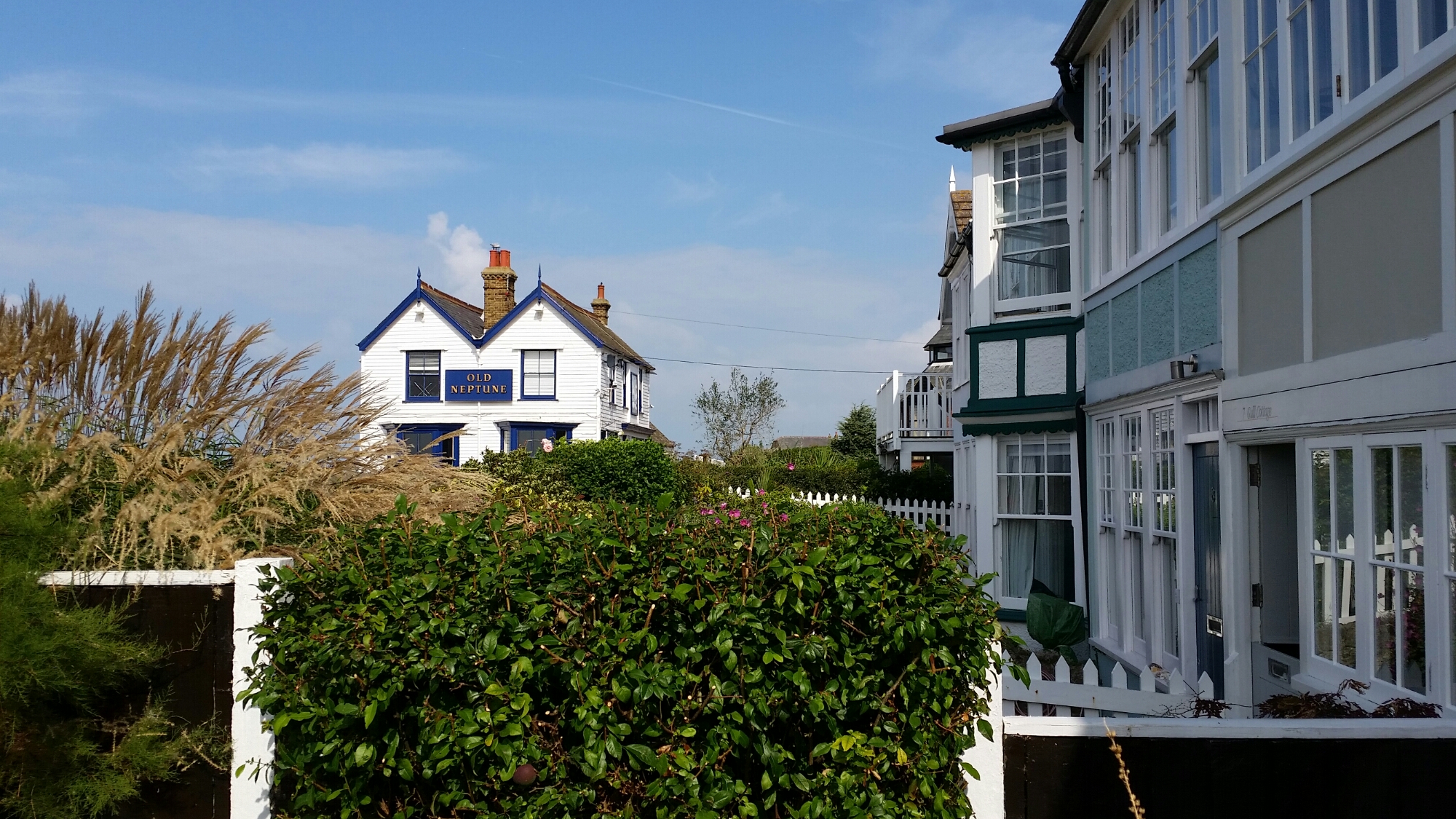
Living as we do in east London, it is relatively easy to escape for the day to Whitstable. We used to go for lunch at the Royal Native Oyster Stores. Today we had lobster in a cottage garden overlooking the sea front and afterwards walked along the shore where the houses are so much smarter and more chichi than they were twenty years ago:

Newcome’s School, Hackney
Now that I am back in London, I have been able to answer the question which had been perplexing me as to why Lord George Cavendish, the early nineteenth-century owner of Burlington House, was educated in Hackney. The answer is that he, along with a number of other children of the Whig political élite, was sent to Newcome’s School in Hackney, where Henry Newcome, the headmaster who gave the school its name, was a noncomformist minister known for his Whig principles, whilst Hackney was known for its healthy green fields. From 1756 to 1779 the headmaster was Peter Newcome, a Fellow of Queens’ College, Cambridge and of the Royal Society, and an expert on earthquakes. Pupils were taught Latin, French and natural sciences, as well as drawing and dancing; they went on excursions to study natural history; played football and cricket (there was a cricket pitch next to the school); and every three years they performed a Shakespeare play. During the 1780s, one of the masters was Coleridge’s older brother.
 | Charles | Saumarez | Smith |
You must be logged in to post a comment.