We went on a Friday evening trip to Tate Modern to see Henri Matisse:The Cut-Outs, a nice scale of exhibition, some of it deeply familiar, but not all, demonstrating Matisse’s discovery of, and pleasure in, the very simple medium of coloured paper cut out with scissors and then sometimes twirled about to make a pattern and often stuck on a wall: partly decorative, but done with extreme deliberation, as was evident from the two clips of original film, which showed him as an old man working with purposeful deliberation as he snipped away and ordered exactly how the pieces were to be placed on the wall. I liked the early experimental work which went into the book Jazz, when the medium was new to him, and the beautiful book covers which he did for a volume of Henri Cartier-Bresson’s photographs, The Decisive Moment, published in 1952, and for the original edition of Alfred Barr’s Matisse: His Art and His Public, first published in 1951.
Monthly Archives: July 2014
James Bradburne
One of my greatest pleasures in recent years has been chairing the Advisory Board of the Palazzo Strozzi. I was asked to do so by James Bradburne, a highly intelligent and entrepreneurial Canadian, who was trained as an architect and ran the Museum für Angewandte Kunst in Frankfurt. Known for his floral waistcoats, he ran the newly established independent institution with great chutzpah, organising a whole series of memorable exhibitions, including a wonderful exhibition on Bronzino in 2010, a recent exhibition on Renaissance sculpture which travelled to the Louvre and a current exhibition on Pontormo. Now, according to the Art Newspaper, he faces the chop. What has he done wrong ? Was he too independent minded ? Or insufficiently ingratiating with his board ? If asked by Saxton Bampfylde, the headhunters who have been employed to find a successor, who should be the next Director, I will recommend Bradburne.
Mary Beard and Grayson Perry
We have just had an event in which Grayson Perry talked to Mary Beard (or was it vice versa?) about her latest book, based on her Sather lectures, on Laughter in Ancient Rome. What struck me most forcibly is what a difficult subject it is to talk about academically, whether in the present or in ancient Rome. If treated analytically, then there is a risk of it seeming humourless, but if discussed with levity, then it doesn’t succeed in being a proper academic study. They brilliantly circumvented this problem with a mixture of good humour, anecdote, information, and jokes from the ancient world.
Queen Alexandra
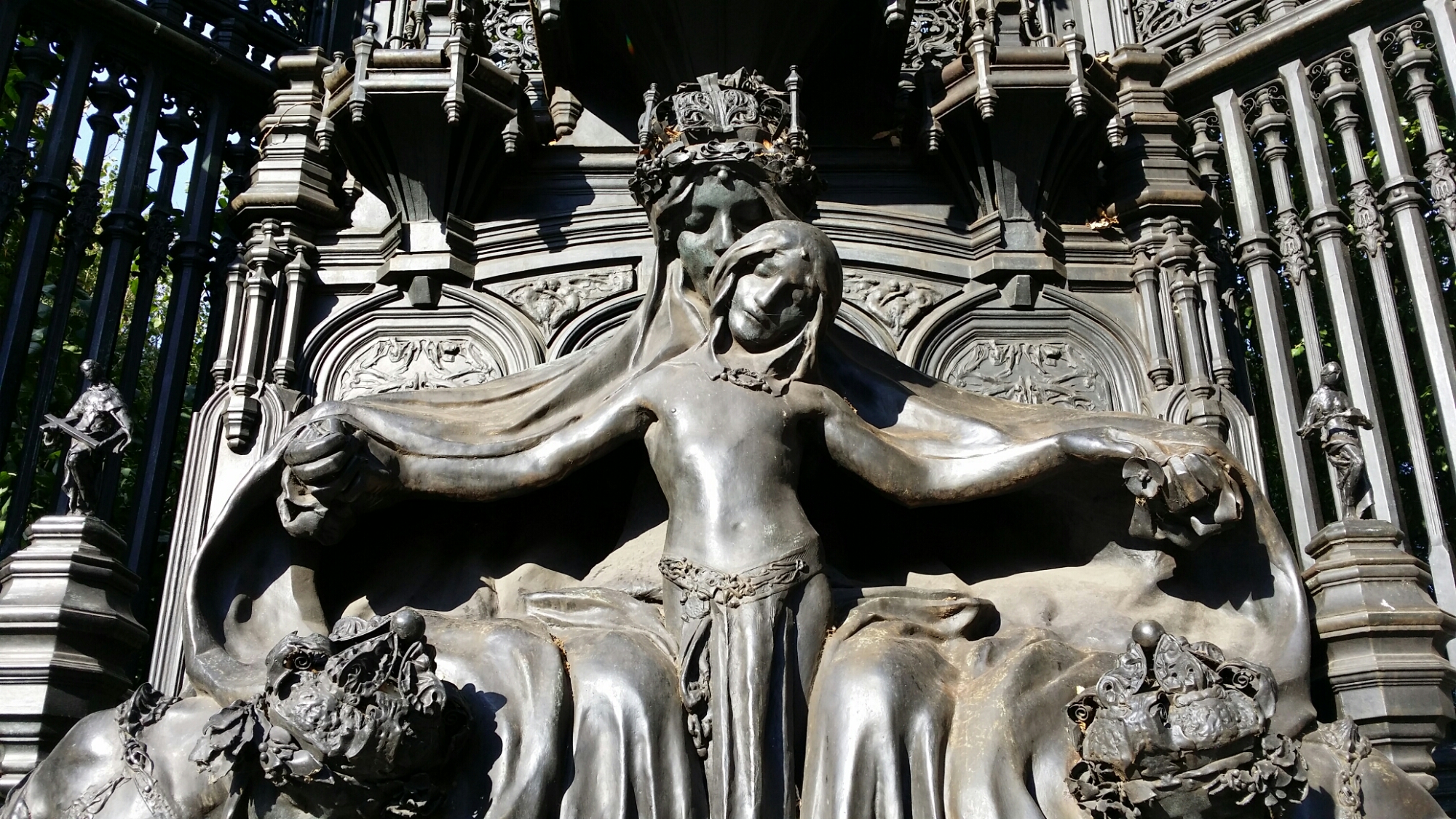
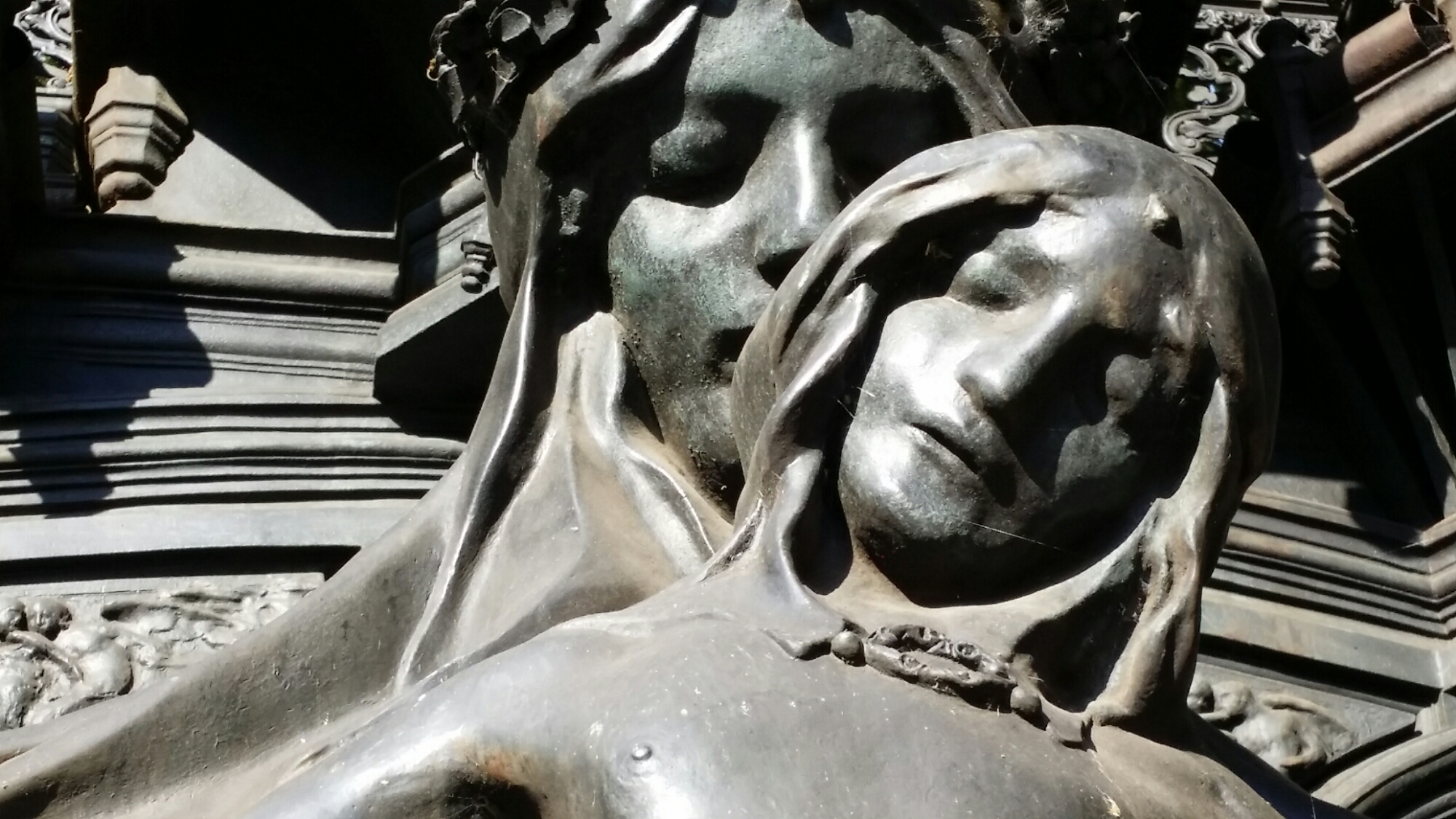
Every morning I walk past a grand and ostentatious statue in Marlborough Gate, which I have always studiously ignored. I was quite wrong. Looked at more closely, it turns out that it is a late work by Alfred Gilbert, the sculptor of Eros, former student of the Royal Academy Schools and of the École des Beaux Arts in Paris, who was forced to resign from the Academy in 1908 else be expelled (he took money for commissions which never materialised). The monument is wonderful, a grand work of late flowering art nouveau, with cobwebbed figures of Faith, Hope and Love, commemorating Queen Alexandra, the Danish wife of Edward VII. She had pleaded Gilbert’s cause with the King, sent him funds in exile and caused him to be reinstated as an RA. It’s not surprising that the monument is full of feeling:
Queen Anne’s Gate
It being a warm summer’s evening, I walked back to the tube across St. James’s Park. Queen Anne’s Gate, originally known as Queen’s Square, the haunt of wealthy politicians and the best preserved group of early eighteenth-century town houses in London, looked magnificent with its grand, ornamented door hoods and replica statue of Queen Anne:


Philip Gidley King
Slightly to my surprise, I have been asked to attend a service in Westminster Abbey today to commemorate the arrival of the first fleet in Sydney on 26th. January 1788. Sadly, I can’t. It transpires that my grandmother Muriel was encouraged to visit Australia just before the first world war by her aunt Emmeline (Muriel met my grandfather in Sydney). Emmeline was the granddaughter of Philip Gidley King, one of the first settlers, who travelled out to Australia as second lieutenant on HMS Sirius, established the first settlement on Norfolk Island, and became the third Governor of New South Wales. I am not sure whether I like or am disconcerted by these strange leaps of genealogy such that with two jumps I am semi-descended from a man who built the first huts on Norfolk Island and whose first children were by a convict.
Whitebait Dinner
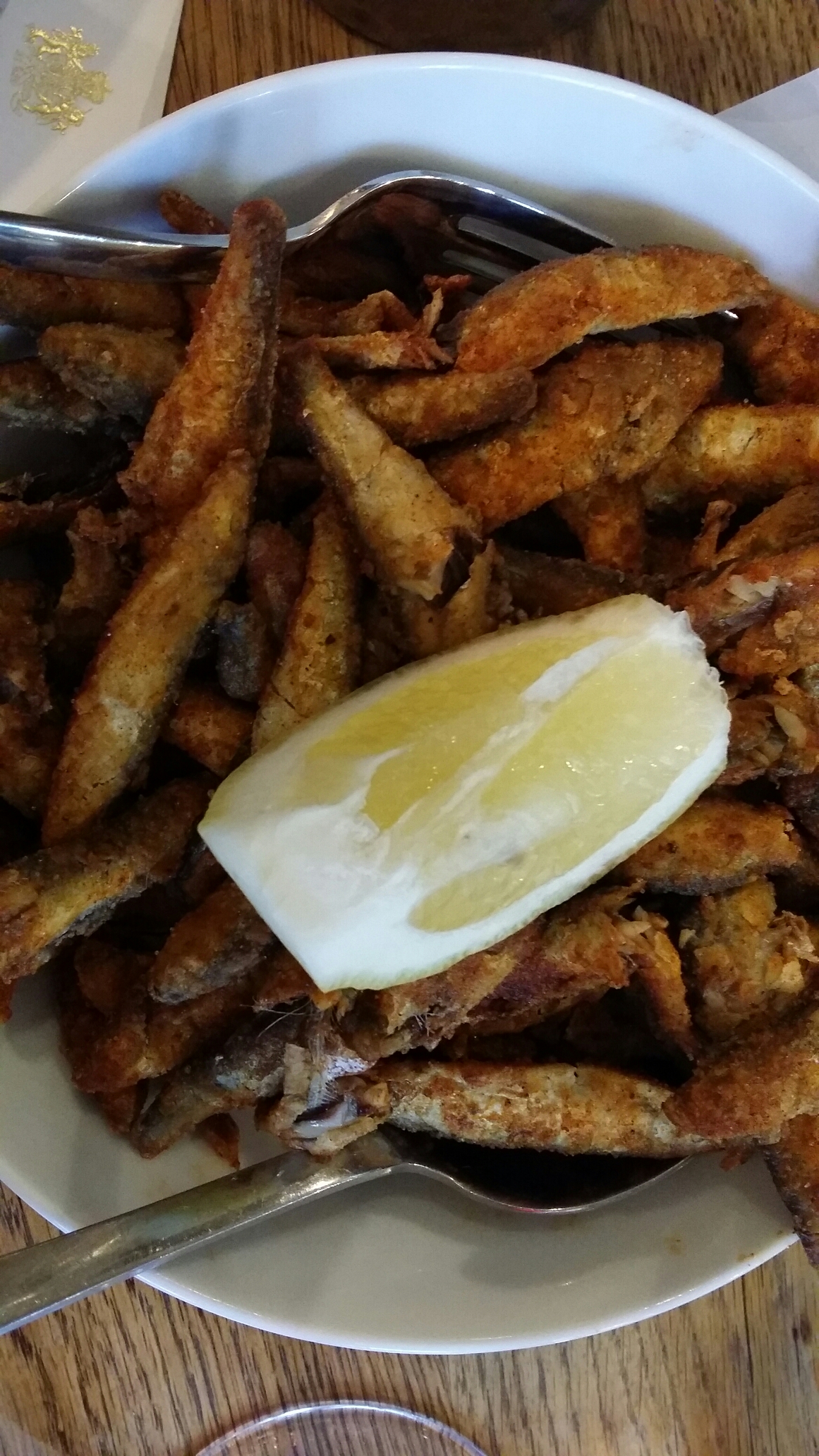
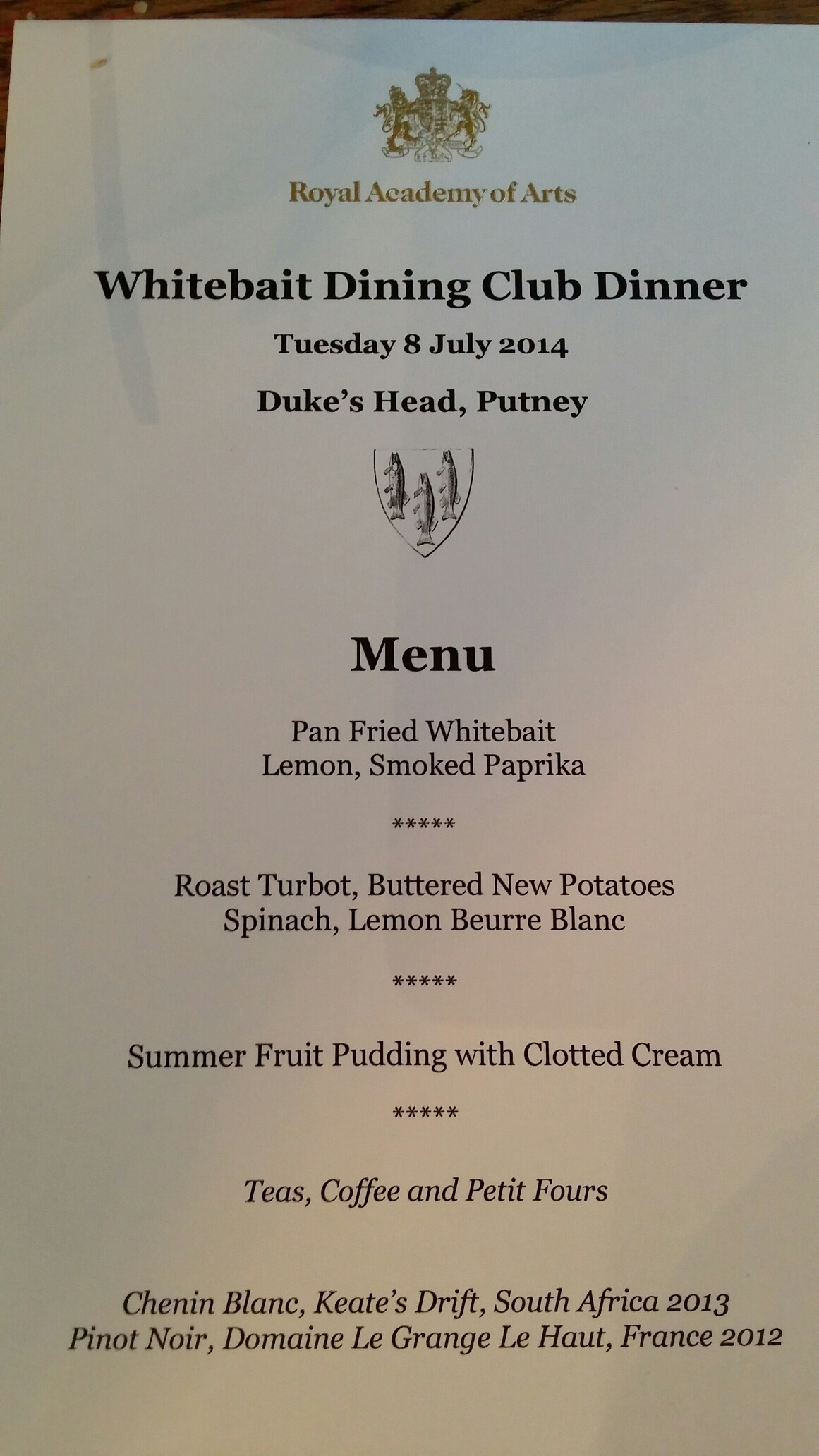
The RA has traditionally celebrated summer with a whitebait Dinner when a large group of RAs and their guests board a boat at Westminster Pier and go either downriver to Greenwich, as Turner did, or more often upriver to Putney, Barnes or Mortlake. Farington describes an occasion in 1818 when a party of RAs visited Eel Pye House in Twickenham and then ‘a little after 3 oClock and about 4 we sat down to excellent fare brought from the Freemason Tavern under the management of a Clever Waiter. We dined in the open at at one table and removed to another to drink wine and eat fruit’. This year, a boat load of 80, more than ever before, went to the Duke’s Head tavern in Putney, an old boating inn, where, as is traditional, we consumed highly salted whitebait and white wine:
Rafael Moneo
Rafael Moneo came from Madrid last night to give this year’s Annual Architecture Lecture at the RA. He eschewed the usual format of talking about his own work and instead talked about the traditional involvement of the architect in history and theory, going back to the Vitruvian belief in commodity, firmness and delight and the writings of Albert, Serlio and Vignola. There was much discussion afterwards as to how far it was a critique of Rem Koolhaas’s idea as expressed in his Venice Bienniale that architecture can be reduced to a kit of parts which can be assembled arbitrarily, without a sense of rootedness in building. I certainly took it as a statement of belief in the role of analysis, the understanding of history and of the craft of building in intelligent architectural composition, as one might expect from the architect of buildings like the Museum of Roman Art in Mérida, the Kursaal in San Sebastián, and the recent extensions to the Museum of Fine Arts in Houston and the Prado in Madrid.
Tom Stuart-Smith (2)
We were invited to lunch by the Stuart-Smiths to see the wonderful garden they have made in a strange bit of countryside sandwiched between the M1 and Hemel Hempstead: part semi-formal garden, part wilderness, with banks of high flowers in beds, a meadow planted with north American prairie plants and an immaculate vegetable garden. This is the semi-formal garden:


Wapping Pumping Station
Much as I salute the arrival of a new organic market in Wapping, I can’t help but lament the closure of Wapping Pumping Station, which was opened in 1977 as an arts venue with restaurant attached, called The Wapping Project. It was an early sign of east end revival, on a lease with a restrictive covenant granted by the London Docklands Development Corporation. It has now been closed and apparently sold to a property developer. As Rowan Moore has pointed out in the Observer, it represents a considerable impoverishment of the public realm. Maybe the market could take it over?


 | Charles | Saumarez | Smith |
You must be logged in to post a comment.