
I’ve been reading the new book on Edmund Burke by David Bromwich, a Professor at Yale (The Intellectual Life of Edmund Burke: From the Sublime and Beautiful to American Independence). I’m struck by how everyone knows everyone in eighteenth-century London. When Burke wants to write a letter to congratulate Adam Smith on his Theory of Moral Sentiments in 1759, he gets his address from David Hume. When he gives his first speech in the House of Commons, Samuel Johnson writes how pleased he is that ‘Now we who know Burke, know that he will be one of the first men in the country’. And one of his closest friends was Joshua Reynolds at whose house he endlessly arrived for dinner uninvited, imposing his poor Irish relations on Reynolds as well.
Monthly Archives: October 2014
Singapore (2)
In the past, I have always been taken round Singapore. With a day to spare before the flight back, I took myself off to explore.
First, because it was close to the hotel, I wandered the streets of Kampong Glam, the still surviving lowrise Arab neighbourhood, including Haji Lane:


World Architecture Festival
After 48 hours of attending an endless round of events at the World Architecture Festival, I have a better sense of how architecture operates. First, it is astonishingly international. Mariana Simas, the Brazilian architect from Sao Paolo with whom I was a judge, was familiar with small local projects, and the architects who had built them, in Vietnam. Second, the geography of influence has tilted strongly towards Asia and Australasia. The Americans seem conspicuous by their absence. Third, architecture as a profession, at least in terms of the bigtime global operators, is predominantly male (look at the line-up of winners), except where it relates to interiors. Fourth (and this is a statement of pure prejudice), much of the most interesting and thoughtful architecture is being done in Australia and New Zealand, both of which have strong and independent national traditions, support their own architects, believe in innovation, and are interested in the relationship between architecture and the natural environment. The winner of the World Building of the Year Award was a21studio for their chapel in Vietnam.
Colour in Architecture
I’ve been on the jury for most of the day for an award for the use of colour in architecture. First, we were shown a project in Lund in Sweden where colour is used to enliven a pedestrian bridge across the main railway line. Then, two bank projects from the southern hemisphere – the new National Australia Bank headquarters in Melbourne, Australia and the new ASB headquarters in Auckland, New Zealand – both of which use colour inventively to break down corporate uniformity. Peter Cook (in bright floral shirt) did a presentation on a new university building which he and his partner, Gavin Rowbotham, have done for the University of Vienna which uses intense colour throughout from the brightest orange to brilliant yellow. A young Vietnamese practice then showed a more temporary community project which uses colour in fabric. We ended with a large multi-generational private house in Kuala Lumpur and a repurposed factory on the outskirts of Adelaide. Luckily, the decision of the judges was totally straightforward. We all agreed that only Peter Cook’s law faculty building used colour with total conviction, making colour integral to the conception of the project rather than applied to it. It was unanimous.
Gardens by the Bay
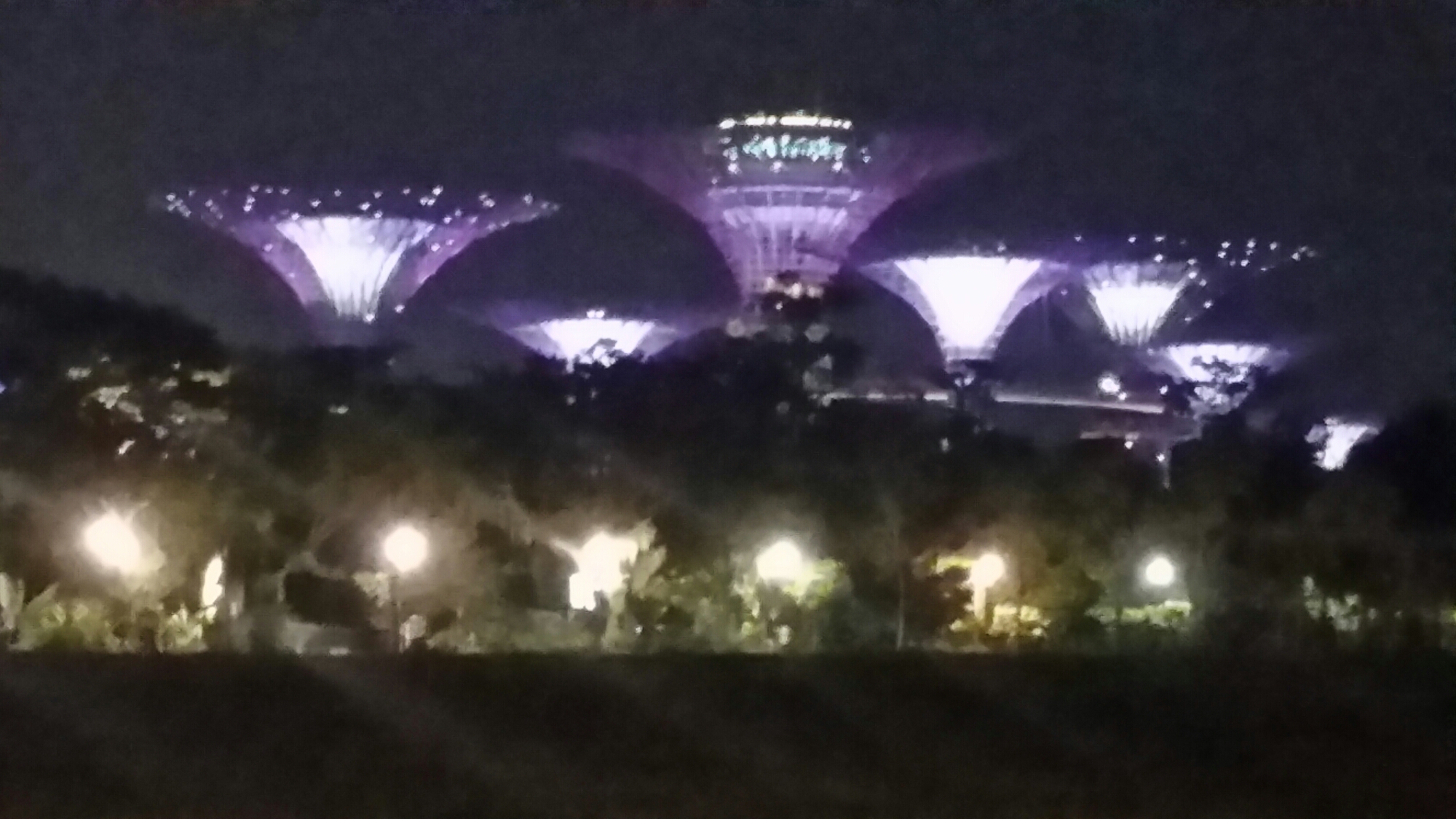
I walked through the Gardens by the Bay during the day and even more by night, pleasure gardens on a grand scale, in a tradition which goes back to Kew, full of exotica and buildings of no purpose, but a form of visual delight. This is a view by day:

And by night:
Richard Rogers RA
Richard Rogers gave the keynote address to a packed audience on the subject of ‘Citizens and the Compact City’. It was an extraordinarily impressive account of his career, ending where it could have begun with the house he designed for his parents in Wimbledon which was motivated by so many of the ideas which he has subsequently explored, including transparency, single span roofs, and a strong sense of community use even in a family house. Almost all of what he said seemed wholly relevant now: the use of brown field sites, opening up high streets, protecting green spaces. Of course, it’s all about use and planning and people as much as it is about architectural design, but that’s what has differentiated him as an urbanist (going back to Masaccio) from his peers.
Singapore (1)
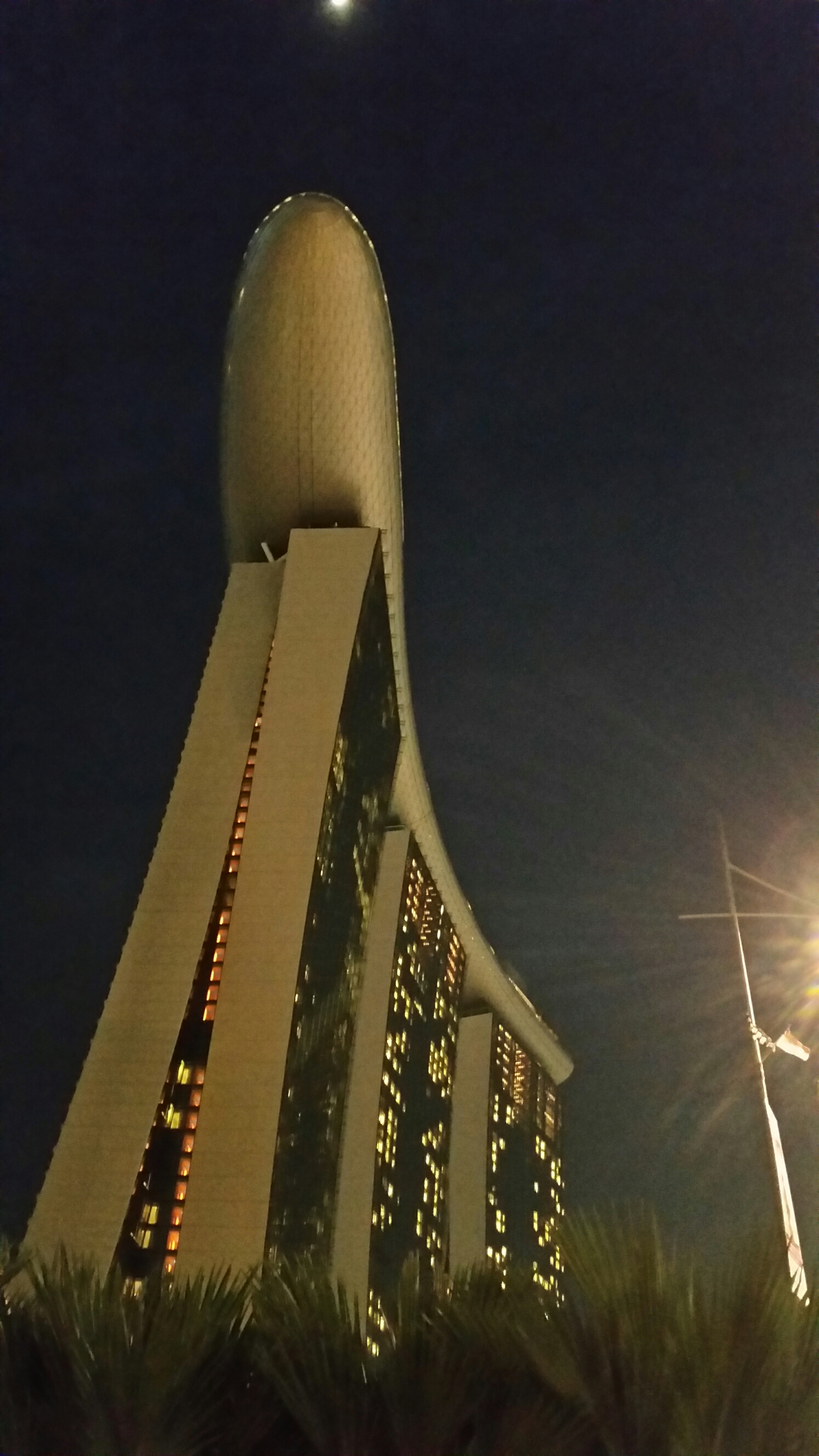
It’s slightly disconcerting to find myself being whisked by taxi from Changi airport straight into the centre of Singapore. I haven’t forgotten the shock of arriving first direct from Bangkok and experiencing the extraordinary contrast between the pandemonium of Bangkok and the Swiss-style order and neatness of Singapore where everything is immaculately planned and laid out through centralised planning by the Singapore Redevelopment Authority. I’m here for the World Architecture Festival, a grand talk-fest and awards-fest for the world of architecture, including Richard Rogers and Peter Cook and Moshe Safdie who designed the building we’re in (in three months):
Richard Wilson RA
En route to Singapore, I have seen for the first time Richard Wilson’s magnificent metalwork sculpture Slipstream which greets one as one arrives at Terminal 2. It’s a mixture between a whale and an alligator as if designed by Frank Gehry in an otherwise smoothly bland building by Spanish architects, Luis Vidal:


 | Charles | Saumarez | Smith |