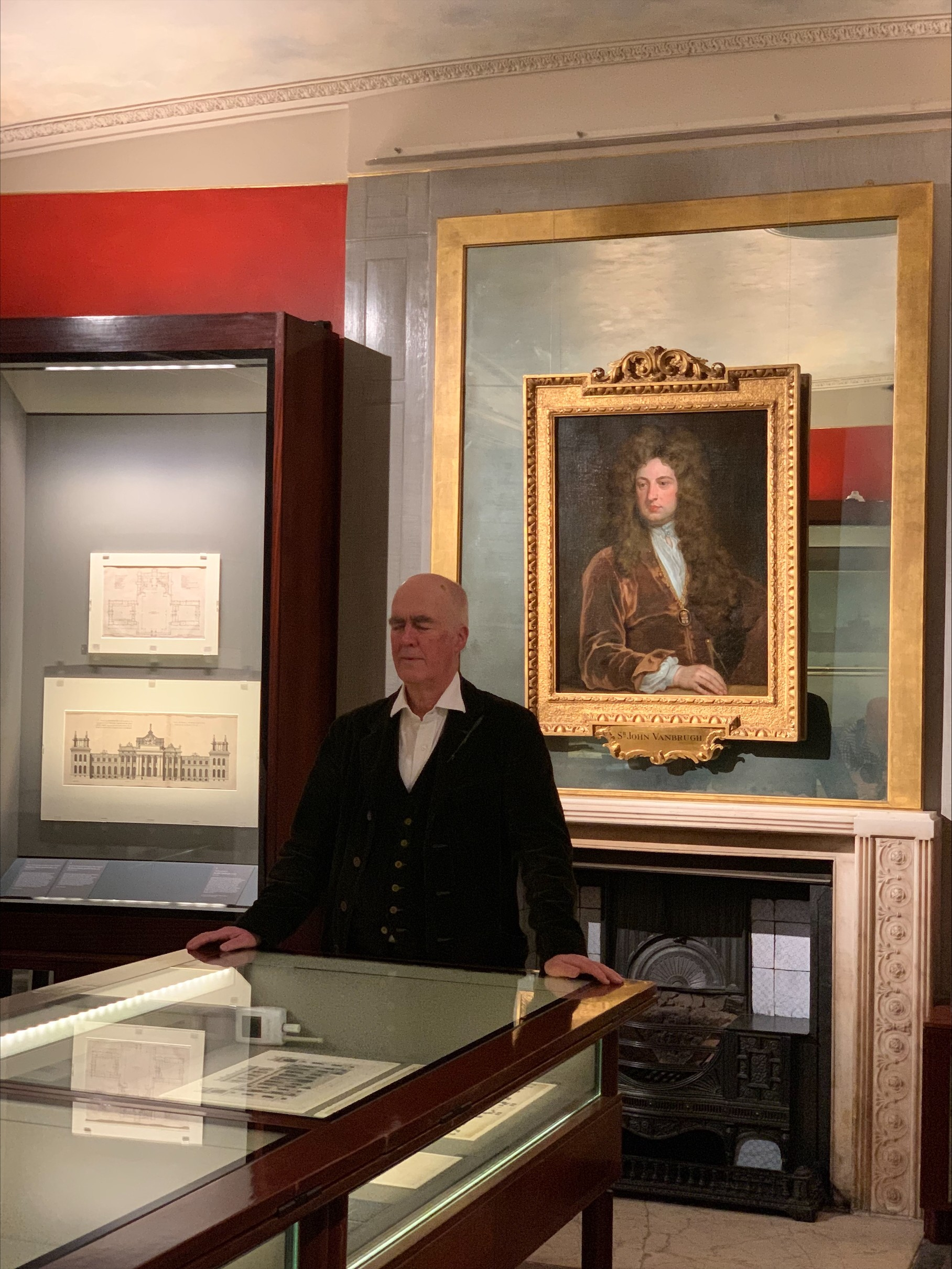
I hav been trying to find out whether or not Hawksmoor was a freemason, as he is generally assumed to be following Peter Ackroyd’s very convincing, but entirely fictitious invention of him as a necromancer. The answer, as I have discovered in a very informative Exeter University PhD. thesis by Richard Berman on The Architects of English Freemasonry, 1720-1740, is that he is listed as such in the Grand Lodge Minutes under the name ‘Hawkesmoor’; and that his future son-in-law, Nathaniel Blackerby, with whom he went on a trip round southern England in the early 1730s and who was to write his obituary in Reed’s Weekly Journal, was extremely active as a freemason, serving as Grand Warden in 1727 and Deputy Grand Master the following year, alongside his work as Treasurer to the Commission for Building Fifty New Churches. But as James Campbell, the expert on this topic, points out, Hawksmoor was only initiated in 1730 at the Oxford Arms in Ludgate Street, towards the end of his career, so it is implausible pace Ackroyd et. al. that it had any influence on his architectural ideas.
 | Charles | Saumarez | Smith |
Freemasonry is an overlooked aspect of 18th century culture
But it is a tricky area to investigate.
Yes. Agreed. Charles
I’ve always been very intrigued.
I’d be interested in thinking about a project on it, actually.
Like ‘religion’, a bit of a hot potato.
There’s much more freely available than there used to be, thanks to the internet and to the Freemasons themselves being very open to research. Charles