I have been reading an excellent book, Plaster Monuments and the Power of Reproduction by Mari Lending, a Norwegian architectural historian (it wasn’t on my reading list). It’s about the desire on the part of nineteenth-century museums to collect reproductions at least as much as originals in order to demonstrate the history of art in as systematic and comprehensive a way as possible.
Things I have learned from it:-
1. Winckelmann’s Thoughts on the Imitation of of Greek Works in Painting and Sculpture was inspired by a collection of casts in Dresden.
2. The collection of casts at the Pennsylvania Academy of Fine Arts was acquired before the majority of the cast collection at the RA by bulk order from Monsieur Getti, who was the official caster at the Musee Napeoleon (i.e. the Louvre).
3. Lord Elgin had casts made of the Elgin marbles before he removed them. These were used to show how much the originals had corroded between the time when they were acquired and an article in the Illustrated London News in 1929. This was partly why Duveen wanted them ‘restored’ when they were installed in his new galleries.
4. Friedrich August Stüler’s Neues Museum acquired its collection of casts from the Berlin Academy.
5. At the time of the foundation of the Metropolitan Museum, it was expected to be a collection of casts, not originals, on the grounds that it is ‘harder and harder to get hold of the chefs d’oeuvres of antiquity’. America was expected not to try and create ‘ideal and impossible museums, filled with masterpieces of original art, but museums mainly composed of reproductions’.
6. Edward Robinson, the fifth Director of the Metropolitan Museum, had previously been Director of the Museum of Fine Arts in Boston, but stood down when Isabella Stewart Gardner and others got rid of the casts from the MFA in 1905 while Robinson was away in Europe. He was promptly appointed Curator of Classical Art at the Met. and its Director in 1910.
7. One of the greatest collections of architectural casts, still extant, is the Hall of Architecture in the Carnegie Museum of Art in Pittsburgh, which was assembled at great speed at the behest of Andrew Carnegie. But no sooner had the Hall opened than John Beatty, who had assembled, lamented how the ‘Institute’s dependence on casts, reproductions, and paintings of a rather sentimental Victorian tradition would seem to be one of the weaknesses of the permanent collections’. This is the first sign of the institutional shift in taste against casts, motivated partly by changing tastes, but also by the increasing difficulty of obtaining casts, due to the reluctance of museums to allow their monuments to be copied. The change in attitude was evident at the same time in the Museum of Fine Arts in Boston’s determination to deaccession its cast collection.
8. Charles Swann much preferred his experience of the portal of the church at Balbec in the Musée de sculpture comparée in the Trocadéro to his experience of the real thing, frustrated by having to endure the reality of its surroundings.
9. Walter Benjamin was the first person to translate Proust into German. Benjamin saw the usefulness of photography in the experience of works of art since it ‘can bring out aspects of the original that are accessible only to the lens’.
10. Josef Albers chucked out all the casts he discovered on arrival at Yale’s School of Fine Arts in 1950 (the fine arts as a title was also chucked out and he made the nude models pose in their underpants and bra), but Paul Rudolph retrieved them from the basement of Street Hall to enliven the wall surfaces of his new brutalist Art and Architecture building.
The book is incidentally illustrated with wonderful images of cast collections, including those of the the Soane Museum, Crystal Palace and the Met (before and when they were sold off).
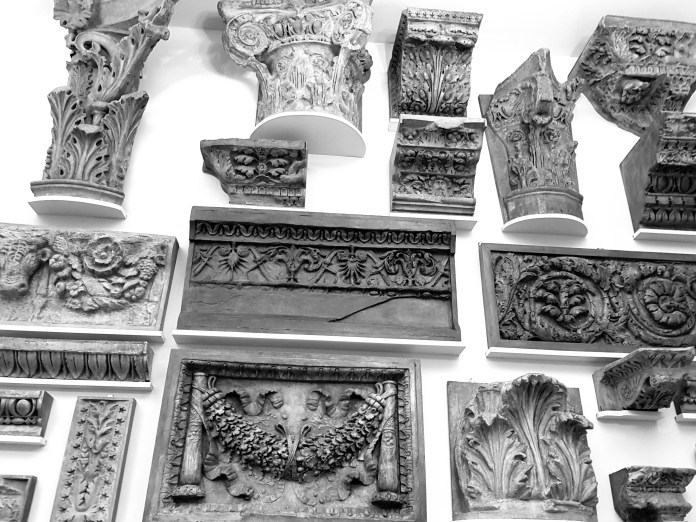
In its honour, I am posting a picture of our redisplay of Thomas Lawrence’s collection of Italian architectural casts which was previously boarded up in the RA Schools where the cast collection apparently narrowly escaped being chucked out as recently as 2000:-
And our cast of the Farnese Hercules, given to the RA by the Prince Regent in 1815, which has come out into the daylight to animate and vitalise the experience of the basement vaults:-


















You must be logged in to post a comment.