Liverpool Street Station (2)

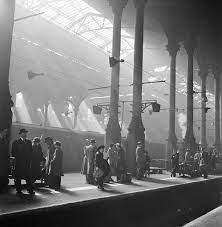
I could not remember the name of the photographer who illustrated John Betjeman’s book about London’s Historic Railway Stations. The book was published by John Murray in 1972 with photographs by John Gay, who was German, born in Karlsruhe, came to London in 1933. He immortalised Liverpool Street Station as it used to be:-

Standard

Liverpool Street Station (1)

I had not appreciated until this evening the enormity of the planned changes to Liverpool Street Station and, based on the accompanying article (assuming you are able to open it), it is hard to judge.

On the one hand, Liverpool Street is now surrounded by massive skyscrapers. Herzog and de Meuron are still amongst the best of the international big name architects, having started their career by designing a beautiful signal box in Basel. And I am perhaps unusual in being an admirer of the Shard, which was put up by Irvine Sellar, who founded the Sellar Property Group. Should one just accept that the City has now so changed its character that fighting to retain an important Victorian building is just hopelessly retardataire ?

On the other hand, I remember the late John Chesshyre fighting to preserve Liverpool Station in the 1970s, as did John Betjeman. They won ! The station has been preserved, a monument not least to the kindertransport, recorded in Sebald’s Austerlitz. Now, it is going to be totally submerged within a monster new development.

I am not convinced it’s a good idea.

https://www.architectsjournal.co.uk/news/herzog-de-meuron-reveals-plans-for-liverpool-street-station-towers

Standard

Henry Flitcroft

I have been reading Gill Hedley’s manuscript on Henry Flitcroft in advance of its publication. I found it fascinating how much can be discovered about a significant , but perhaps not earth-shattering architect who seems to have been successful not because he was in advance of taste, but precisely because he followed it and was able to provide fashionable architecture in a slightly cut-down fashion which very much appealed to his clients, but perhaps not to architectural historians. I recommend it.

https://georgiangroup.org.uk/2022/07/20/henry-flitcroft/

Standard

Looking to Sea

I have been reading Lily Le Brun’s Looking to Sea with the utmost pleasure: it’s so calm, so lucid, so well informed and beautifully well written. I have been trying to figure out its influences: not academic art history, because it is so much better written than most current art history, not trying to show off its learning, but actually a model of cultural studies – demonstrating how the way that particular, carefully selected and sometimes unexpected artists in the twentieth century, including Bridget Riley and Hamish Fulton, have responded to the sea can illuminate so much about the ways in which we view and respond to the environment more generally.

Standard

Perdendosi (2)

I chaired a talk last night organised by the Cambridge Literary Festival in the Fitzwilliam Museum in which the Scottish photographer, Norman McBeath, talked with Edmund de Waal about their publishing project, Perdendosi, in which McBeath documented the appearance of dying leaves in Edinburgh during lockdown in beautiful, austere, classical images and then approached de Waal if he would consider providing text to accompany them. De Waal was himself alone in his studio in West Norwood and has written evocative short prose poems about aspects of mortality and decay which work alongside the images in an effective reciprocal way. He then introduced the project to Daphne Astor who has created a small press based outside Cambridge, The Hazel Press, which mainly publishes poetry. The photographs are displayed in the ground floor ceramics galleries. And the book is available either online, or from the London Review Bookshop or John Sandoe, or up until Christmas in the Gagosian pop-up shop in the Burlington Arcade. It’s an ideal Christmas present !

Standard

The London Bell Foundry (5)

The latest on the Whitechapel Bell Foundry has appeared online (see below, but it may be behind a paywall). Our legal advice suggests that any lessee will need to reinstate a Bell Foundry in order to satisfy the requirements of the existing planning consent and we hope that Tower Hamlets will insist on this, assuming that some level of change is required to the existing fabric. So, we look forward to hearing what the alternative is to the proposal from The London Bell Foundry which has made an offer to lease the building from the current owners, Raycliff, and would move in forthwith.

https://www.theartnewspaper.com/2022/11/17/historic-london-bell-foundry-could-be-saved-from-hotel-development?s=09

Standard

Cambridge Literary Festival

If you’re in Cambridge this evening, I see there are still tickets available for Edmund de Wall in conversation with Norman McBeath, talking about the beautiful small book they have produced together, Perdendosi (https://www.cambridgeliteraryfestival.com/events/edmund-de-waal-perdendosi/).

Standard

The Red House (1)

I’m pleased to see that David Kohn’s Red House has been shortlisted as House of the Year – a very well-deserved accolade.

I’ve written about it for the December issue of The Critic, due to hit the newsstands probably at the end of next week.

https://www.bdonline.co.uk/news/david-kohn-and-rx-shortlisted-for-house-of-the-year/5120477.article?utm_medium=email&utm_campaign=Daily%20Building%20Design%20%20Daily%20news&utm_content=Daily%20Building%20Design%20%20Daily%20news+CID_111b5cc422c7ec27e17acd62b1277b2d&utm_source=Campaign%20Monitor%20emails&utm_term=David%20Kohn%20and%20RX%20shortlisted%20for%20House%20of%20the%20Year

Standard

Martin Parr

I came across a fascinating and vehement debate on Twitter about the virtues or otherwise of Martin Parr’s photography, based on the the work he did in New Brighton in the 1980s (see attached). This gives me the opportunity to thank him for allowing me to post a photograph he took of me in about 2008 at the RA (it’s one of the photographs in my headers). I had wanted him to take photographs of the RA’s Summer Exhibition which I felt would have suited his style of sardonic social photography as I was an admirer of the immediacy of his photographic style – social realism which I can now see might be regarded as possibly lacking in sympathy for his subjects. He’s surely both an interesting and important photographer with a very identifiable and, in its time, new approach.

https://www.magnumphotos.com/arts-culture/society-arts-culture/martin-parr-the-last-resort/

Standard