This morning, you could have listened to my conversation with Ed Vaizey. This afternoon, you can read what his mother, Marina Vaizey, the former long-standing critic of the Sunday Times, thinks of my book, which I know is a bit parti pris because as Ed revealed, and as I already knew, she is an enthusiastic reader of, and occasional commentator on (vide her comments yesterday on the Guggenheim Museum), my blog. But she adds her own interesting perspectives on many of the buildings I’ve written about.
For those of you who are having a nice long lie-in, you might enjoy Ed Vaizey’s weekly podcast which this week – thank you, Ed – covers the topic of what is happening in museums, as well as my book.
I sometimes feel as I listen that I am walking on eggshells as I am expected to know vastly much more about issues such as restitution than I really do, but the podcast has one great virtue, which is that he gave me an opportunity to describe and promote this blog, as well as my book, and I enjoyed the opportunity, as is probably obvious, to deal with such a wide range of current issues, if only summarily, but more than I was able to in the book.
We watched Ammonite last night, hoping to find out more about Mary Anning and her historically important discoveries of fossils on the beaches of Lyme Regis in the early nineteenth century and her rejection by the geological establishment in London. But, no, we had not read the blurb carefully enough. It is a very beautifully filmed, but 100% fictitious, account of a passionate affair she purportedly had with the smart young wife of an amateur paleontologist, who turns out from the reviews to have been a serious paleontologist herself. Great clothes, said to be historical, but possibly supplied by Old Town.
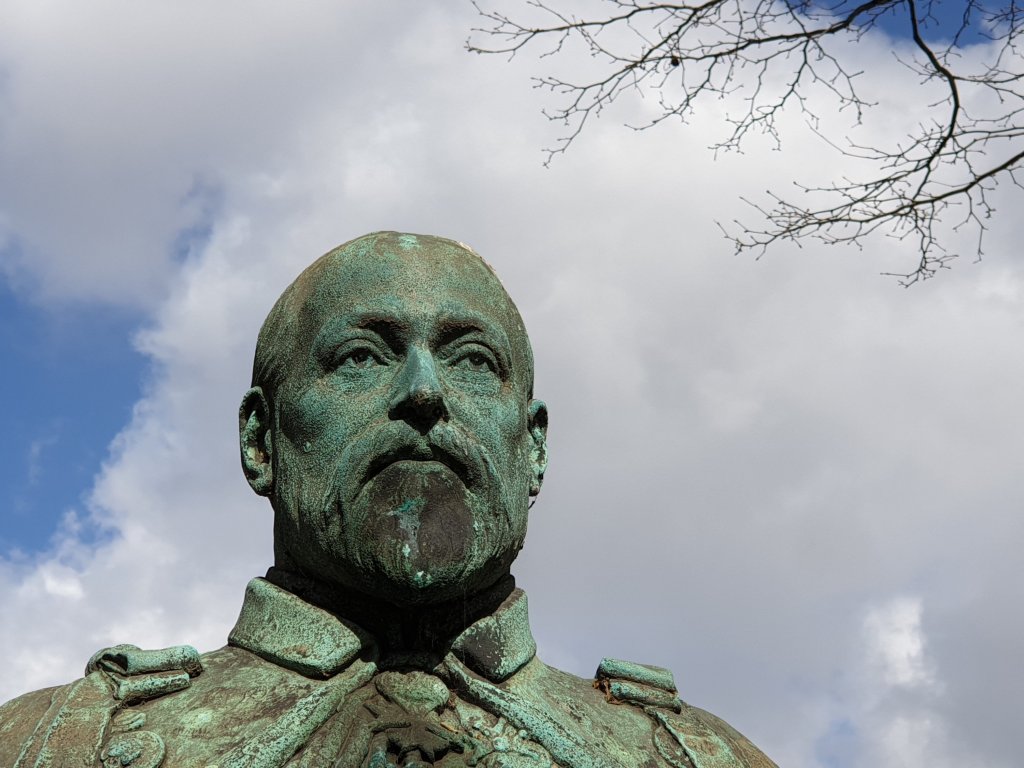
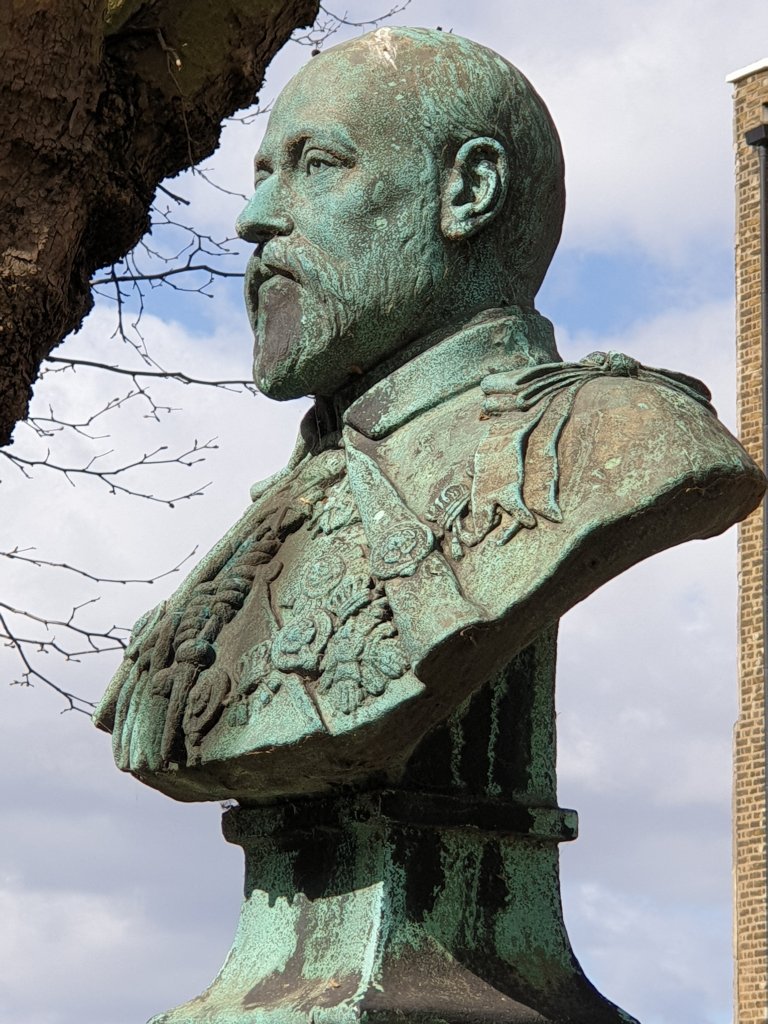
Funny thing. I had never noticed that there was quite a fine bust of Edward VII on the Mile End Road, not far from the statue of William Booth, but much less rhetorical. It was apparently ‘Erected by a few freemasons’ by a local firm, Harris and Sons of the Mile End Road. I hope it isn’t on the list of statues to be torn down, although he was certainly an Imperialist:-
I had an unexpectedly long chat with Robert Elms this morning about museums (https://www.bbc.co.uk/sounds/play/p098ppml) (I was on at about 10.35), starting with our joint experience of Tate Modern, which was so important in transforming people’s attitudes not just to museums, but to contemporary art more generally. We talked about the Museum of Modern Art, so incredibly important in the way it was about the modern and contemporary, originally more about exhibitions than establishing a collection, particularly when one remembers that it was started in 1929, only opening its new building on 53rd. Street ten years later. He was sceptical about the Guggenheim in Bilbao, as some people are, but it has certainly been extraordinarily successful in attracting visitors, not just to the museum, but to Bilbao more generally, and it has also always had an adventurous programme of exhibitions. Then, we talked about some of the museums I maybe should have included. I did think of including Kettle’s Yard and, in retrospect, maybe should have done: so important for its domestic setting and so influential in providing an alternative model for the display of art to the Fitzwilliam. And I now feel badly not having included Yorkshire Sculpture Park, which must have been very pioneering in the way that it showed art in the landscape. Maybe I can do a second edition.
I know you will all be getting absolutely sick of the number of posts I have been doing about my book, but publication day only comes once in a blue moon and I have now spotted that Pentagram have done a very nice piece on their website about its design (https://www.pentagram.com/work/the-art-museum-in-modern-times/story).
As it says, I have worked with Harry Pearce both at the Royal Academy and in the design of the book (now, sadly, out of print) which I did, also for Thames and Hudson, on East London. Following this, he was recruited to do the redesign of Thames and Hudson’s typographic identity, a job of exceptional significance given Thames and Hudson’s long-established involvement in issues of book and graphic design. I felt that the design of the book strangely benefitted from lockdown because of the amount of time he and his assistant designer, Johannes Grimond, were able to devote to its look and layout, tweaking the relationship of image to text and the overall visual layout jointly with Johanna Neurath, the Director of Design at Thames and Hudson, in a way which immeasurably enhances it and gives it a very distinctive visual character.
I did not know the sans-serif typeface they used, as I probably should have done – Paul Renner’s Futura. Renner was a member of the Deutsche Werkbund, published books on typography in the early 1920s and designed Futura in 1927. Since the first museum I cover is MoMA, which itself has had such an identifiable modernist typographic tradition, there is a subtle – or perhaps not so subtle – homage in the look and feel of the book to the legacy of Alfred Barr.
My thoughts on museums and how I got interested in their architecture are now live on the Thames and Hudson website, together with some of the very beautiful images used in the book (actually, they look even better online than in the book):-
A touching and thoughtful review of my book has just appeared unexpectedly on my screen on the official day of its publication. I am particularly pleased that Daniel Baksi commends the choice of images, which gave me the utmost pleasure – picture of architects, donors and museum directors, which are very easy to find online, if hell for my poor picture researcher to have had to negotiate; and the quality of the book’s typographically luscious design by Pentagram. As he rightly says, there are plenty of other people who can do the dirty work of deconstruction.
One of my greatest pleasures in the last few weeks was a long conversation with Romas Viesulas, based in Lisbon, both about my museum book, but more about the books which influenced me while writing it and a couple of books which were being written more or less in parallel.
I feel badly about recommending the book by Michael Govan because it is not easily obtainable, but very revealing of the ideas of the group influenced by Tom Krens at Williams College who have done so much to change the priorities of the museum – from an encyclopedia to a poem, as Govan describes it.


 | Charles | Saumarez | Smith |
You must be logged in to post a comment.