The Warren

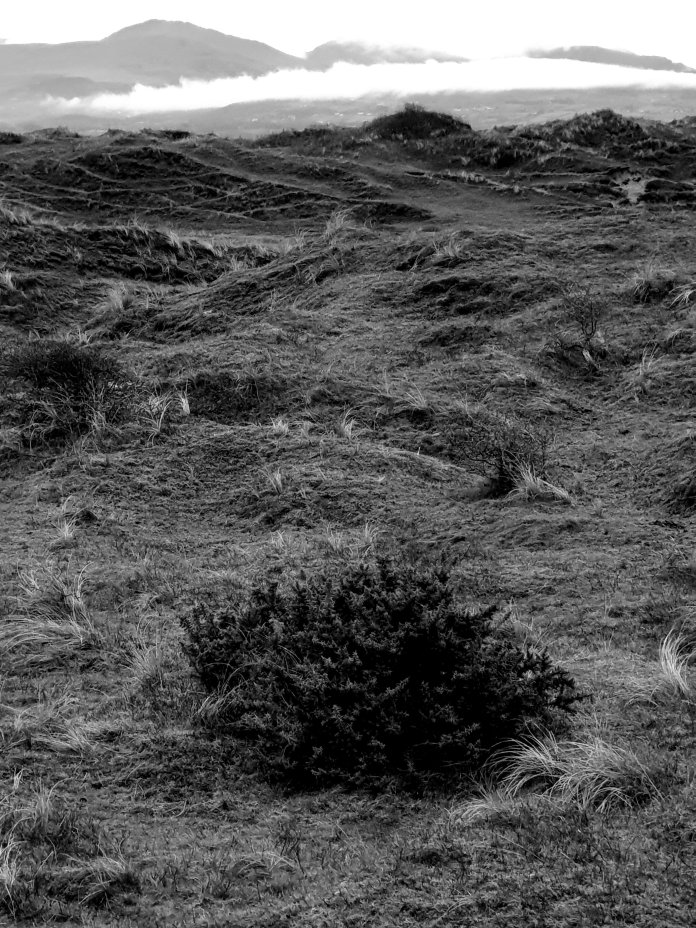
It’s a long time since I’ve walked across the Warren – an area of wild and bleak, grassed over duneland, where it used to be easy to get lost, although now it’s well signposted.

I walked first downriver towards Abermenai:-

Then, I doubled back across the Warren:-

Until it began to get dark:-

Standard

St. Dunstan’s, Stepney

I had always assumed that the churchyard of St. Dunstan’s, which I walk through nearly every weekend, was a creation of the post-war, when I thought the tombs would have have been moved to allow for the erection of temporary prefabs. But I have just learned from a tweet by Alice Rawsthorn that I was quite wrong. The churchyard closed for burials in 1854 and the tombs were moved between 1885 and 1887 to allow for landscaping by Fanny Rollo Wilkinson, who, after training at the Crystal Palace School of Landscape Gardening and Practical Horticulture, was appointed honorary landscape gardener of the Metropolitan Parks and Gardens Association, as well as working for the Kyrle Society which brought beauty to the lives of the poor. I will look at it differently in future, as a Victorian amenity rather than a bit of slum clearance.

Standard

The end of the line

It was my last day at the RA today: my desk has been cleared and is now no longer my desk (it’s the Secretary’s desk, designed as if for an official in the Indian Empire); there were a small number of people still working as I did a last round to say goodbye; then I handed in my staff pass, rather battered with a photograph showing me younger and fresher faced, as I was eleven years ago. More than a sixth of my life, I thought, as I walked through the courtyard for the last time as a member of staff.

Next stop, Hanover Square.

Standard

Staff Christmas Party

One of the things that the RA has always done well is celebrate Christmas (well, of course, now it does everything well). I remember my astonishment when I first arrived to discover that much of the inventiveness and creativity of the staff was devoted to making costumes based on an exhibition From Russia, which at the time hadn’t happened and was under threat of not doing so. I went as a Russian general. This year, the Christmas party doubled as my leaving party and I had the infinite sadness of watching a short, but brilliant film of my doppelgangers everywhere in the RA. No more. My office has been packed up. My intray has been emptied. All that remains is for me to return my outfit to the National Theatre costume store and say farewell.

Standard

The Revamp

I was pleased to see that Olly Wainwright listed the changes at the RA amongst his top ten architectural buildings of 2018:-

https://www.theguardian.com/artanddesign/2018/dec/19/top-10-architecture-of-2018.

We’ve had over a million visitors in the seven months since Burlington Gardens opened on May 19th. – not bad for an institution which normally only gets a million visitors in a year as a whole – and over 100,000 to the new Collections Gallery.

I’m also pleased that he acknowledges the symbolic significance of opening up the Royal Academy Schools.   This was always at the heart of David Chipperfield’s idea for the project, based on his belief that American museums needed to encourage an understanding of art as a practice, not just a finished result.

Standard

The New Jerusalem Bible

As a footnote to the comments and complaints (my own included) about modern translations of the Bible, I remembered that my father was in some way involved with the New Jerusalem Bible. He was. After retiring from his job with the C of E, he was employed as an editorial consultant to Darton, Longman and Todd, responsible for updating the Jerusalem Bible in line with modern biblical scholarship, basing the translation as far as possible on the original Hebrew. In the summer of 1978, he recruited Dom Henry Wansborough, a monk at Ampleforth, to look over the Letter to the Hebrews and he took over the project as a whole, taking seven years on the project, four hours a day. The problem with the translation seems to have been that it was done for purposes of scholarly study, not reading aloud, concentrating on archaeological accuracy in its use of language, not resonance, clarity and sonority.

Standard

Westminster Cathedral (2)

I omitted to mention that one reads the lesson from the gigantic Cosmatesque pulpit, enlarged in 1934 by L.H. Shattuck to accommodate the retinue of clerics who accompanied Cardinal Francis Bourne, the fourth Archbishop, as he preached, and that the effect of the bright lighting is that one can see nothing of the large congregation. This maybe is an advantage.

Standard

Westminster Cathedral (1)

I was asked to read the final lesson in one of Westminster Cathedral’s annual carol services, a slightly terrifying experience for a non-Catholic to read the opening of St. John’s gospel in a modern translation (the New Jerusalem Bible) when the St. James’s version is so well known. But everything else was wonderful: the full panoply of the modern Catholic church, with two Bach cantatas (140, translated by Richard Stokes, and 110), a long Excelsis by Haydn sung by a treble solo, and a beautiful Poulenc Christmas Responsory, all performed with full choir and orchestra in J.F. Bentley’s chancel.

Standard

Tom Monnington PRA

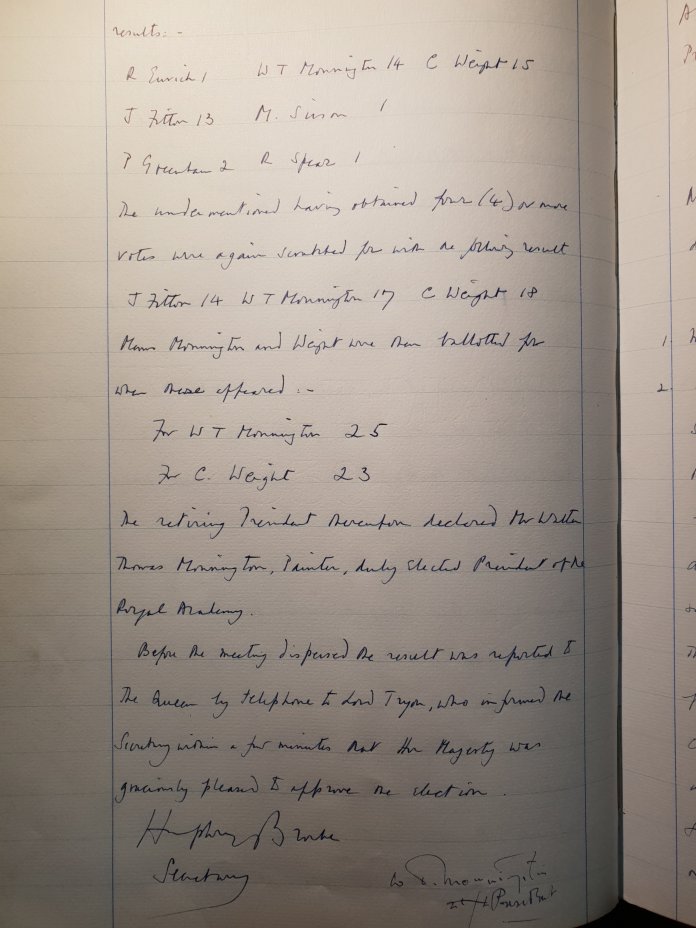
We had a visit this morning from the son of Tom Monnington PRA, a realist painter who was trained at the Slade by Henry Tonks, turned to geometrical abstraction after the war and was elected President of the Royal Academy in 1966 (as became clear from the minutes of his election, by only a narrow margin over Carel Weight):-

My impression is that Monnington began the modernisation of the RA, by encouraging public visits to what had previously been treated as a purely private institution, celebrating its 200th. anniversary with an exhibition on the Bauhaus, and, not least, encouraging Bryan Kneale to do the exhibition British Sculptors ’72, a landmark.

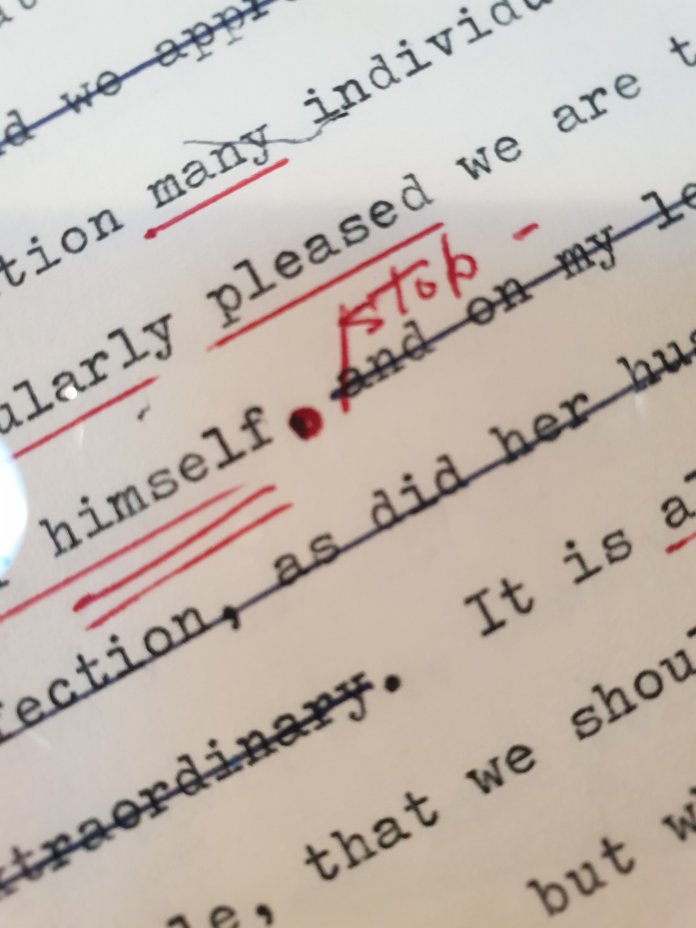
These were his notes for speeches:-

Standard

Co-education

I took slightly longer than usual to get into work today because I became unexpectedly engrossed in my old school magazine, which, since it happened fifty years ago, is devoted to the advent of co-education at Marlborough College.   The girls were described as ‘the icing on the cake’.   ‘This school is a boys’ school and will remain a boys’ school, but it will be a better boys’ school for having a few girls in it’.   The attitudes towards co-education were, in retrospect, antediluvian, but it was at least a small step in the right direction.   Fifteen girls arrived amongst 800 boys.   I was at a disadvantage being small, stunted and scrofulous.   It was September 1968.

Standard