
In trying to find out more about the work of William Barnes as Director of Housing at Camden from 1 January 1971 (I learned the date from a booklet he produced about his work called A Londoner’s Lot), I bought a copy of Mark Swenarton’s incredibly impressive Cook’s Camden: The Making of Modern Housing. I discovered nothing about Barnes who is not even listed in the index, but a great deal about Neave Brown, including the fact that, although an American, he was educated at Marlborough before being encouraged by Bill Howell, a fellow old Marlburian, to study at the AA; and that he himself lived in his first group of houses in Winscombe Road, which he designed in private practice, and that the other residents (there were only five houses and a communal garden) included Ed and Beattie Jones and Michael and Patty Hopkins – an architects’ utopia.
William Barnes
The death of Neave Brown, the architect of such good public housing, reminds me that I have occasionally meant to write something about my late lamented godfather, William Barnes, who was Director of Housing for Camden when construction began on the Alexandra Road estate. I thought I remembered going to lunch with him in the summer of 1972 and him showing me the Alexandra Road estate with the utmost pride, but the dates don’t work. I had also understood that he ended up being rather unpopular with the Council (too patrician, too high minded), but the attached blog suggests this was not so and that he resigned because the policies of the incoming Thatcher government made his work impossible. See https://redbrickblog.wordpress.com/2011/09/04/when-housing-policy-was-truly-ambitious-in-memory-of-william-barnes/. He was also responsible for establishing the London Business School.
RA250
In the interests of providing full information about activities the RA is in some way involved with or supporting round the country in our 250th. year, wonderfully supported by the generosity of the Art Fund, I am posting the link to our website which lists the full panoply of activities country-wide, together with a digital map of their location (https://www.royalacademy.org.uk/ra250uk).
Art UK (2)
Just before Christmas, I wrote a post about the new facility on Art UK which enables one to identify the location of all the works by RAs in British public collections, all 25,000 of them. When I got back from Christmas, I discovered that I had committed myself to writing about some aspect of Art UK’s involvement in our 250th. anniversary. I chose to write at greater length about the benefits of the facility, what one can discover hidden away in British collections, and to celebrate those Cambridge colleges who have agreed to their collections being listed. See https://artuk.org/about/blog/royal-academicians-on-art-uk-celebrated-for-ra250
London Library
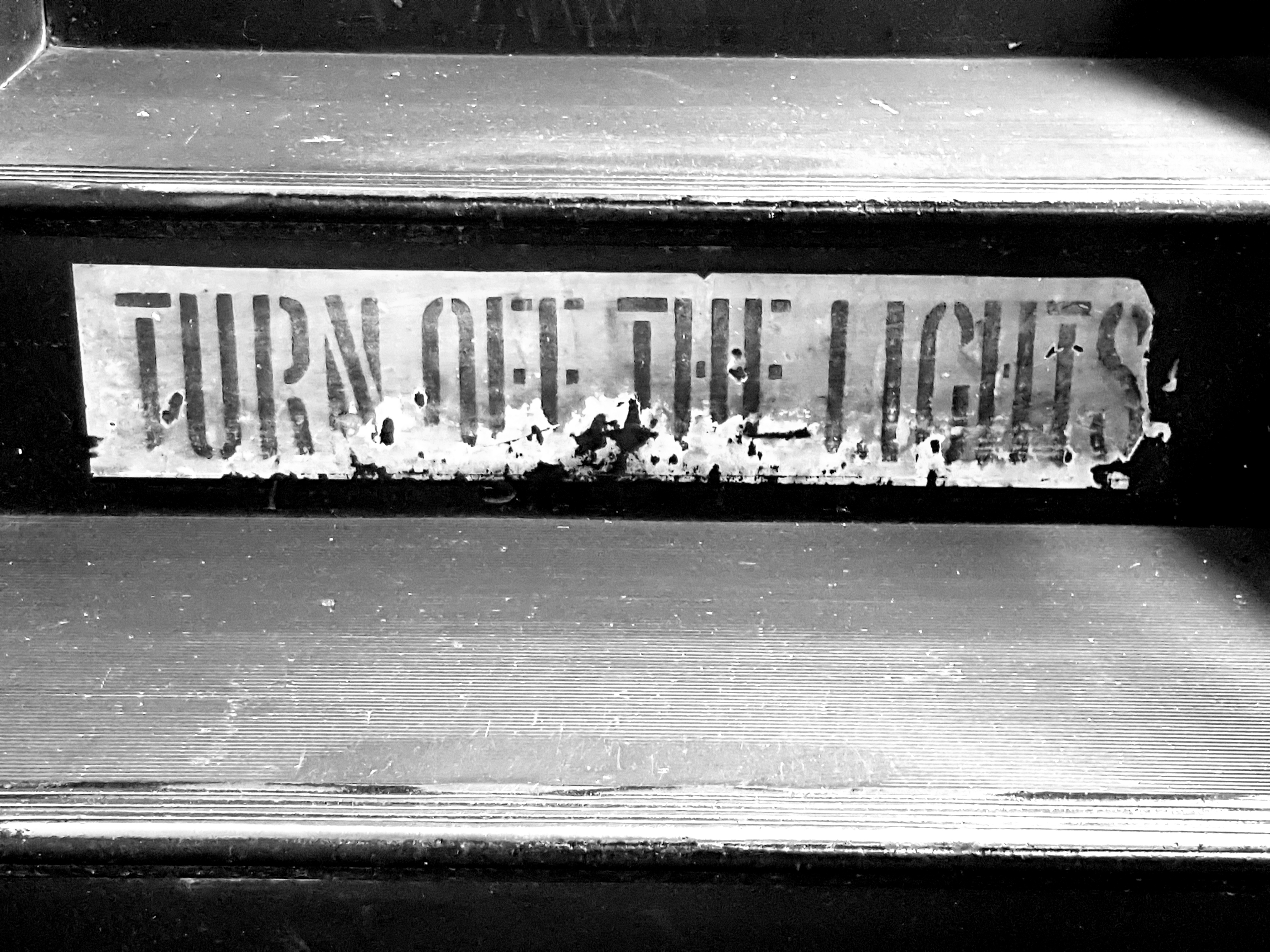
I called in on the London Library after work, partly to deliver some books (my Christmas reading) and to pick up some more (my New Year’s resolution). Because it was after dark, I was even more impressed than usual by the number of signs telling me to TURN OFF THE LIGHTS, which looked as if they might have been put up in war-time, when there was a hunger for reading and a prohibition on lighting:-




Art talks
I was walking past the security box in our backyard just now and I saw in the window a series of slogans:-
Art builds
Art questions
Art transcends
Art works
I thought: is this our new corporate identity ? No, it turned out to be an envelope from Deutsche Bank.

Mile End Vestry Hall
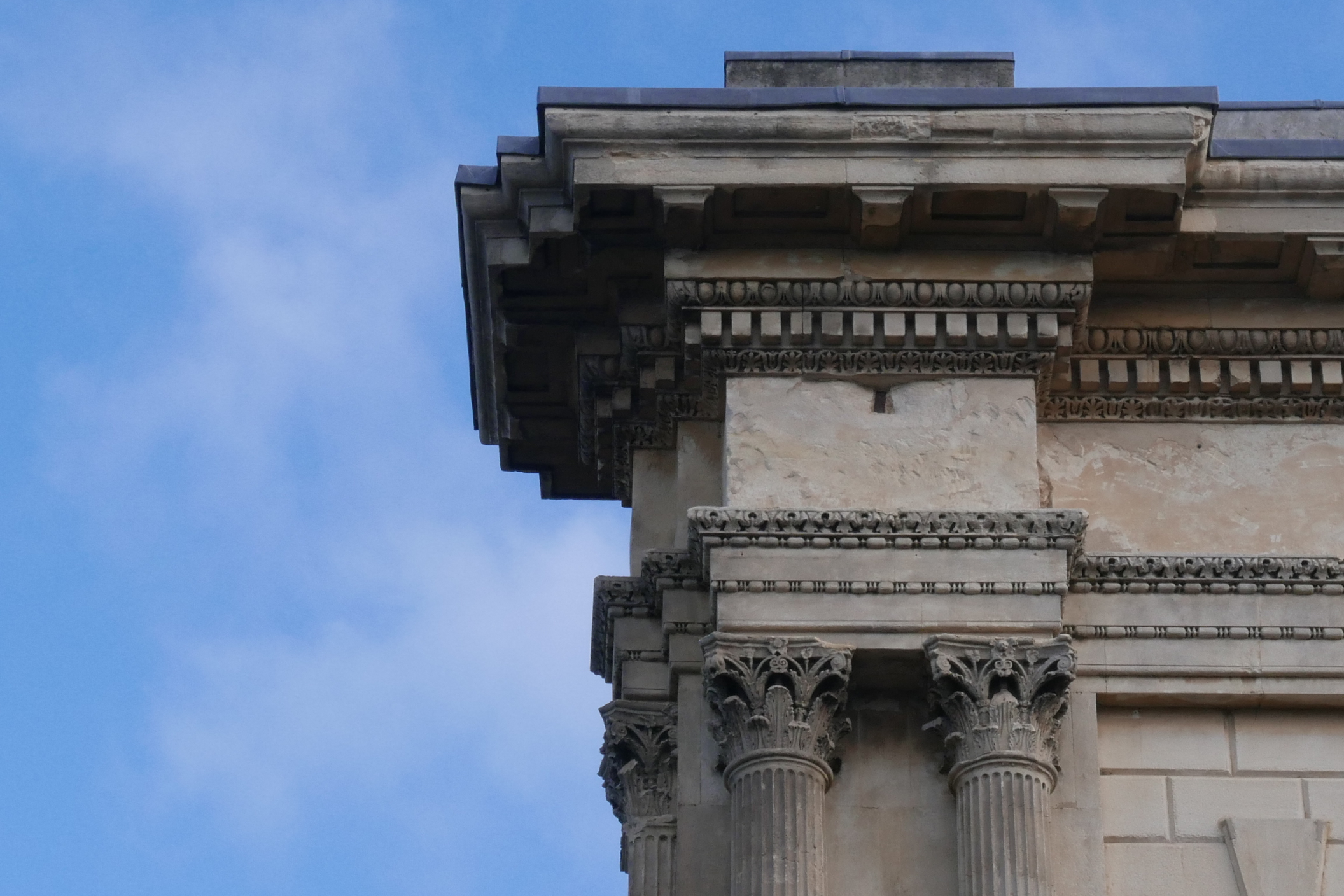
Every so often on my Sunday morning walks, I go past the old Mile End Vestry Hall in Bancroft Road and am invariably impressed by the quality of its classical detailing. Pevsner is a bit snooty about this style of architecture, describing it merely as a liberal interpretation of an Italian Renaissance style, ’emulating the solid Italianate popularized by Charles Barry’s Traveller’s Club in the 1840s’, but I am impressed by how little known the architect is – J.M. Knight who was also responsible for the local Board offices in Leyton twenty years later – and well considered the detailing:-

Burlington Gardens
I have spent the last week moving back both physically and psychologically to Burlington Gardens, our new or old offices, depending on which way you look at it – actually, I have moved back into my old office, but carved in half, so that the half which is a meeting room can be used independently of the office. I’m pleased to have my old desk back, which was once upon a time the Secretary’s desk but, when I arrived at the RA, had been long in store. It has a certain stately magnificence to it, with ample places to put one’s ink, now redundant. I have also been sorting out the books which had accumulated while in Blackfriars – old catalogues and guides to foreign collections, as well as Walter Lamb’s copy of Dictionary of Foreign Phrases and Classical Quotations, published in 1913 (Lamb was my predecessor as Secretary from 1913 to 1951, a mere 38 years). I like some of the juxtapositions which arise in the course of shelving: Michael Sandle next to Rodin; Henry Rushbury next to John Downman. Not least, I’m pleased to have located one of the twelve copies of a short story by Tony Lambton which was printed by Ian Mortimer on vellum, illustrated by Gerald Mynott, and bound by Romilly SS.
Gavin Stamp (2)
Since historians are beginning to document the early stages of post-modernism, it is perhaps worth mentioning Gavin Stamp’s role in the radical reappraisal of modernism which took place in the early 1970s. By the mid-1970s when I first met him, he was already a veteran of conservation campaigns with the Victorian Society, a convert to Ian Nairn (he bought his copy of Nairn’s London in the Elephant and Castle), and, as I learn from his obituary in the Daily Telegraph, a drinking companion of John Betjeman, dressed in three-piece, pin-striped suits with a fob watch and bell bottoms. He was certainly one of the people who was instrumental in the reappraisal of Lutyens, involved in the Lutyens exhibition at the Hayward Gallery in 1981, which was surely a key moment in the shift of attitudes to architectural history, as designed by Piers Gough, and he had wanted to go on to organise a Vanbrugh exhibition at the RA. I think of him as if he was drawn by Tenniel and have been trying to find out the whereabouts of the painting of him by either Glyn Boyd Harte or Lawrence Mynott which was exhibited at the RA at the time.
Gavin Stamp (1)
I have only just heard, very belatedly, of the death of Gavin Stamp on December 30th. He was my supervisor for a course on Victorian architecture in autumn 1975 (or it could have been Spring 1976) when I now realise he was only 27, studying for his Ph.D on George Gilbert Scott, junior. But he always seemed at least a generation older, already a veteran of the Victorian Society and physically slightly larger than life. I saw him only rarely since, but continued to admire him from a distance and lived in hope of his long awaited alternative history of twentieth-century British architecture. He came and gave a paper on Hawksmoor at a symposium I organised in the 1980s at St. Anne’s, Limehouse. He walked in to our kitchen and said ‘I’m not surprised you’re repainting this. It’s a horrible colour’. Romilly was in the process of painting it Moroccan Turquoise. He taught Otto as well at Cambridge, a mere thirty years or so after he had taught me.
 | Charles | Saumarez | Smith |
You must be logged in to post a comment.