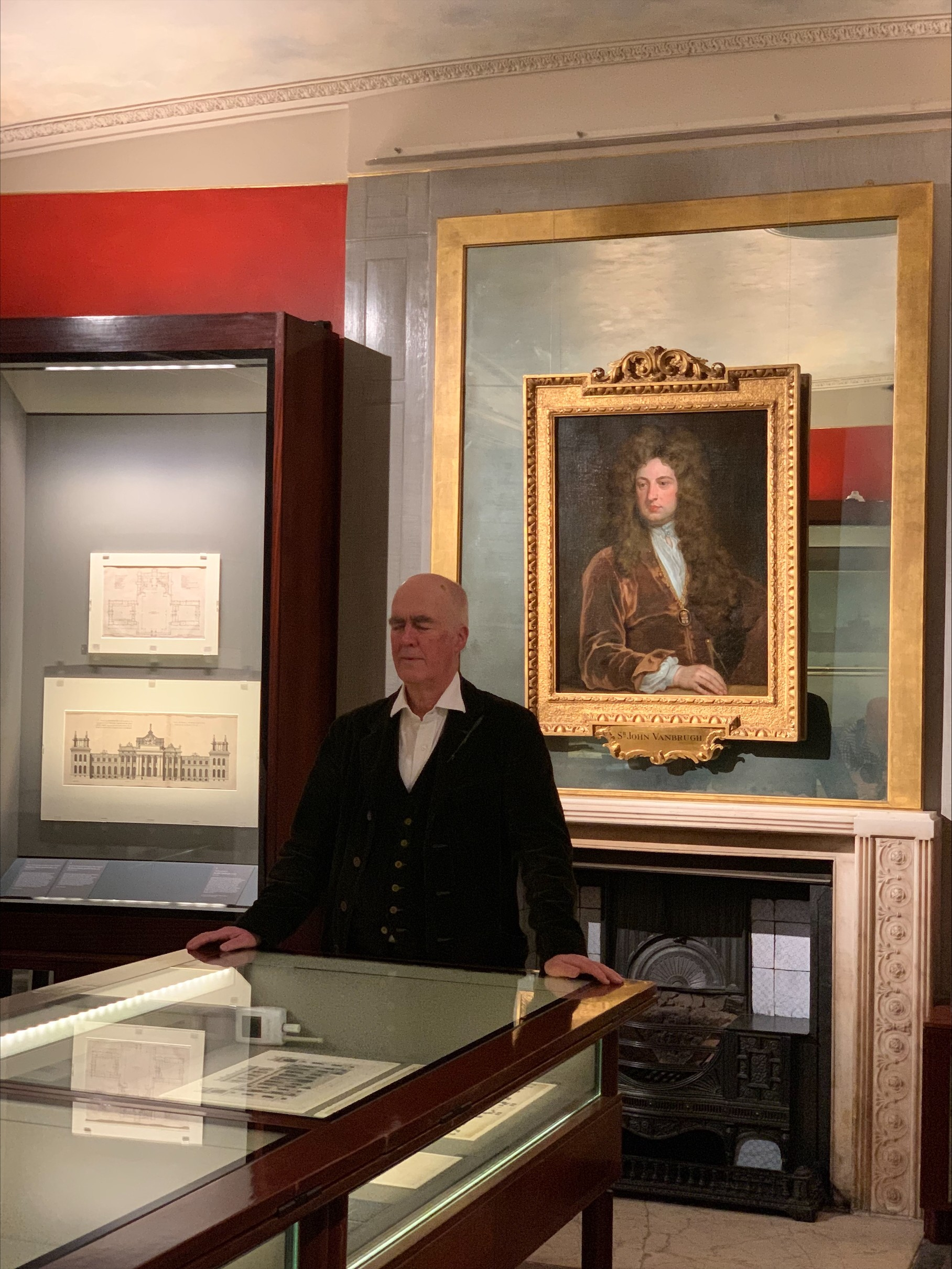
Blenheim Palace has done Vanbrugh proud with an interactive exhibition of all aspects of his life, but particularly the problems with the construction of Blenheim and information about the building technologies and craftsmen involved.
It is maybe oddly helped by the fact that the roof of Blenheim is being reconstructed:-
In the entrance hall, you get to meet Vanbrugh:-
Then, you are able to tour through the private apartments. And there are brilliant animatronics based on the vitriolic letters between Vanbrugh and the Duchess of Marlborough.
Well, I suppose it was totally predictable that the City’s planning committee would give permission to the monstrous proposals for the development of Liverpool Street Station. After all, they give permission to 98% of the projects which are presented to them.
In other words, they are a rubber stamp.
I have written what I think of the project for Apollo in case you have a subscription:-
Following the award of the RIBA Gold Medal to Níall McLaughlin, I thought I would have a look at the housing scheme he did for the Peabody Trust, a relatively early work, commissioned in 2001 following a competition restricted to young architects.
It’s in Silvertown which feels a long way away, just south of Royal Victoria Dock, next to the vast and still undeveloped Millennium Mills and surrounded by housing from the 1980s. It was done in collaboration with an artist, Martin Richman, who suggested the dichroic film panels. It’s a little bit surreal – a piece of experimental modern architecture in an area of urban wasteland:-
I walked past Islington’s South Library this afternoon with its beautiful brickwork and monumental entrance, an unexpected piece of English baroque detailing.
Perhaps unsurprisingly, I find it was designed by Mervyn Macartney, who was Surveyor of St. Paul’s Cathedral, so an expert on Wren, publishing a book on Later RenaissanceArchitecture in England in 1901.
The library was finished in 1916, not a good year for architecture and was immediately taken over as a Food Control Office:-
In revisiting Marlborough, I surprised the librarian by asked about the seventeenth-century library which was concealed behind a locked door of one of the classrooms. I could see that he was a bit sceptical.
I have managed to verify its existence. It was the library of the vicars of St. Mary’s, Marlborough bequeathed to the town by the Rev. William White in 1678. It must have been stored by the school and was looked after by Edwin Kempson who taught maths (before my time), had been a mountaineer, and was Mayor of Marlborough.
It was transferred on loan to the Bodleian in 1985 which is why its existence in the School has been forgotten.
Littlecote is a big rambling Elizabethan house in the Kennet valley, the majority of it built by William Darrell from 1583.
We approached from the west. The chapel to the north (left in the picture) is medieval: the conservatory to the south was added in 1809:-
There is topiary in the garden:-
Inside, we started in the Dutch parlour, a fascinating room with seventeenth-century genre paintings on the walls and what look like a more sophisticated, Italianate painting on the ceiling. The Dutch paintings are traditionally said to have been done by Dutch prisoners-of-war during the second Anglo-Dutch War. Recently, it has been suggested that they are later and could conceivably have been painted by the young Hogarth which looks implausible. Either way they are fascinating.
The ceiling painting:-
The wall paintings:-
Then you come into the Brick Parlour which has a surreal installation which the guide books don’t mention and date back to Peter de Savary’s attempts in the 1980s after all the armour collection was bought by the Royal Armouries to turn the house into some kind of folk museum:-
Beyond, the chapel is also fascinating, a Cromwellian survival:-
It altogether looks as if it deserves more investigation, since the entry in Pevsner does not give much information about the recent history of the house, nor the paintings.
It’s a long time since I’ve been to Mildenhall Church, down a lane in the Kennet valley – so beautifully preserved with its Gothick or early Gothic revival pews and twin pulpit, half way between Batty Langley and Pugin.
You must be logged in to post a comment.