Benjamin Franklin College

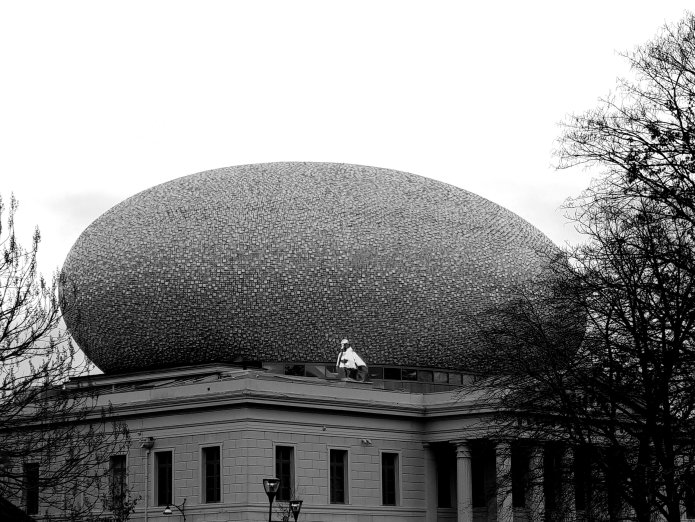
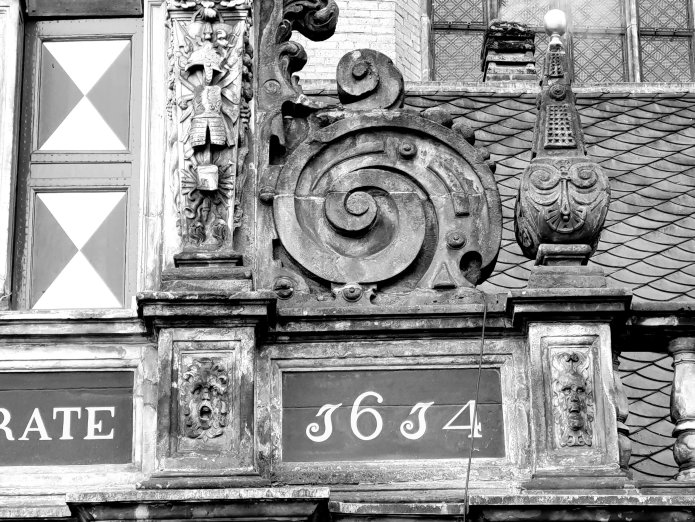
Last time I was in New Haven, there was much discussion of the architecture of the brand new colleges, Pauli Murray and Benjamin Franklin, designed by Robert Stern, Yale’s former Dean of Architecture, in homage to the work of James Gamble Rogers, the late Gothic Revivalist, whose work dominated Yale in the 1920s and 1930s. I am not usually persuaded by these exercises in collegiate faux gothic (eg Demetri Porphyrios at Magdalen College, Oxford), but this is done with confidence and brio as Gothic Survival, not Gothic Revival:-
image

image

image

image

Standard

Arts and Crafts Exhibition

A daytime flight to New York made it possible for me to get to grips with Jessica Douglas-Home’s fascinating biography of William Simmonds, the painter/sculptor/puppet-maker who was trained at the Royal Academy before the first world war and then worked as an assistant to Edwin Austin Abbey in Fairford and helped on the detailed design of the tank during the war.   I only half knew that in 1915, at the height of the First World War and despite opposition from the RA itself, the Arts and Crafts Exhibition Society mounted a big exhibition at Burlington House which, in spite of late opening, a blackout, no catalogue and Zeppelin attacks, was a huge success, including a gallery devoted to the work of William Morris, Burne-Jones and Walter Crane and work by Gimson, Barnsley, Arnold Dolmetsch and Henry Wilson, the Society’s President.

Standard

Viand

Thank goodness for the New York diner.   There’s a classic on Madison Avenue, just down from Hermes.   I hate to think what the rent must be.   I could have ordered Corned Beef Hash, but didn’t:-

image

Standard

Gillian Ayres RA (2)

I may have posted the attached before, but had forgotten that the piece I wrote about Gillian for her last exhibition in Beijing is available online:-

https://www.royalacademy.org.uk/article/tribute-to-gillian-ayres-ra

Standard

Gillian Ayres RA (1)

We had a send-off for Gillian Ayres, no church service, just a semi-institutionalised wake.   It was quite clear that we should have served gin and tonic, not elderflower cordial, because nearly every speaker referred to that as her favourite drink, along with the sixty cigarettes a day.   The President spoke, her son Sam, Shirley Conran, her accountant, a lawyer who collected her paintings:  all made clear what a wonderful, anarchic, anti-establishment, warm-hearted rebel she was, as a person as well as in paint.

Standard

Argyll House

I didn’t include Argyll House in my description of Westcliff-on-Sea because I couldn’t find out anything about it:  that’s because I only had my copy of the original 1954 Pevsner, which would have spurned an example of seaside moderne, not James Bettley’s huge and revised 2007 edition which tells me  that it was designed by Howis and Belcham (they specialised in cinema design) in 1937:-

image

Standard

The Lovelace Courtyard

We had a small event at lunchtime today to unveil a plaque in the Lovelace Courtyard, designed by Gary Breeze:-

image

It celebrates the gift which made possible the design and planting in the space in between Burlington House and Burlington Gardens which used to be known as Nun’s Walk (the ghost of the nun is apparently no longer seen).   It’s a very simple design by the Belgian designer Peter Wirtz:  cobbles and grass and a semi-circular path;  but so satisfying as seen from the Weston bridge, a small bit of green space in the heart of the city:-

image

image

Standard

Leigh-on-Sea (2)

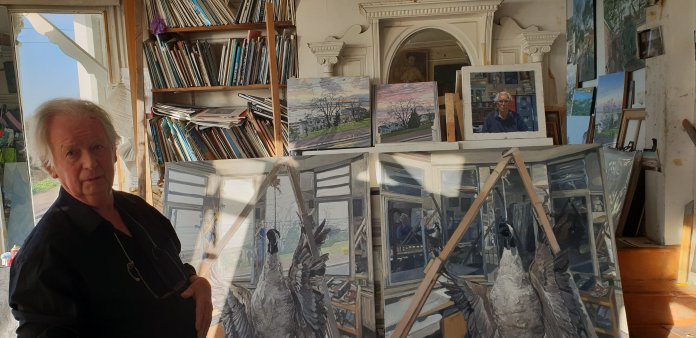
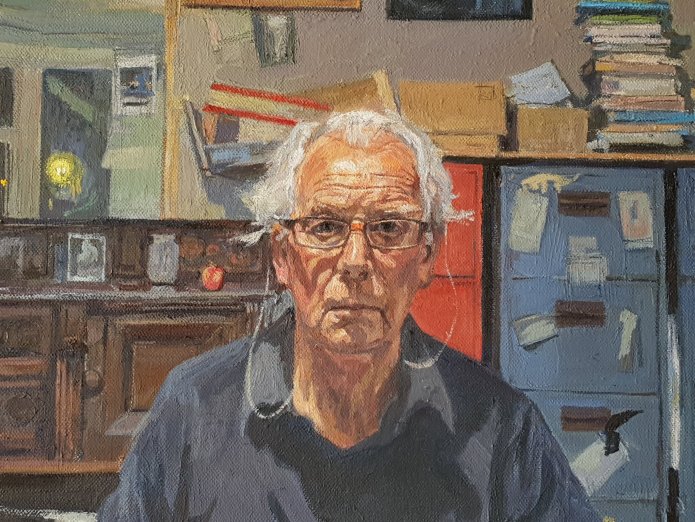
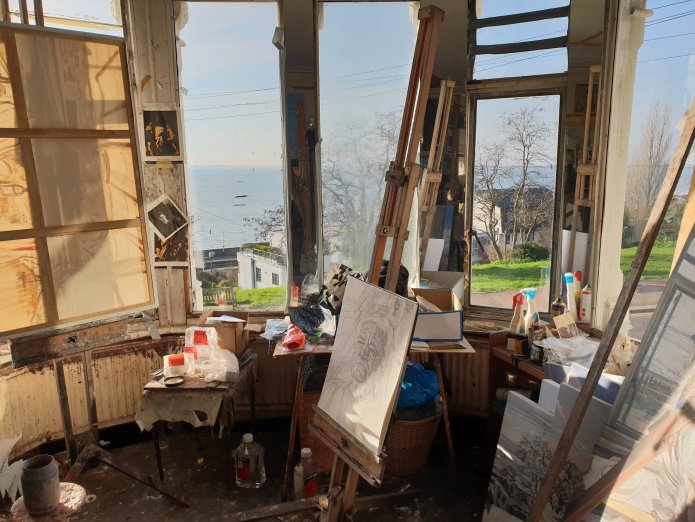
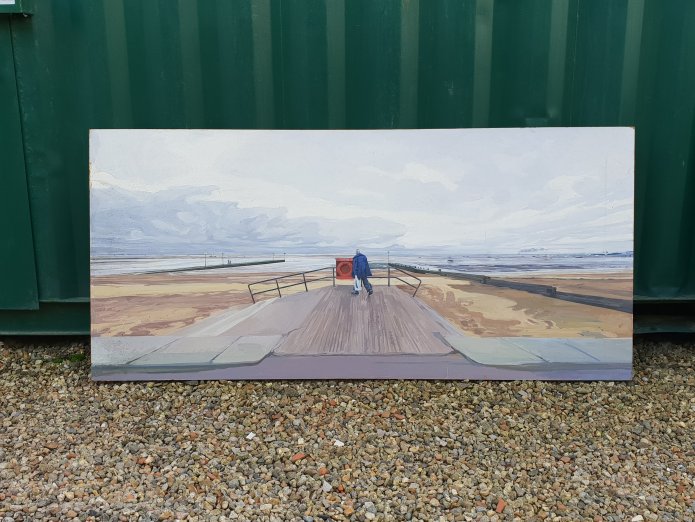
As a footnote to my entry on Leigh-on-Sea, I was putting away my copy of Norman Scarfe’s 1968 Shell Guide to Essex and spotted my copy of Ken Worpole’s Essex Journey.   It reminded me that John Fowles was a native of Leigh-on-Sea – ‘a single narrow street, with salty, muddy houses, still retaining snugly the character of fishing and naiveté’;  and so too was Simon Schama, who opens Landscape and Memory with a recollection of ‘the low gull-swept estuary, the marriage bed of of salt and fresh water, stretching as far as I could see from my northern Essex bank, toward a thin black horizon on the other side’.  So, too, is John Wonnacott, whose house overlooks the beach at Chalkwell and some of whose greatest paintings are not his portraits, but views of the Thames Estuary and Essex mud flats.

Standard

Leigh-on-Sea (1)

Romilly wanted to see the sea, so we took the train from Limehouse (change at Barking) to Leigh-on-Sea, what remains of a small fishing village on the western outskirts of Southend.   It’s a place of pubs and boats and views across the water to Sheerness:-

image

image

image

We walked along the seafront, through the more genteel Chalkwell, to Westcliff-on-Sea, with its cafés fronting onto the Esplanade:-

image

image

Southend has a funfair:-

image

image

The longest pier in the world:-

image

image

And Royal Terrace, built in the 1790s as part of the New Town and so called after Queen Caroline’s visit in 1803:-

image

image

image

How pleased we were to make it to Southend Station:-

image

image

image

Standard