Stephen Cox (2)

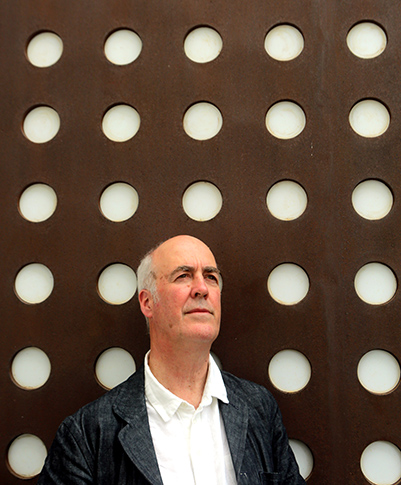
Last night, I went to a very beautiful exhibition by Stephen Cox RA in an antiquities gallery, Kallos, in Davies Street, in which he intermingles his own work in porphyry and marble with comparable antiquities.

It reminded me that years ago he asked me to write a short introduction to his work which, as things turned out, was never published.   I checked to see if I still had it.   I do and reproduce it below:-

I must have first met Stephen Cox in 1994, around the time that I was appointed Director of the National Portrait Gallery, because I remember having an animated conversation with him in a restaurant in Albemarle Street about the nature and meaning of portraiture and sculpture — how far the convention retained its validity in the twentieth century, to what extent its conventions could be stretched, and whether or not it was possible to represent someone through their foot.   I disagreed.   More recently, I have several times been invited to attend — I should say, to witness — the opening or unveiling of new work.   Each has been differently memorable because of the quality of the work itself:  its classicism;  its curious combination of being serene and mute and, at the same time, transcendent, intensely articulate in the ways by which it refers to the spiritual meaning of its material — marble, pietra serena, alabaster and sometimes simply raw stone.   Each work has also been influenced by the choice of setting, which has invariably been a part of the experience.

Most recently, we visited the two exhibitions held near his house on the borders of Shropshire and Herefordhire:  one in the new museum attached to Hereford Cathedral;  the other at the Meadow Gallery in a field by the river at Burford outside Tenbury Wells, not far from his house on Clee Hill.

Slightly surreally, we walked round and round the circuit of paths, like a miniature eighteenth-century labyrinth, admiring Stephen’s larger-scale work.   I retain photographs of him standing craggily beside his own rockwork and remember that Stephen Bann was there as well — not surprisingly as an interpreter of Stephen Cox’s work and someone who is enthusiastic, too, about the work of Ian Hamilton Finlay, who has, more systematically than Cox, explored the relationship between art and the garden in the Pentland hills south of Edinburgh.   In Shropshire, Cox had created a small Stonehenge, very simple, out of beautiful, quite slender, nearly vertical shafts of stone.   Unlike the real Stonehenge, this one could walk through and appreciate the quality of the geometry, the subtle distinctions in the shape and character of the shafts of stone.

Elsewhere in the circuit was a tomb, reminiscent of the Rothschild travertine tomb now in the grounds of Waddesdon;  a stone seat;  an arch into the garden;  and carvings which reflect the amount of time he spends in south India.   They are representative of Stephen’s work:  half-oriental;  half-classical;  with a powerful use of the material qualities of stone and of memory, which gives his work its elegiac quality.


Standard

Renzo Piano Hon. RA

There are two things that I will particularly remember about Renzo Piano in conversation with Razia Iqbal last night:  one was the sense of a tall, incredibly well preserved architect with a passionate interest in the craft of building (his father ran a Genoese construction firm) reflecting intermittently on the history of architecture – the democratic forces which led to the construction of the piazza which occupied helf the public space of the Centre Pompidou and the origins of the piazza in the idea of civitas;  the other was the incredible pleasure with which he greeted the award of his diploma, more than ten years after he was made an Hon. RA.

Standard

Paul Nash

I had no idea that Edward James employed Paul Nash to design the bathroom for his house in Wimpole Street after his marriage to Tilly Losch.   The floor- to-ceiling ladder was to help her exercise and the room was lined with purple glass to match her ice blue eyes.   Quite something (the photograph is by Dell and Wainwright):-

image

Standard

Stepney City Farm (2)

I am frequently thankful for Stepney City Farm, not just for its Saturday farmers’ market bringing coxes into central London, but for its greenness, so close to the city and the construction site for Crossrail, both of which can be seen beyond the goats:-

image

image

image

image

image

image

image

Standard

Post-war Stepney

Every so often I get a glimpse of what post-war Stepney was supposed to be, not the planners’ wasteland lamented by Ian Nairn, but carefully considered yellow brick, low rise and green, as in the Cleveland Estate, named after the Earl of Cleveland who owned the estate up until 1720 and tucked behind the chapel at the end of the almshouses on Trinity Green.   I had never walked through until this morning;  it has an unexpectedly arcadian sense of privacy, helped by the allotments in its middle:-

image

image

Standard

Stephen Spender

Prompted by the Hauser and Wirth’s display at Frieze Masters about Stephen Spender’s interest in art – a friend of Henry Moore, took drawing classes with William Coldstream at the Euston School in the late 1930s, bought work by Auerbach at his first gallery show in 1956, travelled to China with David Hockney in the 1980s – I have been reading his son Matthew’s account of his parents and his upbringing in A House in St. John’s Wood:  In Search of My Parents.  It doesn’t tell one much about their interest in art (she taught Visual Perception in the Department of Cultural Studies at the RCA), but it does a great deal about their respective love lives.   I was intrigued by the story that when Anthony Blunt discovered that he was being investigated by MI5 for spying, he simply went to their offices and removed his file, thereby considerably slowing the investigation;  and his description of his wife Maro’s ‘habit of treating a secret as if it were a delicious substance to be spread over a large area, like anchovy paste on toast’.

Standard

Newnham College

The discussion round the legibility or otherwise of Cathy de Monchaux’s new sculpture at Newnham (is it a vulva or is it a tower of books ?  The answer – very appropriately – is that it’s both) made me intrigued as to what exactly had been demolished in order to allow the construction of Walters and Cohen’s new brick building facing onto Sidgwick Avenue.   The answer is Lyster & Grillet’s mid-1960s Strachey building, named after Pernel Strachey, the suffragist Principal who tried, but failed, to get degrees awarded to women in 1921.   I can understand why it was better that it went than a new building constructed in the garden, but I remember rather admiring its hexagonal contextualism at a time when these characteristics were so unfashionable.   This is what the building looked like (not my photo):-

https://goo.gl/images/FAvYNQ

Standard

The Revival of Classicism

We spent the day immured in the crypt of the chapel at the Royal Naval College, listening to different types of classical revivalism: the messianic belief of Sandy Stoddart who has kept the flame of Thorvaldsen alive in Glasgow; Craig Hamilton who has designed a neoclassical chapel in Culham talking of his admiration for Lutyens; Pablo Bronstein who has a Rex Whistler-ish pleasure in the fantasies of neoclassical decoration; and Oliver Wainwright talking about the dictator neoclassicism of Pyongyang. Wainwright implied that all forms of neoclassicism bear the taint of fascism, maybe forgetting that, at least up until the second world war, the majority of American democratic institutions, including libraries and museums, were still designed as beaux arts monuments and, indeed, David Chipperfield’s forthcoming concert hall in Edinburgh is nearly pure Ledoux.

It was a relief to be able to escape upstairs into the pure eighteenth-century neoclassicism of Athenian Stuart’s Greenwich Chapel:-

image

image

image

image

Standard

Cathie Pilkington

We went to Pallant House to see Cathie Pilkington’s latest, and elaborate installation on the first floor of the old house, playing with works from the collection, including works by Edward Burra, Henry Moore, Graham Sutherland, Hans Feibusch and Paula Rego, reinvigorating, and getting visitors to engage with, their imagery .

The first room is devoted to surrealism and is relatively conventional with a case full of miniatures from the 1930s, made for an exhibition ‘Children Throughout the Ages’ held at Chesterfield House in 1934. Her work fits seamlessly with this era:-

image

It’s a version of a larger work shown in the same room, her diploma work:-

image

The second room Good-Bed-Bad-Bed gives the title to the exhibition, with a Hepplewhite bed which has been dressed for the occasion:-

image

image

image

image

image

image

The third room, Playing Dead is less dark, responding to Henry Moore’s Suckling Child:-

image

image

image

The fourth room is Still Life:-

image

image

Standard

15, Clerkenwell Close

I was rootling round Clerkenwell Green earlier in the year when I came across 15, Clerkenwell Close, a curious and unexpected new building development, fairly conventional in its overall architectural form, but highly unusual in having a secondary, load-bearing structure made out of rough-cut French limestone, looking as if it has recently emerged, which it has, from the quarry.   This building has since then become a cause célèbre because Islington Council has asked for the building to be demolished on the grounds that it does not in all respects meet the original planning permission.   It seems that the Council failed to upload the approved revisions to the original planning permission and neighbours objected.   Now the Council has acknowledged that the stone façade was approved, but is still asking for the entire building to be demolished.  It feels like a test for taste.   Is an architect nowadays allowed to make an emphatic architectural statement or must everything be politely clothed in brick, as has become the default position for the new urban vernacular ?  What is obvious having now looked at the building more carefully is how serious it is:  a considered statement of stone construction, not just playful, and very beautifully detailed:-

image

image

image

image

image

image

image

image

Standard