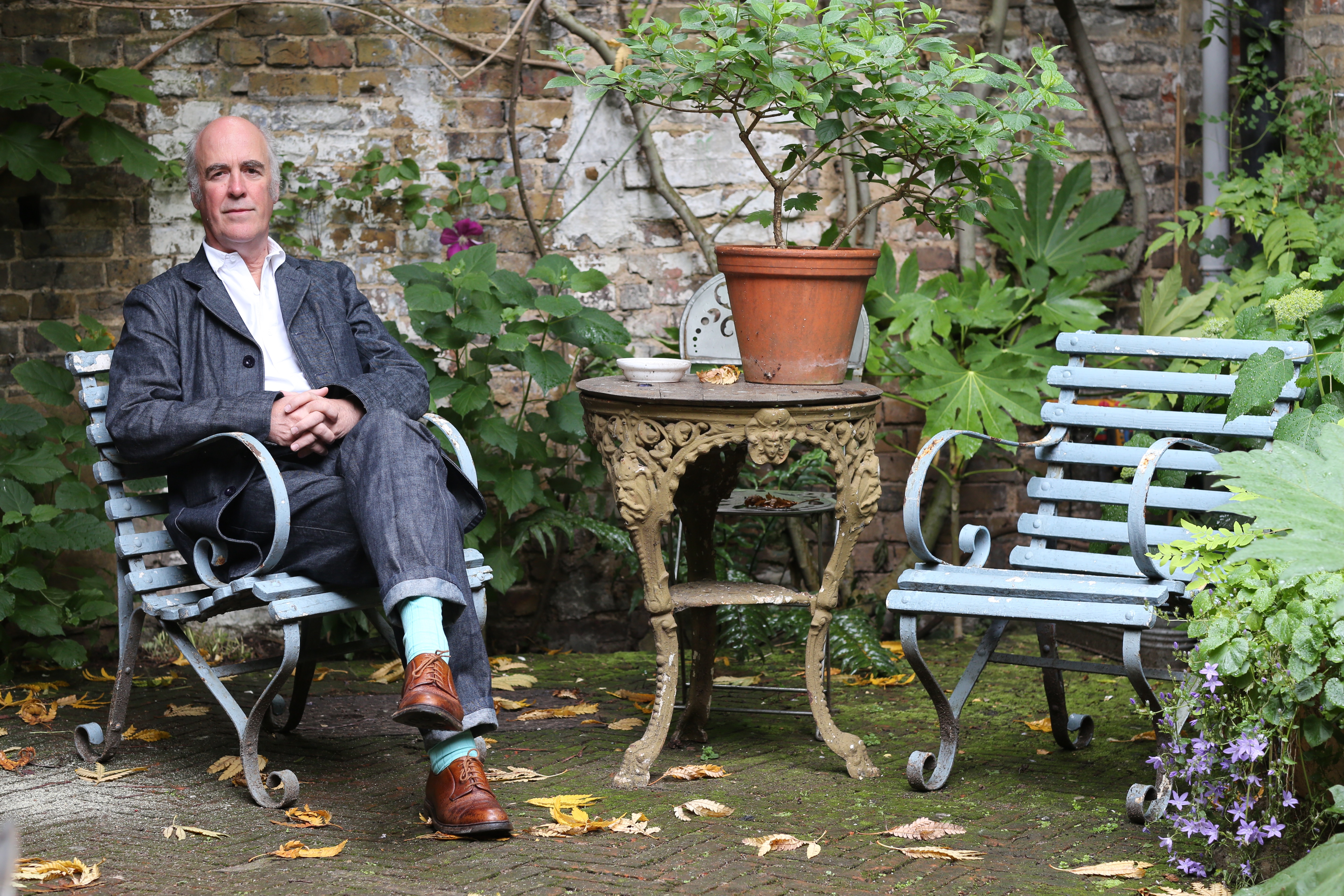
The annual dinner is the highlight of the RA’s year, an opportunity to celebrate the annual exhibition, for the RAs and the art world more generally to sport their plumage. This year the speaker was Mervyn King, who is not only a former Governor of the Bank of England, but also a former Trustee of the National Gallery. He spoke of the democracy of the annual exhibition in encouraging new collectors into the field and of the work of Tom Monnington in reviving the fortunes of the RA, as well as painting murals for the Bank of England. The most moving fact of the evening was that El Anatsui, a new Honorary RA, had come over especially from Nigeria for the evening.
Tag Archives: England
Non-members Varnishing Day
Today was non-members varnishing day, when those who have entered the Summer Exhibition come to see where their works have been hung. It begins with a church service when we stop the traffic, process down Piccadilly led by a steel band, and attend a church service in St. James’s. It must be one of the more secular occasions of the church year, conducted with vim by Lucy Winkett. Then everyone goes back to the RA to eat strawberries, judge the hang, and hear who has won the prizes.
Wolfson Prize for History
I went to the prizegiving for the Wolfson Prize for History tonight, which I have been going to nearly every year for the last twenty. I like to go in order to find out what historians have been writing, at least the good ones; and as a mark of respect to Leonard Wolfson, who was an extraordinarily knowledgeable and enthusiastic reader of twentieth-century history. I once walked him round the twentieth-century gallery of the National Portrait Gallery. He knew gigantically much more about every single sitter, particularly the politicians and generals, than I did. I enjoy the dryness of the occasion, the presumption that no-one in London ever bothers to read a book. This year the prize went to two books, The Red Fortress by Catherine Merridale, about the Kremlin, and a book about the archaeology of the Mediterranean, The Making of the Mediterranean Sea by Cyprian Broodbank.
Sir Hugh Casson Lecturing
I don’t remember seeing this portrait of Hugh Casson in the exhibition we did about him last year. I really regret never having met him as his memory lives so strongly still at the RA as the President who revived its fortunes in the late 1970s, not least by founding the Friends in 1977. He is said to have brought the Queen Mother to hanging lunches. The portrait shows him little and neat, eyes glinting behind his glasses. It’s painted by Bernard Dunstan, who became an RA in 1968 and is still one aged 94.
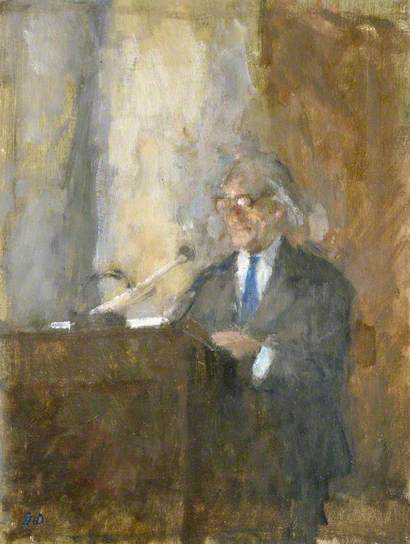
Ⓒ Royal Academy of Arts
Whistler
I was asked to give a speech at the Fine Art Society to mark the foundation of the Whistler Society. The reason I was asked was because he was never made an RA. Why ? He himself was keen. He started exhibiting his engravings in the annual exhibition in 1859. This was how his work came to public notice. In 1864, he exhibited four works – The Scarf, Old Battersea Bridge, The Golden Screen and The little White Girl. He was sufficiently confident of his abilities to put himself forward as a candidate. But when, on 8 May 1866, six elections were held, Whistler received not a single vote. Why ? Too cocky ? Too American ? Wrong style of painting ? He wrote to complain. His biographer says that ‘to the day of his death he would have accepted membership’.
Sebastiano Ricci
In honour of this afternoon’s meeting of the General Assembly, I am posting the ceiling painting of the room where the meeting will be held . But how many of us will look at it ? Ricci was one of those decorative painters who came to London in the eighteenth century in search of lucrative commissions. One can see why he was so popular. It’s got a certain swish and swagger, animating the scene from Ovid whereby Bacchus, accompanied by assorted satyrs, discovers Ariadne alone on the island of Naxos:

Ⓒ Royal Academy of Arts
Here are some details:
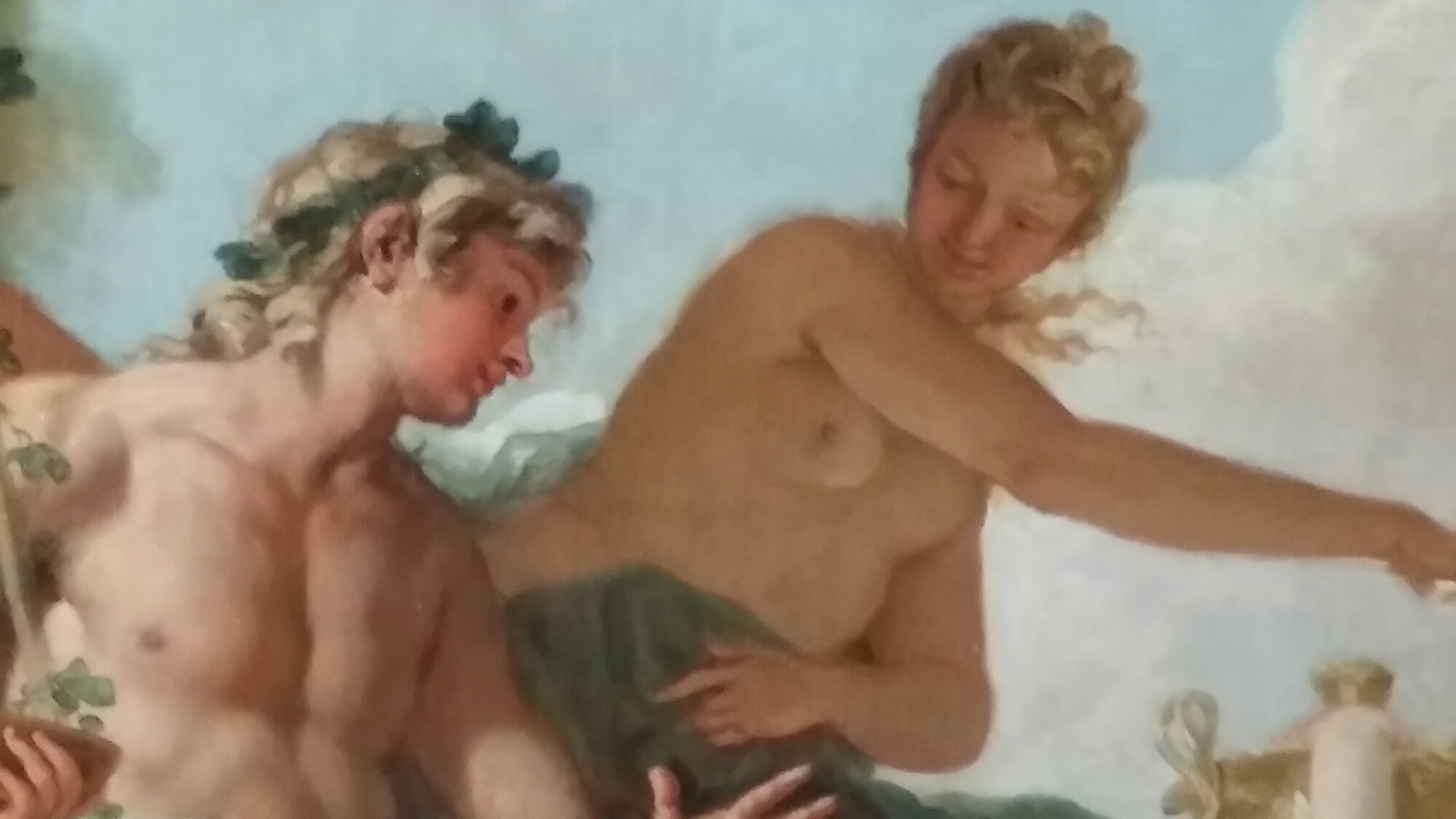
Ⓒ Royal Academy of Arts
60
I have spent the day celebrating my sixtieth birthday. I was born exactly sixty years ago today in the Old Vicarage in Redlynch near Salisbury. Early in the day, I was given some bright red, calf length socks, maroon braces, a book about Paul Smith and some cup cakes with pictures of me on them. In some ways, it was an ordinary day, starting at 8am with a fundraising catch-up, a strategy meeting in the second half of the morning, interviews in the afternoon. At lunch, I celebrated a new three-year partnership with BNY Mellon. Now I’ve got my bus pass.

Jean Cooke
I have fallen behind on my choice of paintings for the Director’s Cut of the Public Catalogue Foundation. I wanted to include Jean Cooke’s self-portrait entitled Et jamais je ne pleure et jamais je ne ris (it’s a phrase from Baudelaire’s Fleurs du mal) because, when I arrived at the Royal Academy, she dominated the meetings of the General Assembly. Extremely small, she had a squeaky voice. Whatever she said was treated with awe. She lived in a cold cottage in Birling Gap, had been married to John Bratby (of kitchen sink fame) and once drove a Morgan.

Ⓒ Royal Academy of Arts
Catherine Goodman (12)
What is it that is so satisfying about sitting for one’s portrait. Many people will think that it’s simply vanity, the delayed gratification of being depicted for posterity. But it’s more than that. It’s partly being allowed to do nothing, and feeling faintly virtuous in doing nothing. Then, there’s the companionship, the chitchat which accompanies a sitting. Somehow it feels like a collaboration, as if one is party to the act of portraiture by contributing to it not just what one looks like, but one’s past history. Catherine said that it was good that I had been so grumpy one sitting as this would be one strand in the portrait. It’s a composite, not just a snapshot. At least, that’s the theory.
Today was meant to be my last sitting. It’s not clear if it was. It was slightly tense because of the pressure to finish. No gossip. Short breaks. Lots of looking at the picture from a distance and in the mirror. It was too wet to judge and I still haven’t seen it.
Mozart in London
Mention of Johann Christian Bach reminds me that we should be celebrating the 250th anniversary of Mozart’s visit to London (maybe others already are). He arrived on 23 April 1764 with his father, mother, and older sister, Maria Anna. They took lodgings over a barber’s shop in Cecil Court. He was already known across Europe as a prodigy, had proposed marriage to the young Marie Antoinette, met Goethe in Frankfurt, and been introduced to Madame de Pompadour in Versailles. I like to think that Reynolds might have passed him in Frith Street (or Filth Street as it was then called).
 | Charles | Saumarez | Smith |
You must be logged in to post a comment.