It’s a long time since I used to use the Docklands Light Railway, travelling in to work on two toy trains from Westferry to Bank, scrunching as it turned the corners on the track. I remember how at a dinner party in the mid-1980s a junior official at the Treasury told me that she had tried to cancel it as a public project on the grounds that there was no possibility of it being of discernible use. Now it extends all the way south of the river, weaving its way through Canary Wharf and past the new huge station designed by Norman Foster for Crossrail. I have been able to travel from Bank to Cutty Sark, past what used to be the wastelands of the Isle of Dogs and the Mudchute, and up Crooms Hill through the rain to the Manor House overlooking London.
Monthly Archives: May 2014
Michael Craig-Martin
I’ve been told that my choice of works for the Director’s Cut on the Public Catalogue Foundation is too historical and doesn’t sufficiently convey the character of the contemporary Royal Academy. So, I’m going to add Michael Craig-Martin’s self-portrait, which he gave as his diploma work in December 2007. I like the fact that it’s a self-portrait. I remember one of the RA’s saying how delighted he was that portraits had been eradicated from the Summer Exhibition, so Craig-Martin is characteristically going against the trend. I admire his intellectual rigour and independence of mind, so this is an unashamed tribute:

Photo: R.A./John Hammond © The Artist
Ja-Kyung Shin
We spent much of the day – this year as in other years – at Collect, the Crafts Council’s annual exhibition, now at the Saatchi Gallery. It has the great benefit of being increasingly international with galleries from Amsterdam, Frankfurt and Korea. As last year, we particularly admired a set of teaspoons designed and made by a young Korean silversmith called Ja-kyung Shin in which the bowl of the spoon is replaced by crumpled silver:

Catherine Goodman (8)
I’ve quite missed my sittings with Catherine. It’s an opportunity for two hours of reverie and gossip. This time I actually got an incredibly brief glimpse of my portrait, but at the precise moment when I realised who it was, she too realised that she had left it on the easel and whisked it away. So I only have a flash of it like a mirage. I now feel that if I were ever to see it properly, it would disappear before my eyes. Time is running out before her exhibition in June and I don’t like to ask if I will be included. Afterwards, I retreat for a macaroon and Collect.
Baden-Badener Unternehmer Gespräche
The third group I have talked to in the last 48 hours was a group of high-powered Germany industrialists who came to the Royal Academy as an optional part of their programe of study in London. The group was set up in the early 1950s as part of the angst of post-war Germany about the extent to which industrialists had supported Hitler. The idea was that young business leaders would meet their counterparts in other countries and discuss moral and ethical issues of common concern. I was impressed by the way Germany business leaders are often more intellectually oriented than their British counterparts, more like academics, and they asked good questions about the system of training in the Royal Academy Schools, the extent to which we provide any business training (I suspect not much) and what motivates Friends. They couldn’t quite grasp that the Royal Academy has no system of public funding and never has, apart from its debts being underwritten by George III.
The Apposition
Yesterday, the Bethnal Green Academy. Today, St. Paul’s School on the green fields of Barnes beside the Thames. I had been asked to be the Apposer, who is required to listen to four expositions on recondite subjects in public and then comment on them. Not an easy task as the subjects included quantum computers, the extent to which T.S. Eliot was a truly modernist poet, the building of robots in synthetic biology, and the theory of a just war. It’s impossible not to compare the discrepancies in opportunity between the state and the private system, except to note that St. Paul’s was, at least in its origins, the product of a highly egalitarian desire for free education of poor scholars from ‘all nacions and countries indifferently’.
Bethnal Green Academy
Some time ago, I was asked if I would sign up for a scheme called Speakers in Schools, whereby there is a register which allows state-funded schools to ask people in public life to speak to them. I have only been asked to speak once before to a school in Wimbledon. This morning I was asked to speak in the Bethnal Green Academy.
I walked there. Past the legacy of Victorian social improvement:


The Summer Exhibition
In honour of the many Friends of the Royal Academy who have kindly looked at my blog today (I’ve had record numbers of visitors) I am doing a second post related to the history of the Summer Exhibition. It’s a picture of the process of selection as painted by Charles West Cope in 1875. It’s one of the stars of the exhibition of our collection currently on in Bendigo outside Melbourne, Australia (see previous blogs). It tells one so much about the nature of the high Victorian RA. The artist was named after Benjamin West (his sister was named after Turner) and he was Professor of Painting in the Royal Academy Schools. He is in the background, bald and bearded. The then President, Sir Francis Grant, leans back in his chair, whiskered and supercilious and wrapped in a rug. In the front, Millais has taken off his top hat and put it on the floor in front of him. My predecessor, Sir Frederick Eaton, is dutifully taking notes. The whole scene exudes a sense of the authority that the Academy held in 1876, when the Academicians were all wealthy, selling their works to industrialist and nouveau riche collectors.
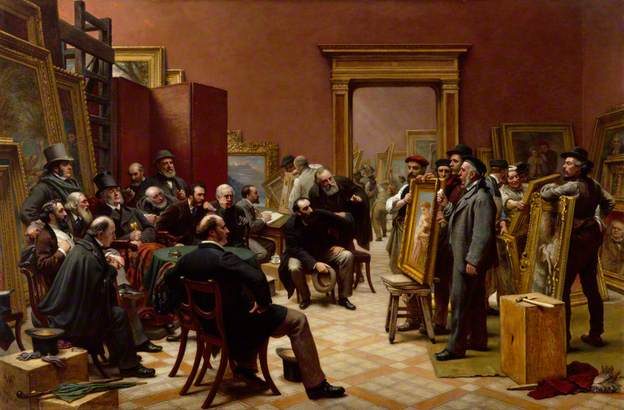
Ⓒ Royal Academy of Arts
A hanging lunch
This is the season when the annual Summer exhibition is hung. Wandering round the galleries in the morning, members of the committee are busy with the difficult task of selection of pictures and sculpture for whichever room they are hanging, intent on doing the best for the Royal Academicians, their peers, for the open submission, and, not least, for the public. Each year I am impressed by how deeply seriously they take it – how to make the best possible display, how to show as many works as is practical without overloading the rooms, how to balance works by known artists and unknown, how to grapple with the tricky individual works. At 11, they are fortified by beef tea (reputedly, a mixture of sherry and bones). By lunchtime the artists involved in the hanging need fortification. They retreat to the General Assembly Room. This scene of Academicians having lunch during the hang was painted by Frederick Elwell (he’s standing up on the left) in 1938, lots of old men sitting round the table with their cigarettes and cigars. Nowadays lunch is quicker and much less formal, self-service and tough beef. It concentrates on the problems of the hang, but also includes a bit of RA gossip, which is why I always like this time of year.

The Royal Academy Selection and Hanging Committee, Frederick William Elwell. © The Royal Academy of Arts
Lynn Chadwick
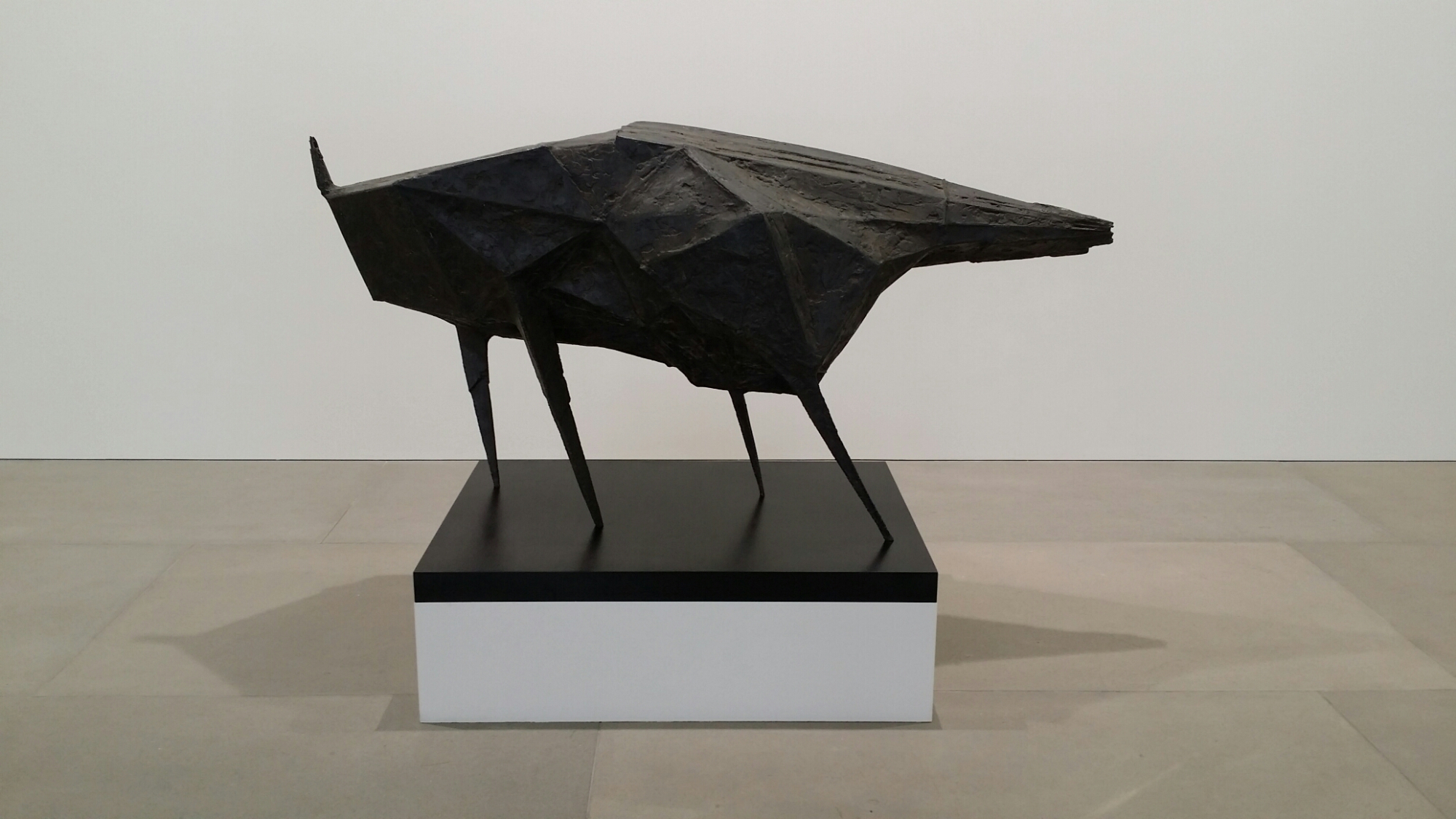
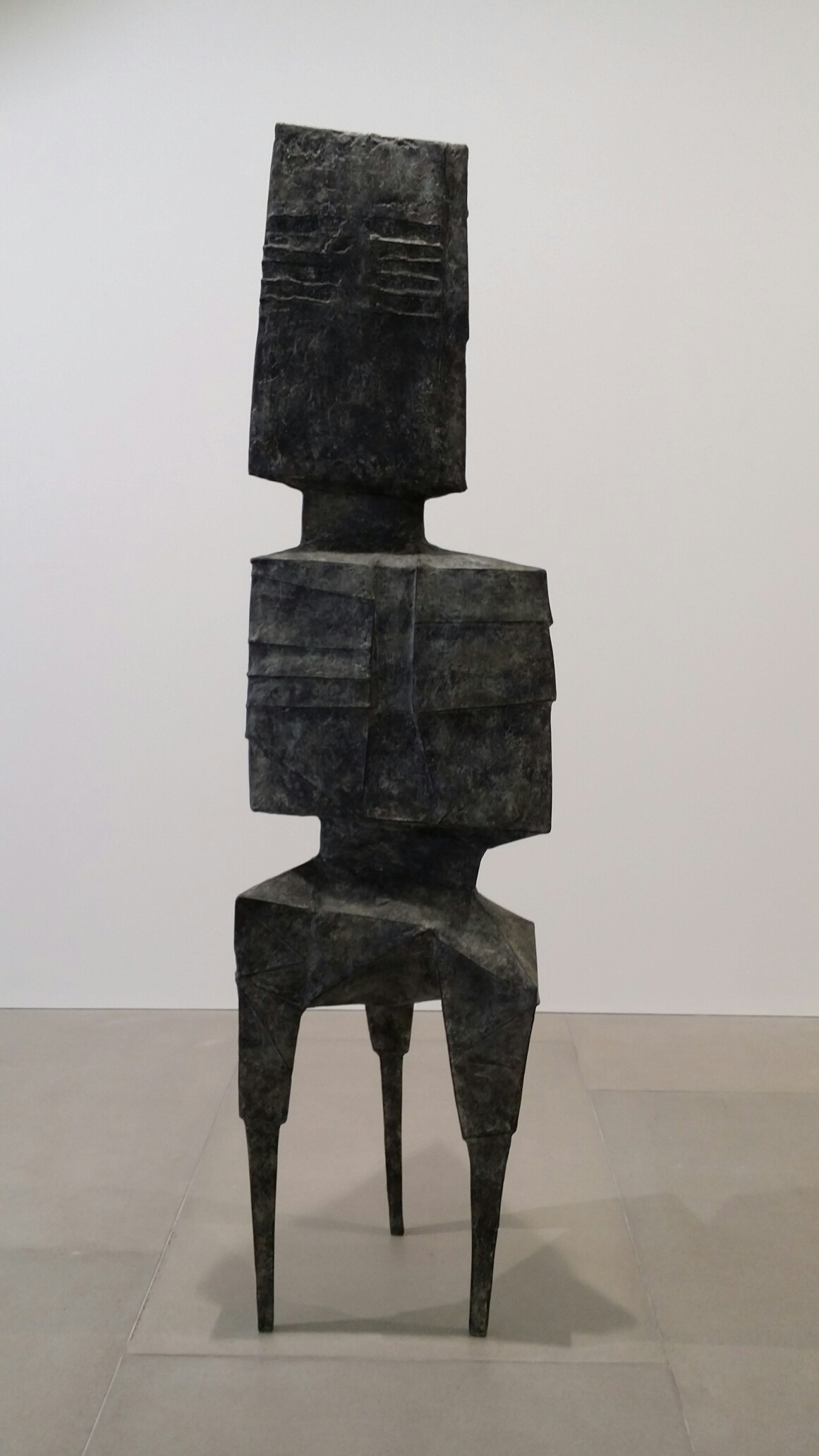
I popped in to the Lynn Chadwick exhibition at Blain Southern on my way back from work last night. It complements a display of his more monumental pieces in the Royal Academy courtyard. I remember going to Nether Lypiatt, Chadwick’s Gloucestershire estate, and bombing round in a Land Rover looking at works, aliens in a lost magic valley. His works have not lost their strangeness, like anthropods from a third world: ungainly beasts, half naturalistic and half space age. He is nowhere half so well remembered as Hepworth and Moore, but it’s good that we’re being encouraged to look at the work again.
 | Charles | Saumarez | Smith |
You must be logged in to post a comment.