
I have discovered, in reading more about Michael Hamburger and W.G. Sebald, both German émigrés who lived much of their lives in East Anglia, that their friendship was not straightforward, as appears in the Translator’s Note in Unrecounted, the volume of Sebald’s poems which Hamburger translated in 2005, where he reveals that ‘Although Max Sebald had given me copies of all his books published since our first acquaintance, he never so much as mentioned the writings of these miniatures to me and gave me no copy of For Years Now‘. Hamburger apparently described the final period of Sebald’s life ‘as a time of crisis…full of enigmas, conflicts and contradictions he chose not to clarify’. I learned this and much else about Sebald, including how Tacita Dean first came across his writings on a bus in Fiji in September 1999, in a website called Vertigo (https://sebald.wordpress.com). I recommend it.
Monthly Archives: March 2018
Yugen
Talking of beautiful things, we went last night to see the three ballets performed in honour of Leonard Bernstein’s death, including Yugen, based on the Chichester Psalms, commissioned by Walter Hussey, the Dean of Chichester Cathedral from 1955 to 1977. The set design was by Edmund de Waal, very simple, large vitrines, but appropriate for the intensity of the dance.
Tacita Dean RA (2)
Of the four biographical films that Tacita Dean is showing at the National Portrait Gallery – David Hockney, Cy Twombly, Michael Hamburger and Merce Cunningham – I found the long, indeterminate film of Michael Hamburger in 2007, the year of his death, the most moving. Nor had I realised how important Hamburger was to an understanding of Sebald, a fellow émigré, who came to Britain with his family in 1933, settling first in Edinburgh, then London, then Hove, went to Westminster and Christ Church and began by translating Hölderlin. His desk, looking out onto orchards, shown in Dean’s film, appears in The Rings of Saturn and Dean made her film for an exhibition called Waterlog which was shown in Norwich Museum and the Sainsbury Centre in 2007. It shows Hamburger talking about the rare varieties of apple which he grew and picked.
Tacita Dean RA (1)
Since I didn’t manage to see Tacita Dean’s exhibition Still Life properly last night, I thought I should have a proper look at it today. It’s an intriguing mix of old and new, starting with the continuities in the depiction of Still Life, with a group which includes work putatively by Chardin from the collection of the National Gallery, a Still Life by Henri de la Porte from the York Art Gallery, a Rose-Crested Cockatoo (1917) by William Nicholson and a print of Bread (2004), surprisingly by Cy Twombly (no photography). These are then juxtaposed with a very beautiful watercolour of Apples by William Holman Hunt and a film by Dean herself which examines slowly and tenderly images of the spotted surface and stalk of a pear in a glass bowl, itself severely mottled and dirty, in microscopic, but out-of-focus detail. Next door is a Zurbarán next door to a Wolfgang Tillmans, and a Sienese mountainscape next to Thomas Jones’s miniaturistic Wall in Naples (c.1782), interrupted by bird song. It’s all about the slow intensity and record in the observation of ordinary things, now and then.
Eglon House
I joined an early morning patrons’ tour of Eglon House, an homage to the Maison de Verre in a mews behind the public library in Primrose Hill. It was until recently an Express Dairy, in the days when there were still cows grazing on the slopes of Primrose Hill, but in the 1960s it was converted into recording studios for the likes of David Bowie. Six years ago, the site was bought and converted into a grand and fastidiously detailed (curtains by Henry Moore) live-work premises by Chassay Last architects, now on the market for £21 million. Alan Powers described the history of the original Maison de Verre, designed by Pierre Chareau for Dr. Jean Dalsace, a gynecologist who needed privacy, in a side street on the Left Bank, out of glass, steel and iron. It was first featured in an article in The Architect and Building News in 1934, rediscovered by Kenneth Frampton (and Richard Rogers) in the 1960s, and is now lived in by an American architectural historian:-


Whistler’s Mother
I went to the launch last night of the new biography of Whistler’s Mother: Portrait of an Extraordinary Life by Daniel Sutherland and Georgia Toutziari (actually, I was speaking at it). The book contains an account of how Whistler’s picture of his mother was submitted to the annual Summer Exhibition at the Royal Academy in April 1872 and very nearly turned down: too unfinished perhaps, too nakedly emotional, too monochrome (these were all comments of the critics when it was first shown). They had already turned down The White Girl, his great portrait of Joanna Hiffernan ten years earlier, now The Symphony in White No. 1, one of the masterpieces of the National Gallery of Washington. Then, Sir William Boxall RA, the Director of the National Gallery, a shy man, who had been a friend of Wordsworth, told Council that he would resign if they did not accept the picture. The picture was grudgingly accepted and is now recognised as one of the greatest pictures of the nineteenth century. We wanted to borrow it for our forthcoming exhibition about the ups and downs of the Summer Exhibition, The Great Spectacle (opens June 12th.), but sadly weren’t able to. I’m sorry because it might have been possible to judge what its impact must have been amidst acres of mediocre subject painting.
Burlington Gardens
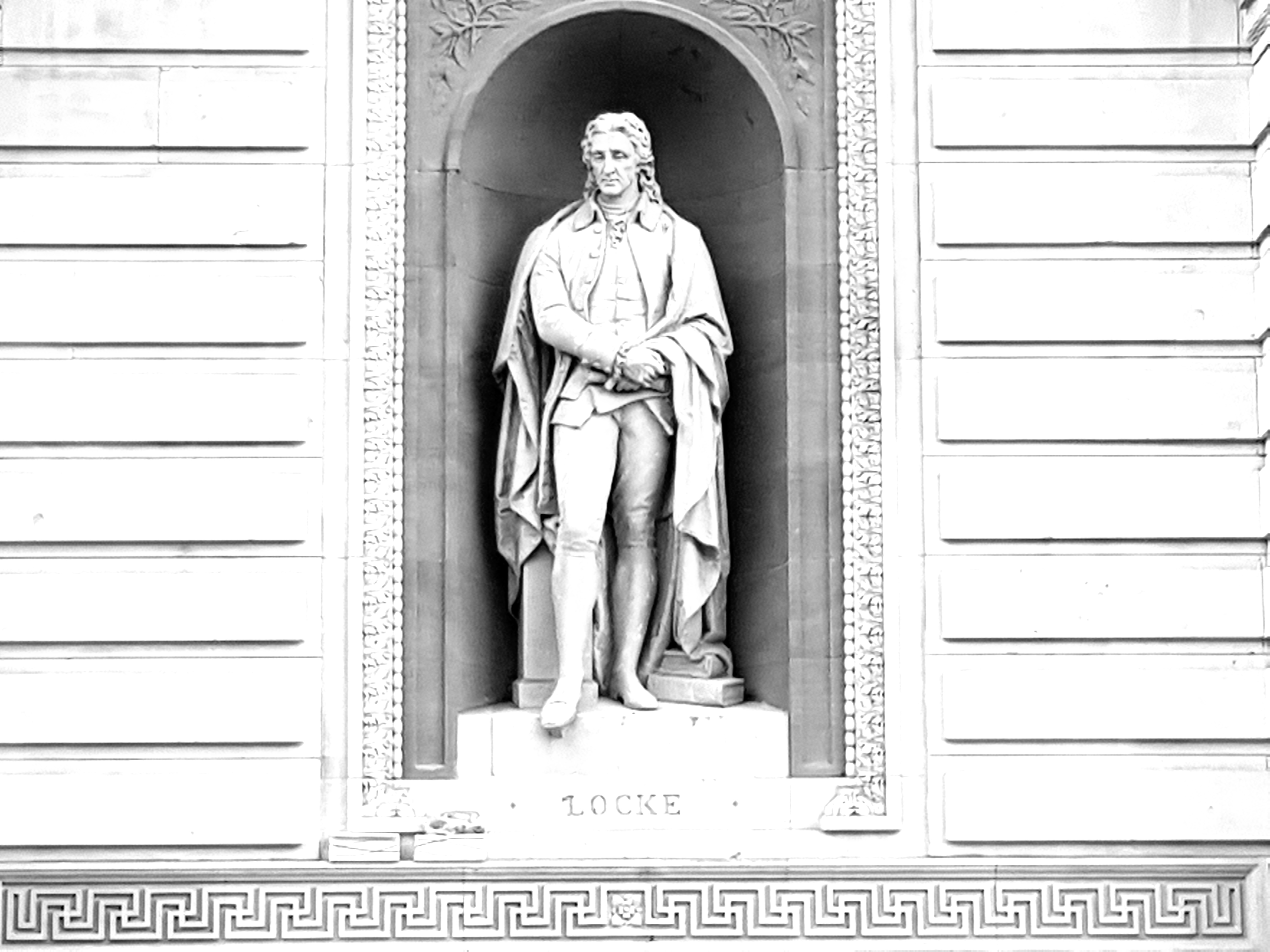
Every day more of the façade of Burlington Gardens becomes visible. Today for the first time, it is possible to appreciate the plinth which marks the junction between the building and the street, looked down on by the newly cleaned statue of John Locke:-

G.F. Watts
I went to a dinner tonight to honour the bicentenary of Watts’s birth (he was born on 23 February 1817, the son of a pianoforte maker in Bryanston Square). Hovering over the evening was the question why Watts, who was a pariah of the Bloomsbury Group, has enjoyed a recent reincarnation as a Grand Old Man of Victorian painting. Virginia Woolf described his memorial exhibition in 1905 (at the RA) as ‘atrocious‘ and lampooned him in her play Freshwater. He might have been included in Eminent Victorians if Lytton Strachey had regarded him as remotely interesting. Part of the answer must lie in the Watts Gallery, which used to be seedily neglected, looked after as a sinecure by Wilfred Blunt, Anthony’s older brother. Now it has been revivified by Perdita Hunt, a Trustee of the HLF, and Richard Ormond, who was chairman of trustees for a mere 32 years (I think he became a trustee in 1972). Part of it may lie in the fact that Mary particularly was a good socialist, interested in the practice of pottery in the village. And part of it is a matter of time – that someone who was such a big figure in his lifetime, the subject of an exhibition at the Metropolitan Museum, is definitely worthy of historical record, if not necessarily artistic admiration.
Thomas’s
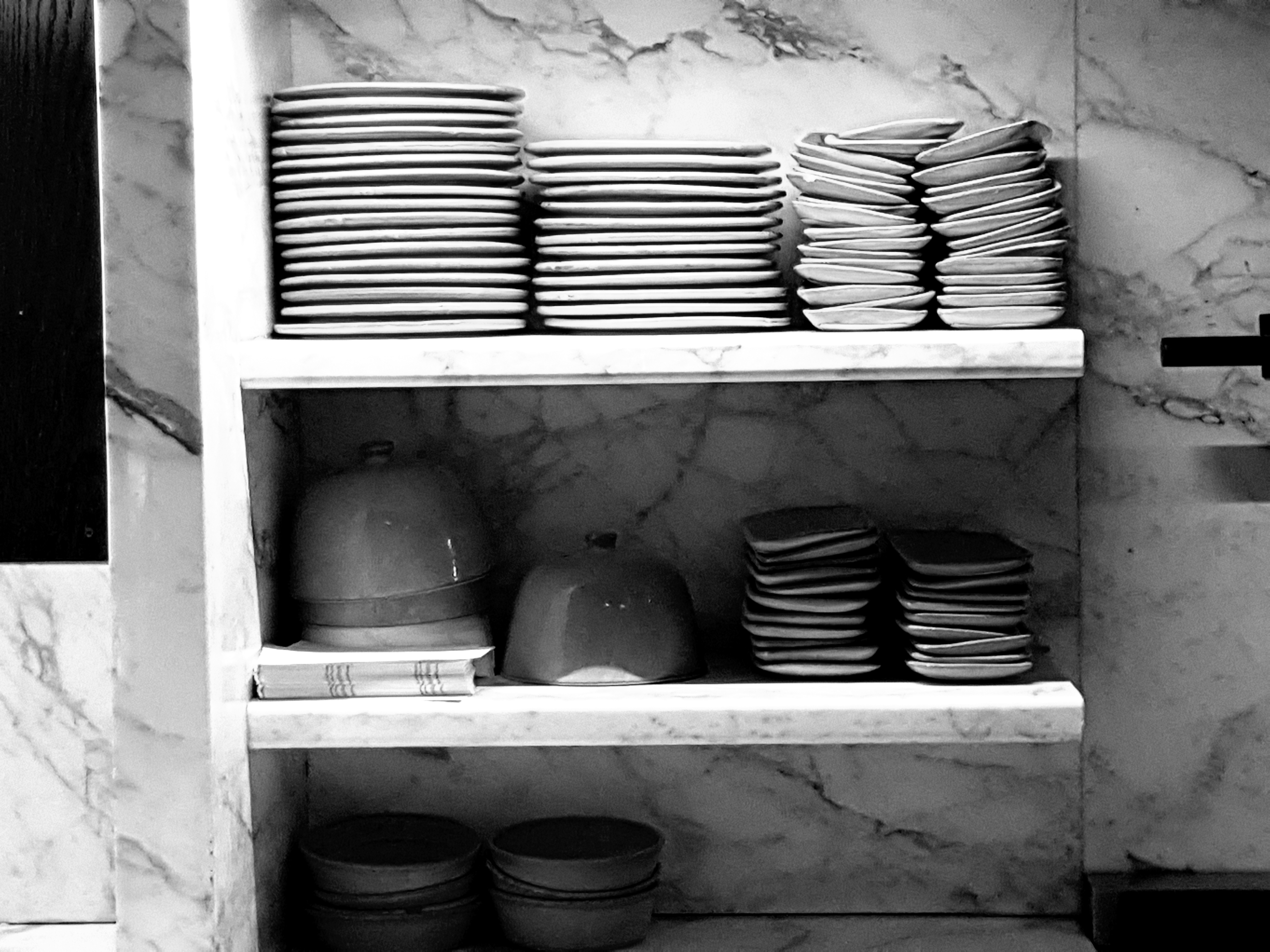
Since returning to Burlington Gardens, I have become a fan of occasional, therapeutic cream teas at Thomas’s, the café attached to the side entrance of Burberry’s on Vigo Street. They not only provide information about the provenance of the butter (‘betwixt the Severn and the Wye’) and the jam (Rosebud Farm in North Yorkshire), but also the crockery, which comes from the Muddy Fingers Pottery in Northumberland:-
Syon House
For those who do not have convenient access to a copy of Ruth Guilding’s Owning the Past: Why the English Collected Antique Sculpture, 1640-1840 (Yale University Press, 2014), as referred to in the Comments section, this is what it tells one about the genesis of the sculpture collection at Syon. The house was inherited in 1749 by Lady Elizabeth Seymour, the only daughter of Algernon Seymour, 7th. Duke of Somerset, who had been responsible for the landscaping of the grounds of his house at Marlborough, including putting a grotto into the prehistoric Mound. Together with her husband, Hugh Smithson, she took the name of Percy and, in 1766, he became Duke of Northumberland. In 1760, they commissioned James and Robert Adam to do up the house in the latest Roman antique manner, based on Robert’s deep knowledge of Roman antiquity, prompted not so much by his friendship with Winckelmann, who he had never met, as Piranesi, as well as being much influenced by his interest in the archaeological remains of Spalatro (now Split). Since it was not straightforward to acquire original sculptures in Rome, they commissioned replicas, including a cast of the Apollo Belvedere by Joseph Wilton. I’m not sure that this in any way invalidates Mary Beard’s conjunction of Winckelmann, Robert Adam and Syon in her second programme, merely demonstrates that the eighteenth-century passion for antiquity was longstanding and that Robert Adam, like Mary Beard, belonged to the admirers of things Roman, as opposed to Winckelmann, who liked (and idealised) the Greeks.
 | Charles | Saumarez | Smith |
You must be logged in to post a comment.