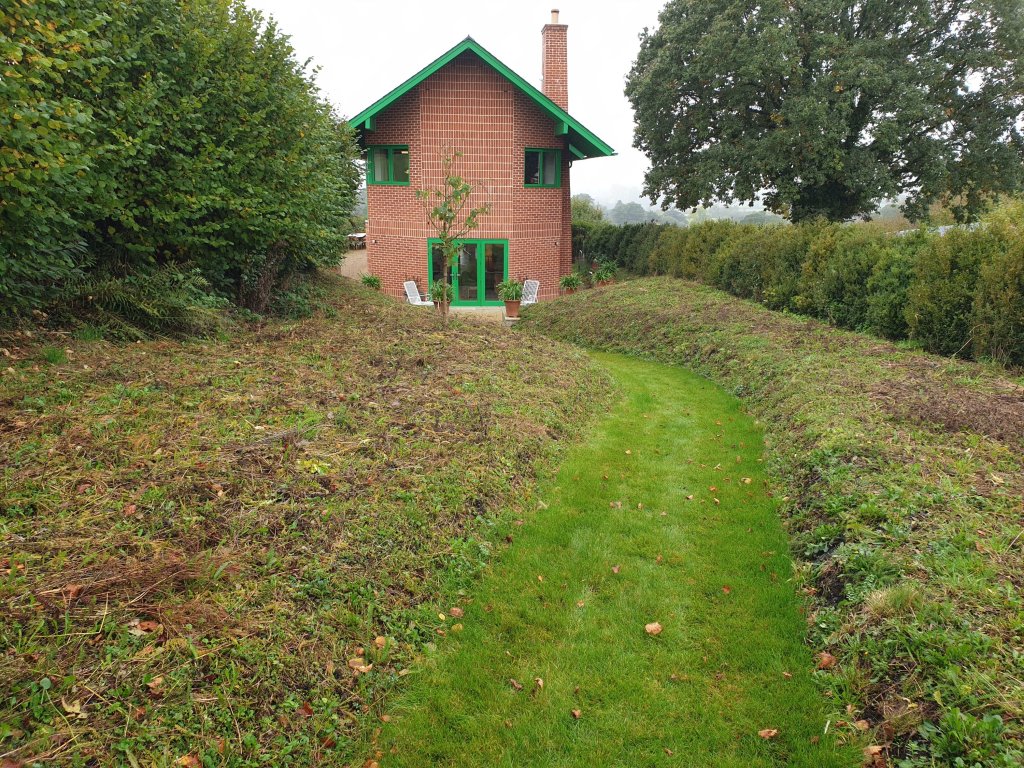
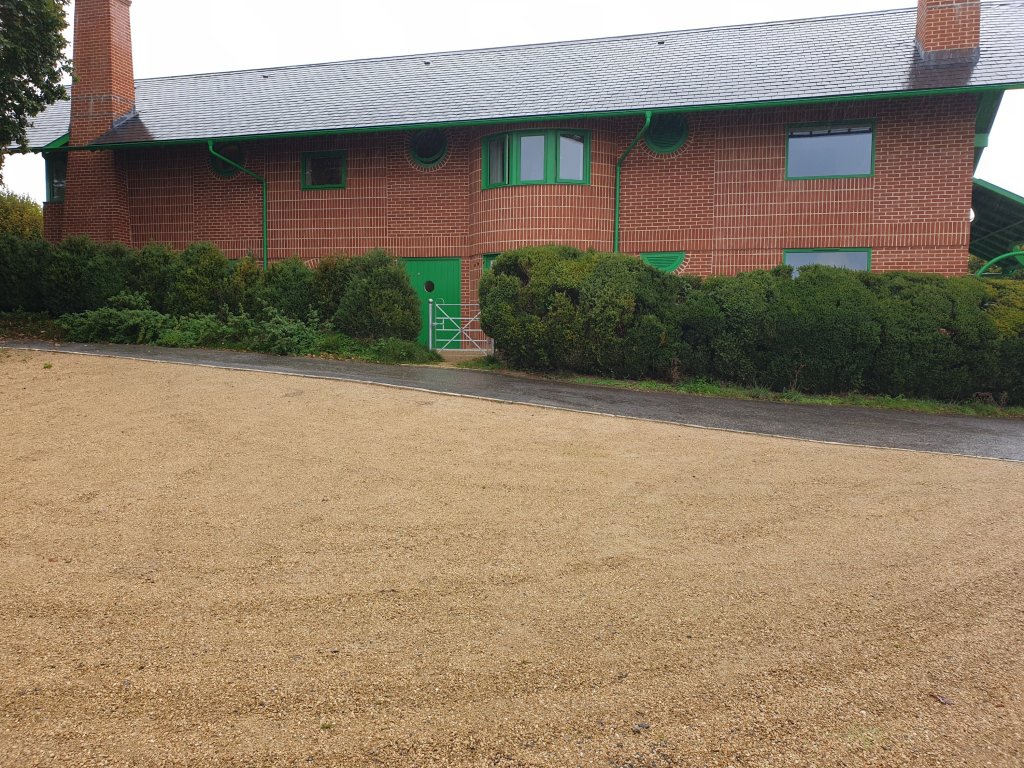
Worth reading the attached account of Poundbury by Oliver Wainwright who I would not have expected to be remotely sympathetic, but turns out to be, if only because it it surely vastly much more desirable than the standardised developer estates which are now dotted arbitrarily all over southern England. And I’m not sure what the RIBA suggests as a good model for large-scale housing development. Certainly, nothing in this year’s Stirling Prize which is nearly all in London.
Author Archives: Charles Saumarez Smith
The Oxford Comma
I have been following the discussion about the use of the Oxford Comma with some interest.
I was taught as a child never to put a comma before ‘and’ in a list – I assume by my father who was a strict grammarian. He also taught me to have three spaces in front of a full stop. Thérèse Coffey – or is it Jacob Rees-Mogg ? – recommends two. I remember the terrible moment when Michael Baxandall added a comma before an and in the draft of my PhD. thesis. He was a pupil of F.R. Leavis. When I questioned the errant comma, he said it improved clarity. Grammar is there to assist understanding. So, I continue to use an Oxford comma, but only sometimes, according to circumstances.
So, my sense if that an Oxford comma is a bit like Jacob Rees-Mogg’s top hat: something for exaggeratedly old-fashioned disciplinarians, which should be used flexibly, not as a cane by an elderly headmaster.
David Lowenthal (1)
I went to the much-postponed conference organised to commemorate the late, great David Lowenthal, a geographer by profession. He studied geography at Berkeley, California, was employed for a long time by the American Geographical Society, before migrating to University College, London as a Professor of Geography. But he was someone whose range of intellectual interests deliberately evaded all disciplinary boundaries. He got a degree in history from Harvard (only a BS because he couldn’t read Latin), his PhD was in history at the University of Wisconsin, and he is a father figure in heritage studies, following his books, The Past is a Foreign Country (1985) and Possessed by the Past: The Heritage Crusade and the Spoils of History (1997).
What I hadn’t realised is what a big figure he is, also, in Caribbean Studies as the author of West Indian Societies, funded by the Institute of Race Relations and published by Oxford University Press in 1972, a book which sounds like a combination of history, geography and social sciences.
What I learned, much of which I did not know was:-
1. His father, Max Lowenthal was an important New York lawyer, who supported workers’ rights and got into trouble with McCarthy for writing a book critical of the FBI. David’s writing was similar to his father’s: present the written evidence as far as possible and leave the reader to interpret it.
2. He was introduced to the Annales School by the first of his mentors, Jean Gottmann, in Paris after his service doing topographical studies of Eastern Europe for the Intelligence Photographic Develooment Project (IPDP) in the last year of the Second World War. Of course. So much of his technique is that of the Annales School. Look at the environment. Look at everything. Don’t treat history as events.
3. Because much of his life was spent as a researcher at the American Geographical Society, he could choose what he worked on and so wasn’t an orthodox academic. He wasn’t especially good at playing the academic game and was encouraged to take early retirement from University College in 1985, the year of his magnum opus.
4. He was a great man, of boundless intellectual enthusiasm and generosity, who made a multitude of friends, many of whom were there to honour his memory.
Kenneth Frampton
I went to hear Kenneth Frampton launch the fifth edition of his book (it actually appeared pre-COVID in 2020) Modern Architecture: A Critical History, first published in 1980, the high noon of Post-modernism, as demonstrated by Paolo Portoghesi’s 1980 Venice Architecture Biennale. Frampton’s book was in some way, I sensed, a riposte, a canonical text of the modern movement, suggested by Robin Middleton, who was Frampton’s successor as technical editor on Architectural Design in the 1960s, and commissioned by Thomas Neurath, the then managing director of Thames and Hudson. What was impressive was – as Frampton was the first to acknowledge – the nearly impossible geographical range of the book, including brief sections on each of the countries of South America, but also how up-to-date the selection of architects: Chipperfield, not just for the Henley Rowing Museum, but also the Jacob Simon Gallery in Berlin (2018); Niall McLaughlin for the Sultan Nazrin Shah Centre in Worcester College, Oxford; and Eric Parry for 4, Pancras Square in London (2017). I just hope I remain as intellectually- and physically – alert at 91.

By Royal Command
Attached are some reflections, not just mine, on the benefits of royal support and patronage, which I have experienced not just at the Royal Academy, but, more recently, at the Royal Drawing School, which the Prince of Wales established in 2000 and has continued to support very actively (videlicet my recent post about the printmaking studio at Dumfries House):-
Dumfries House (3)
My final post about Dumfries House is the reason why I was there: the opening of the new Printmaking Studio, a beautiful and incredibly well-equipped facility for print makers who are on short visiting fellowships administered by the Royal Drawing School. It was designed by Keith Ross – so convincingly part of the surroundings that I did not initially realise that it was brand new, right next door to the old laundry which has been converted into drawing studios.
These are the Glen Dimplex Drawing Studios:-


This is the new Printmaking Studio:-


Portraits of the Queen
Not surprisingly, I have been thinking of the big John Wonnacott painting of the Royal Family, done for the Queen Mother’s 100th. birthday in 2000, commissioned as a way of showing the different generations of the Royal Family – a sense of their interaction, their family relationships and of the succession, which didn’t seem such an issue then.
In retrospect, I wonder if it should have been done in Clarence House, not Buckingham Palace, but it was a self-conscious updating of John Lavery’s The Royal Family at Buckingham Palace (1913). I notice that pictures acquire a different aura of significance long after the event:-
https://www.apollo-magazine.com/the-many-faces-of-the-queen/?s=09
Dumfries House (2)
Readers may legitimately wonder what the mood was like yesterday in the grounds of Dumfries House. The answer is that I remember hearing the noise of a helicopter in the distance, maybe at about 10 o’clock. It was. When we learned that it was the Prince of Wales summoned to Balmoral, I think we all knew instinctively what that was likely to mean; but it was a long wait through the course of the day, in which I was the least well informed. Everyone else seemed to have vastly much better access to the rumour mill. At 5 o’clock, I got a call in the Entrance Hall (use of phones is forbidden) to ask if the news was true. I asked as I left the house half an hour later, but it was unconfirmed. So, I only learned when I switched on the tv – very unusual for me – at 6.25 in the hotel bedroom. The end of an era. And the beginning of a new one.
Stratford vs. Hackney Wick
As readers of my blog will know, I got very interested earlier in the summer in the development of Hackney Wick which is changing very fast, but in a way which I think has been pretty successful, although the artists who have had to move out because of changing property prices will not agree (I met one last week).
I also started exploring the former Olympic Village. At the time, I wasn’t aware that both were a result of large-scale planning by the London Olympic Development Corporation under the chairmanship of, first, Ken Livingstone, then Boris Johnson and are a perfect exemplification of recent policies towards urban planning and that, over the summer, a lot of other people were going to write about the success or otherwise of the London Olympic Legacy Development Corporation, its successor body, including Oliver Wainwright in the Guardian very negatively and Rowan Moore in the Observer more positively.
My analysis, based on bicycling more than reading, apart from Grindrod’s admirable recent Iconicon, has just gone live:-

You must be logged in to post a comment.