Ted Cullinan (1)

I was very sad to hear of Ted Cullinan’s death, not just because I admired his approach to architecture – so thoughtful about its materiality – but because, when I was at the RA, he was one of the nicest, most supportive and most generous spirited of the older generation RAs. I never realised that he had been raised a catholic, nor that his grandfather had owned a house designed by Inigo Triggs. He was, in some ways, a latterday arts-and-crafts architect, interested in how buildings are made, in spite of his modernist training. My favourite of his projects is the amazing, large-scale Faculty of Mathematics at Cambridge, which should have won the Building of the Year award when I was a judge, except we were told it wasn’t quite complete. He did the Divinity School too, which holds its own against Stirling. A 100% nice man.

Standard

Ruminations on globalism

While I was in Shanghai, I was asked by Tom Marks, the editor of Apollo, to write a piece on the role of the national museums. I totally misunderstood what he was asking me to do, since my mind was full of the fact that it was the Centre Pompidou, not the Royal Academy or National Portrait Gallery, which had taken up the offer of space in David Chipperfield’s fine and well-placed new museum on the West Bund. So, I wrote what I felt, based on my now – possibly out-of-date – experience as to how the government treats international relationships, a topic of some significance if we are not to retreat into a narrow nationalism.

Here it is. What I was actually asked to do will appear in the next printed edition:-

https://www.apollo-magazine.com/united-kingdom-international-relations-culture/

Standard

Whitechapel Bell Foundry (2)

I am re-posting the latest post on Spitalfields Life not just because it describes and shows pictures of yesterday’s rally, but because it provides such an admirably clear account of the legalities of the hearing next Thursday: that if the Council is to allow re-use, the current owners must be able to demonstrate that its previous use is not viable (and, indeed, to advertise its availability which, of course, they haven’t). They obviously can’t do this, because there is an alternative, economically viable plan from the United Kingdom Historic Building Preservation Trust to re-establish its previous use, which has been available since soon after the Foundry’s sale and was known to Historic England before they gave their ill-gotten advice. So, if it follows its normal legal procedures, Tower Hamlets should simply turn the application down.

https://spitalfieldslife.com/2019/11/10/save-our-bell-foundry/

Standard

Autumn

In the intervals of going to Taipei, I can’t help but notice that the full blast of autumn has arrived, so that even Stepney Green looks like Western Massachusetts at the height of the fall:-

And the garden, too, is golden:-

Standard

Whitechapel Bell Foundry (1)

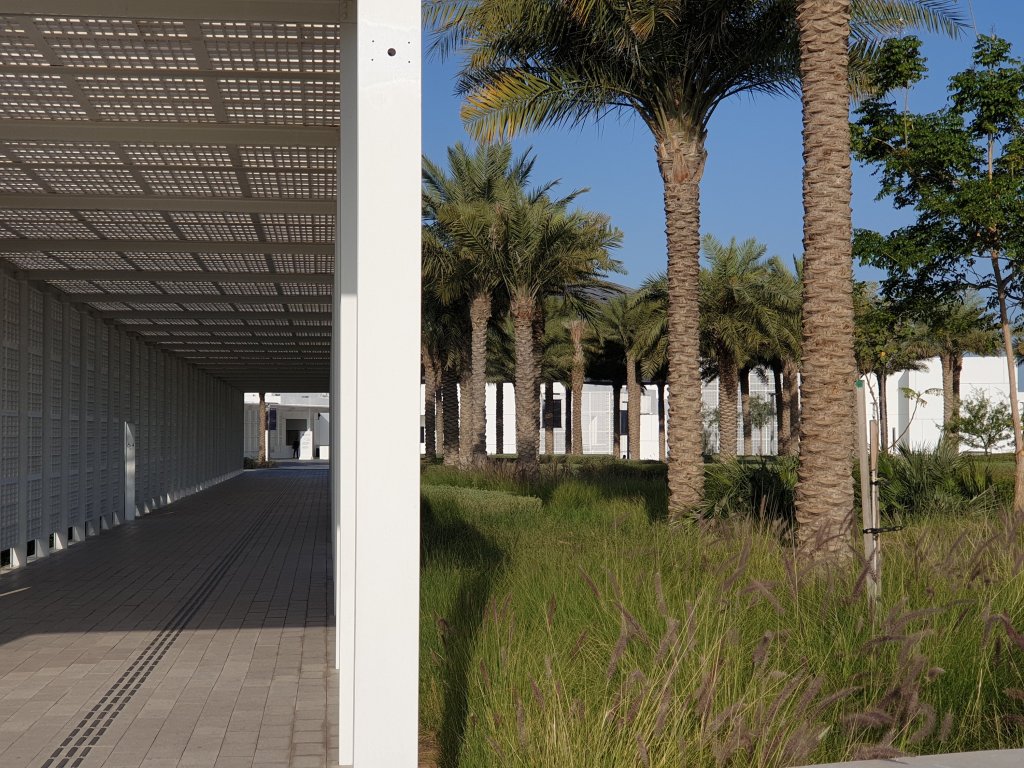
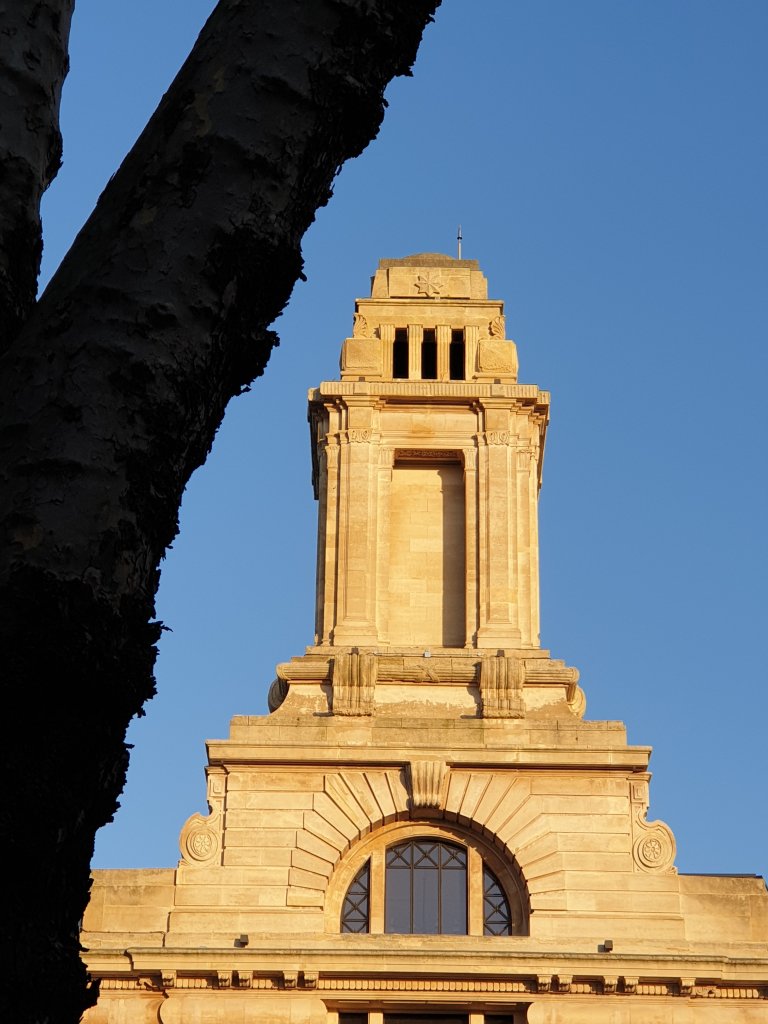
We went to the local rally in support of the campaign to save the Whitechapel Bell Foundry, which was held, first, in the hall of the East London Mosque, and, then, outside the Foundry itself. Three of the local councillors, who provide much the best hope of persuading the planning committee not to give permission for change-of-use, spoke eloquently about the importance of the Bell Foundry as a local resource, a survival of a deeply embedded sense of local traditions against the tide of international property speculation. They succeeded in persuading the committee to turn down an application last week, contrary to the officer’s advice.

I wanted to make the point that the Bell Foundry is not just of local, but of national importance. In the 1980s, I used to accompany students from the V&A and Royal College of Art on study trips to sites of industrial significance, including the Ironbridge Museum and Styal Mill in Lancashire. But none of them were as redolent or powerfully evocative of old systems of manufacture and traditional labour practices as the Bell Foundry, which had an extraordinary sense of nearly medieval continuity.

The officers have recommended approval of the plans to turn the Foundry into a hotel. I hope that, on Thursday, the councillors will be able to persuade the planning committee to turn the plans down.
Standard

The Charterhouse

I went to the Charterhouse, an unexpectedly peaceful and surprisingly large-scale, semi-monastic foundation sandwiched between Smithfield Market and the Barbican, dating in its origins to a Carthusian monastery founded in 1371, dissolved in 1537 when the Prior was hung, drawn and quartered, and used to store Henry VIII’s hunting apparel until it was taken over by the North family who built the Great Hall. In 1611, it was converted by Sir Thomas Sutton into an almshouse and school. The school moved out to Godalming in 1872, leaving the almshouses to be occupied by a community of brothers, who can enjoy a remarkable set of medieval buildings, repaired after the war by Seely and Paget:-

Standard

Ways of Drawing

One of the benefits of travelling has been the opportunity to read and digest Ways of Drawing, the Royal Drawing School’s recently published bible, containing the thoughts and ideas of its teaching staff and ex-students, including a brilliant description of what it feels like to be an artist’s model by Isley Lynn (but no pictures of what she looks like), a description of the pleasures and experience of drawing in the countryside by Daniel Chatto and of drawing items of natural history close-up by Clara Drummond. Cumulatively, the essays convey the intensity of the experience of drawing and of how it gets one to think as well as look. They’ve printed 10,000 copies, which shows how popular it is expected to be.

Standard

National Palace Museum

I felt the extreme angst of only having a morning to visit the National Palace Museum, one of the great museums of the world with its Imperial collections, the residue of all the works put into packing cases in 1933, and transported first to Shanghai, then Nanking, and eventually between December 1948 and February 1949 to Taiwan, where they were displayed in a new museum in the mid-1960s.

We started with the jades:-

I tried to remember what Craig Clunas taught in his seminar about the Cong:-

Jade Pigs were to hold as one entered into the next world:-

Then, we looked at bronzes. A cauldron from the late Shang Dynasty (c.13th. Century BCE):-

A wine vessel from the 11th. century BCE:-

The pattern on a flask from the 5th century BCE:-

A container from the Han Dynasty (25-220 AD):-

Down to painting and calligraphy, where we admired an eighteenth-century depiction of Li Bai’s ‘Preface to the Banquet at the Peach and Plum Garden on a Spring Evening’:-

I barely had a chance to study the amazing collection of ceramics. I suppose it’s always possible that one day I will come back.

Standard