The BBC arranged for a special screening of The Private Life of the Royal Academy at the Hay Festival, prefaced by a discussion chaired by Mark Bell, the BBC’s Commissioning Editor for Arts Programmes. When I first saw the programme, I wasn’t sure what the response was, but it has become increasingly clear to me that people appreciate its honesty and warmth, that it is not trying to whitewash the institution, nor necessarily to promote it, but to depict it in depth and with humanity. It was a long way to go, but worth it, if only for lunch at the other River Café:-
Author Archives: Charles Saumarez Smith
Howard Hodgkin
I went last night to the opening of the exhibition of Howard Hodgkin’s last paintings at Gagosian, an unexpectedly moving occasion of works when he was old and increasingly infirm, but still capable of painting emotionally vivid paintings with no more than a few strokes of the brush, an impeccable colourist, summoning up mood, place and atmosphere with extreme minimalism of expression, including the paintings he was working on in India at the time of his death in March 2017.
The Summer Exhibition Chronicle
Last night the Paul Mellon Centre published an online account of the history of the Summer Exhibition year-by-year with a description of the artists who entered, the key works, and, where possible, the press and public response, each year written by a different author (https://chronicle250.com). It is going to be an absolutely invaluable resource, not just for the history of the Royal Academy, but for the study of changing fashions in British art as a whole, starting with a description by Mark Hallett, the Mellon Centre’s Director, of a portrait of William and Penelope Welby by Francis Cotes which appeared in the first exhibition which opened on 26 April 1769 in Lambe’s Auction Rooms on Pall Mall. I wrote the entries for 1949 because I was interested to find out what works were exhibited in the year that Alfred Munnings gave his memorably bigoted speech (https://chronicle250.com/1949) and for 2008, the first year that I attended Summer Exhibition committee meetings (https://chronicle250.com/2008). Today is Varnishing Day, as we embark on the opening arrangements for the 250th. Summer Exhibition and, this year only, The Great Spectacle, a survey of the whole history of the exhibition, beginning with a history painting, Hector Taking Leave of Andromache by Angelica Kauffmann, exhibited alongside three others by her in 1769.
Barking (2)
Whilst in Barking, we went to admire the curious brick folly designed by muf in Barking Town Square to soften the effect of a large new development by Allford Hall Monaghan Morris alongside the 1930s Scandinavian-style town hall. Muf erected a pure brick folly at the back of the Iceland store to give Barking a sense of its history, which it should have anyway, given that it’s the site of an Anglo- Saxon nunnery founded in 666 by the Bishop of London, with a lunatic asylum attached which apparently gave rise to the phrase ‘Barking mad’:-
Barking (1)
My birthday treat was to go on a trip to Barking, to see the allotments alongside Barking Park, all impeccably neat and full of people out tending their flowers on Bank Holiday Monday:-
Perch Hill Farm
On the way back to London, we called in on Perch Hill Farm (not open to the public) in order to admire the cutting garden:-
Firle to Charleston
I had wanted to walk along the old coach road from Firle to Charleston, remembering the first time that I visited the house in the early 1980s when it had just begun to be restored, walking along the track under Firle Beacon.
I started by walking across the fields from Charleston:-
Looking out across Firle Estate:-
No tea available in Beanstalk Cottage:-
Then back along the track to Tilton:-
Charleston Barns
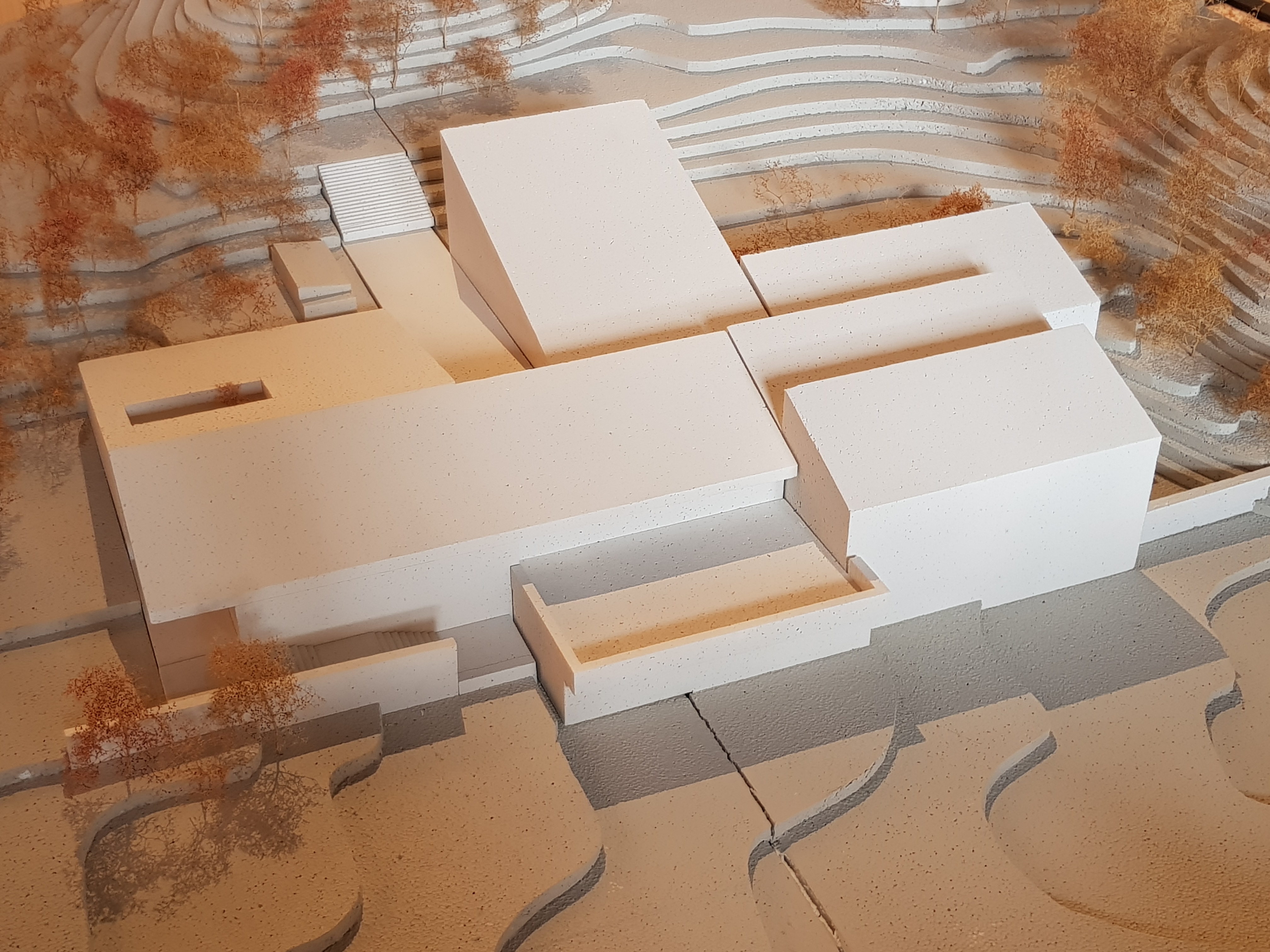
At lunchtime I saw the progress that has been made on the renovation of the Charleston Barns, which are looking good.
The eighteenth-century barn which had a fire in the 1990s and was then rebuilt:-
And the beautiful new daylit gallery spaces in the part added by Jamie Fobert:-
Due to open in September.
Vanessa Bell (2)
I do not think of Vanessa Bell as a product of the Royal Academy Schools because the whole of Bloomsbury was so implacably hostile to the the Royal Academy and everything it stood for. But it was then the leading art school and after lessons at home from Ebenezer Cooke and a period studying at Arthur Cope’s art school at Park Cottage in Pelham Street, she entered the Royal Academy Schools in 1901 where she learned anatomy and perspective from, amongst others, George Clausen and John Singer Sargent. Not much of her early work survives apart from her very beautiful silvery picture of Iceland Poppies which survives at Charleston and shows how accomplished she was as a painter before friendships with Roger Fry and Duncan Grant moved her in the direction of Post-Impressionism.
Vanessa Bell (1)
I had forgotten how redolent of Vanessa Bell’s paintings and personality the interiors of Charleston are, including the bedroom on the ground floor where she died on 7 April 1961 under a portrait of Julian from whose death she never wholly recovered:-


You must be logged in to post a comment.