
Well, of course, I had hoped that Romilly would win, but am nonetheless pleased and proud that she was on the longlist and am posting some photographs I took of her most recent work in her honour:-


Well, of course, I had hoped that Romilly would win, but am nonetheless pleased and proud that she was on the longlist and am posting some photographs I took of her most recent work in her honour:-
I spent part of a meeting this morning staring at Benjamin West’s Self-portrait over the fireplace on the other side of the room and realising how little I know about him, other than the fact that he came from Philadelphia, was trained as a painter in Italy, came to London in 1763, and was the longest serving President of the Royal Academy, taking over from Joshua Reynolds in 1792, resigning in 1805, reinstated in 1806, and serving until his death in office in 1820.
What sort of person was he ? His Self-portrait in the RA suggests someone rather smoothly worldly, wearing a cravat, sitting in the President’s chair (it was painted in 1793, the year after he was elected President), with his hand wrapped over a pile of books, and with the river facade of Somerset House behind. I know that he was a successful artist. I didn’t know that he was a successful dealer as well, buying Titian’s Death of Actaeon at auction in 1785 for 20 guineas and appointed Surveyor of the King’s Pictures in 1791, the year before he became President of the RA.
Although he was much admired and supported as an artist by George III, becoming official historical painter to the king in 1772 and commissioned to supply history paintings to both Buckingham Palace and Windsor Castle, this did not prevent him from supporting the French Revolution and visiting Paris in 1802 in order to pay his respects to Napoleon.

© Royal Academy of Arts, London; Photographer: John Hammond
Following my reference last week to the earlier competition for Burlington Gardens, David Chipperfield’s archivist kindly located what must have been his entry for it – or, at least, his notes for his presentation which are dated 6 February 1998 (I must have got the date of the competition wrong).
What is interesting is how many of the characteristics of his subsequent architectural design are – as I had half expected and is probably inevitable with an architect dealing with the same set of issues – already evident in the earlier competition entry. The sketches show his sense of the beaux arts relationship between Burlington House and Burlington Gardens, which he illustrates in a tripartite arrangement – house, courtyard, gardens; his understanding of the whole site as a single unified campus; the dilemma of a second front door to Pennethorne’s Burlington Gardens; his acknowledgement that the issues to be solved were as much organisational as physical; and the requirement for what he describes as a NEW LINK.
He asks rhetorically HOW TO LINK THE TWO BUILDINGS; and answers his own question by illustrating an AXIAL LINK, the only difference to the final solution being that he shows it as a link from the ground floor of Burlington Gardens to the main floor of Burlington House, as opposed to, as has now been built, its basement.
The reason I’m especially interested in these drawings is that the bridge (oddly given this history) only made its appearance relatively late in the gestation of the current scheme, since the 2008 competition was about Burlington Gardens on its own, and, when a link was originally proposed, the idea was to have a grand reverse staircase in the space now occupied by the McAulay Gallery taking one from the ground floor of Burlington Gardens to the basement and then across the courtyard sans bridge.
It is now a key feature – if not the key feature – of the design:-

I have been trying to find out more about Eric de Maré, the 1950s architectural photographer whose fascination for industrial buildings was such a formative influence on a number of architects in the late 1950s, including Norman Foster and Michael Hopkins, who learned about the idea of anonymous architectural form in the photographs he supplied for The Functional Tradition as shown in Early Industrial Buildings, first published as a special issue of the Architectural Review in July 1957 and reissued the following year as a book supplemented by a few additional photographs by John Piper and Richards himself.
De Maré was the son of a Swedish timber merchant, educated at St. Paul’s and the Architectural Association, and worked for a period as an architect before becoming editor of the Architect’s Journal in 1943. After the war, he went freelance and wrote a book on Canals which demonstrated his fascination for the industrial vernacular, with a chapter on ‘Sculpture by Accident’ and photographs of lock valves, balance beams, and bollards. He described this as a form of functionalism: ‘its constiuent elements are geometry unadorned, and it owes its effects to the forthright, spare and logical use of materials’.
Michael Hopkins paid for the acquisition of de Maré’s photographic archive by the Architectural Association in 1990 and his book inspired the construction of the barge-boarded lift inserted into (or onto) the back of our house not so long ago:-

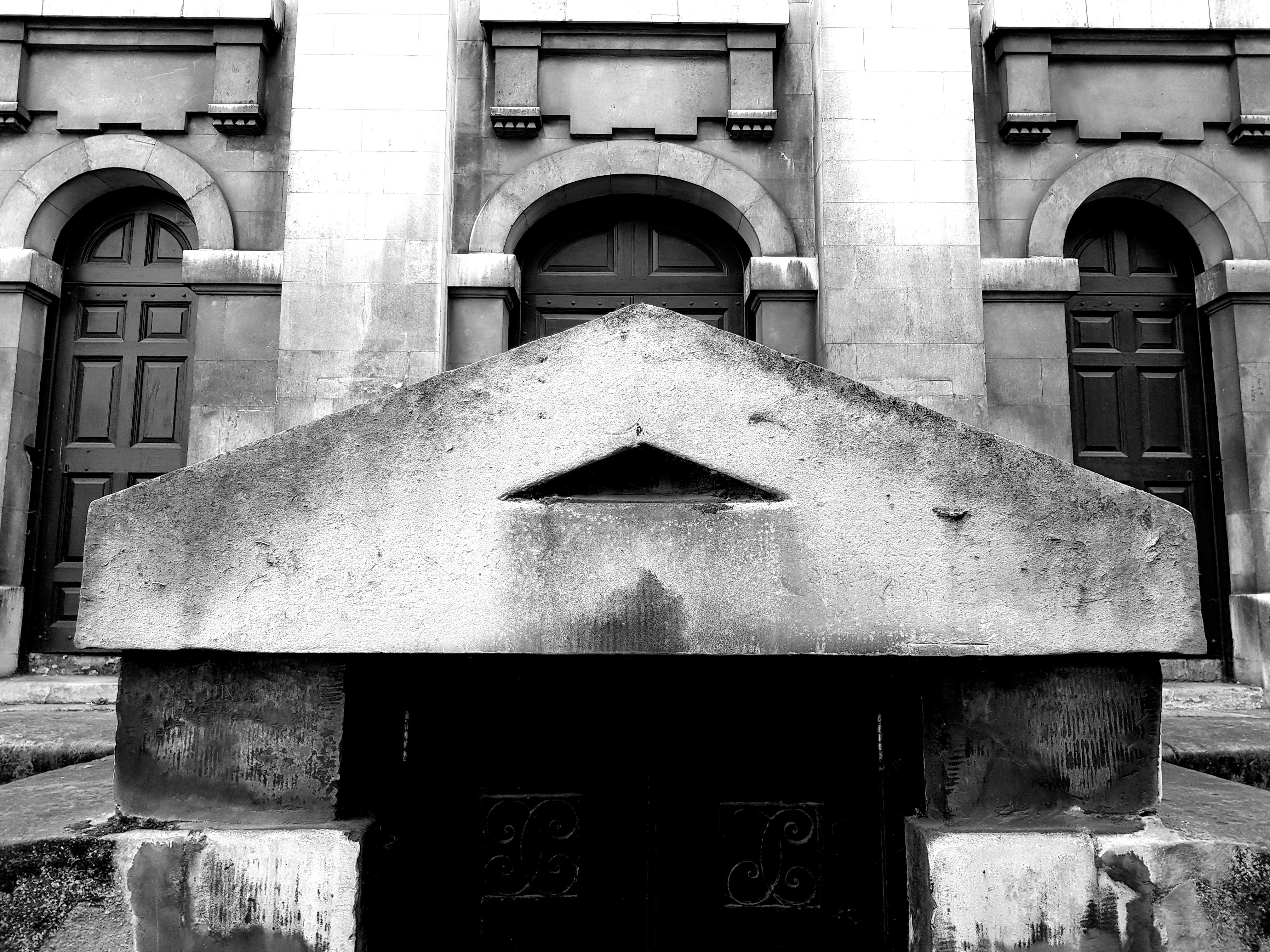
St. Alfege, Greenwich is the Hawksmoor church I know least well. It was the first to be built following the passing of the Fifty Churches Act in 1711. Hawksmoor produced two alternative designs. The smaller of the two was chosen on 6 August 1712 and it was agreed that it was ‘To be proceeded upon with all convenient speed’. By September, the bricklayers were at work in laying the foundations. It was consecrated in 1718. Because it was an adaptation of an existing medieval church, it lacks the originality of Hawksmoor’s east London churches, but it still has plenty of characteristically monumental detailing. The tower was later and by John James:-



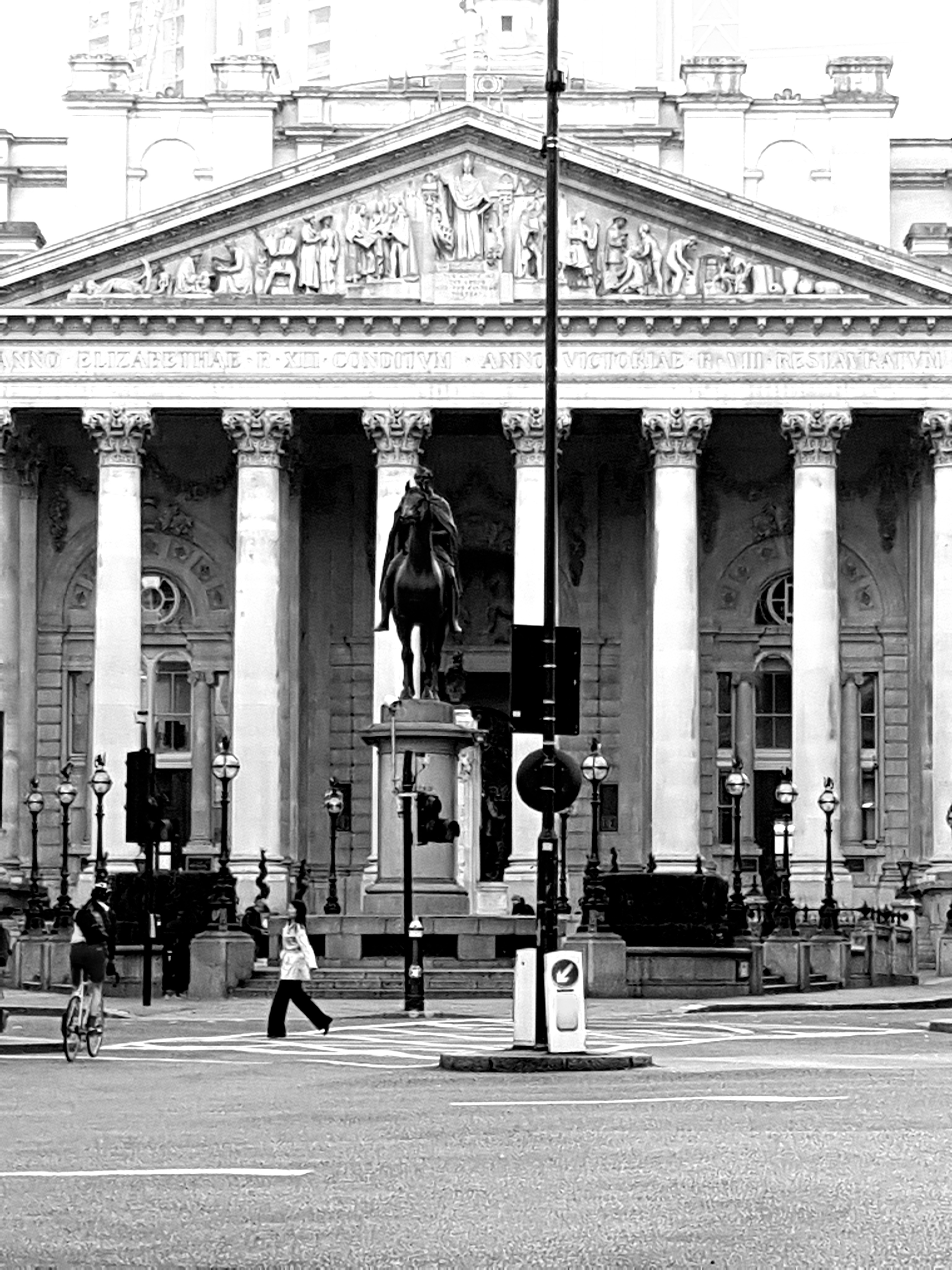
An early morning breakfast in the City allowed me to see the Royal Exchange building oddly and unusually without traffic in front. The original Royal Exchange by Queen Elizabeth I on 23 January 1571. It burnt down in the Fire and a replacement was designed by Edward Jarman. It burnt down in 1838. Its replacement was designed by William Tite who mainly designed railway stations, but won the second competition for a grand, classical building against Cockerell, Smirke and Barry:-
Beyond it is the Cheesegrater, the Gherkin and an as yet unnamed tower block currently under construction:-

And the Walkie-Talkie hovers in the early morning smoke:-

I have now had a chance to read Moneo’s lecture in its elegant, printed form and to confirm what I had half realised: that Moneo compares the contemporary loss of faith and belief in the tenets on the Modern Movement and the move away from the Vitruvian concepts of firmitas, utilitas and venustas to a belief in technological suprematism alone (or anything goes) is paralleled by Soane’s situation at the end of his life: ‘It is a situation not very different to that of Sir John Soane, when, at the end of his life, from his house in Lincoln’s Inn Fields, he could see that the architectural canon and the language of Classicism were no longer valid and that the new world of architecture was something he wouldn’t recognise’.
I went to hear Rafael Moneo give what was described as the first Soane annual lecture at the Royal Institution, although I thought I had a shelf-ful of earlier ones in the Soane section of my library, and receive the Soane Medal, a replica of the medal that Soane was given in 1835 by ‘the Architects of England’. It felt like a manifesto, deeply felt and dense with historical references. There were two things which I will particularly remember. The first was the way in which Moneo described Soane in the early 1830s at the end of his career mourning the loss of faith in the classical tradition as a younger generation began to experiment with radical pluralism: ‘Soane, who had shown his profound love and respect for Rome in the design of his own home, and his passionate collecting of classical antiquities, was conscious, perhaps with a certain melancholy, that he would represent the end of the deeply nostalgic English architecture that had taken the Eternal City as its inspiration since the time of Inigo Jones’. The second was the extent to which David Chipperfield, who was master of ceremonies and engaged Moneo in questions after the talk, so obviously admired Moneo for his compromise between modernity and the reference to history. He did an exhibition of Moneo’s work in his 9H Gallery in 1986, just at the time of the completion of the National Museum of Roman Art in Mérida. It showed the route out from postmodernism, a belief in the more cerebral, as well as material, qualities of building.
I went last night to a discussion about the characteristics of cities in the 2020s which took place under Chatham House rules. I hope that I am not breaching them by saying that much of the discussion was about the need for devolution and the involvement of the local community if the housing crisis is in any way to be solved; and that Brexit is likely to make this impossible, because, not least, it involves far too much of the energies of the current government. One statistic particularly stuck in my mind, which is that in London, 80% of the housing being built is affordable to only 8% of the population: hardly the way to solve the crisis.
And I enjoyed the staggering view south of central London:-


And of New Zealand House close to:-

I took Ricky Burdett and David Rosen round Burlington Gardens. Both have been closely involved with the project at different stages – Ricky as a member of the jury in the first competition in 1996, won by Michael and Patty Hopkins, but with David Chipperfield as close runner-up; David Rosen who was responsible for leasing the ground floor gallery space to Pace. Ricky’s comment was how unforced it feels as a project, using the existing spaces and enhancing their characteristics, rather than trying to impose new uses on them. I have never seen David Chipperfield’s entry to the 1998 competition and have often wondered how far it informed the intelligent confidence of his entry to the third and final 2008 competition ten years later:-
 | Charles | Saumarez | Smith |
You must be logged in to post a comment.