
I meant to find out about J.P. Gandy Deering yesterday, wondering about his role assisting Wilkins in the design of University College. The answer is that he was the younger brother of the great J. M. Gandy, draughtsman to John Soane (their father was a waiter at White’s Club). A pupil of James Wyatt, he was trained at the Royal Academy Schools, exhibiting A Design for the Royal Academy in 1807. After travelling to Greece on an exhibition organised by the Society of Dilettanti, he collaborated with Wilkins on the design of an 820 foot tower planned for Portland Place and on the design of the University Club in Pall Mall. He actually came second in the competition for University College, but then assisted Wilkins in the execution of his winning entry. In 1828, he inherited an estate in Buckinghamshire from his friend Henry Deering, took his name, and more or less gave up architecture.
University College
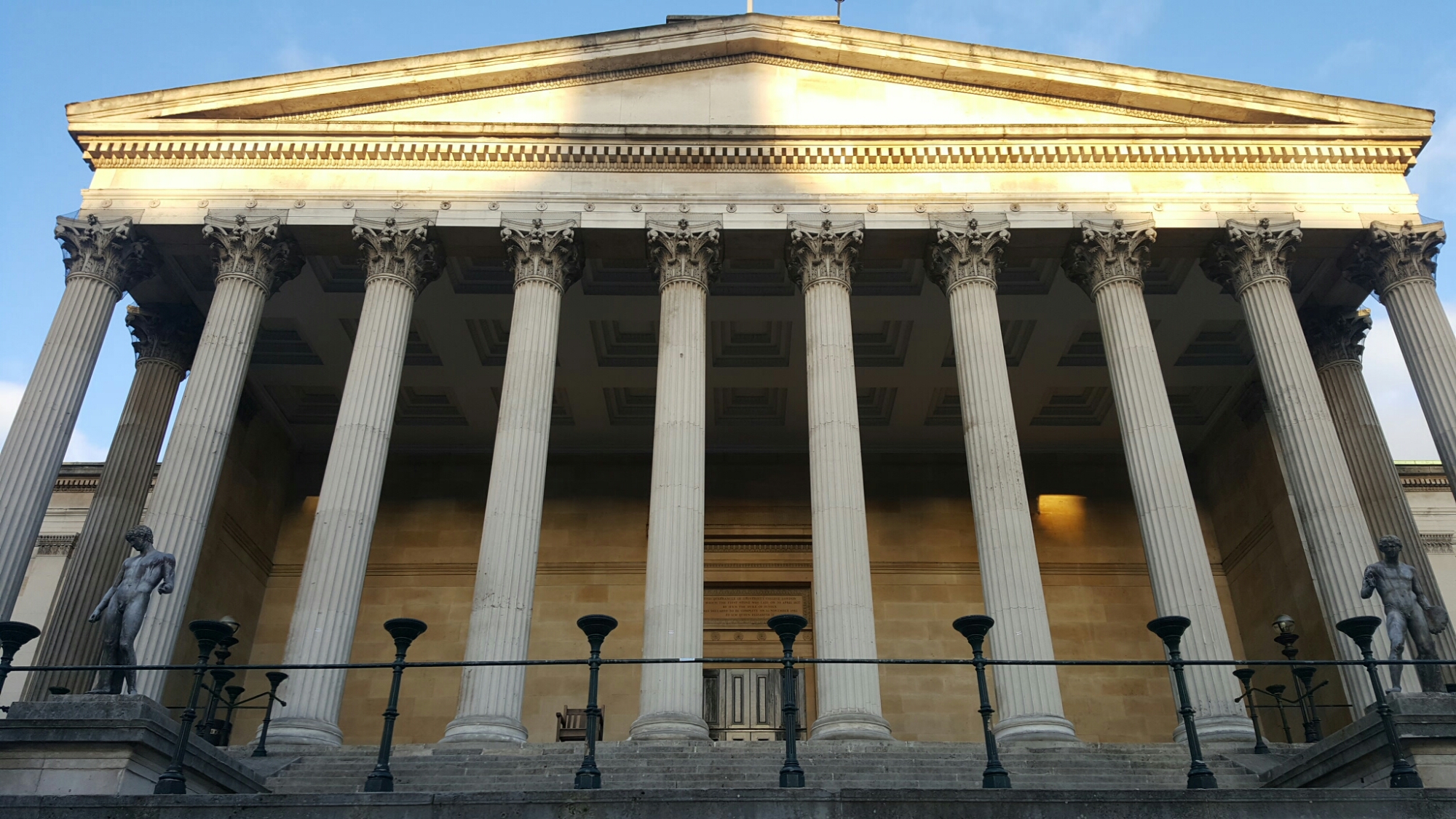
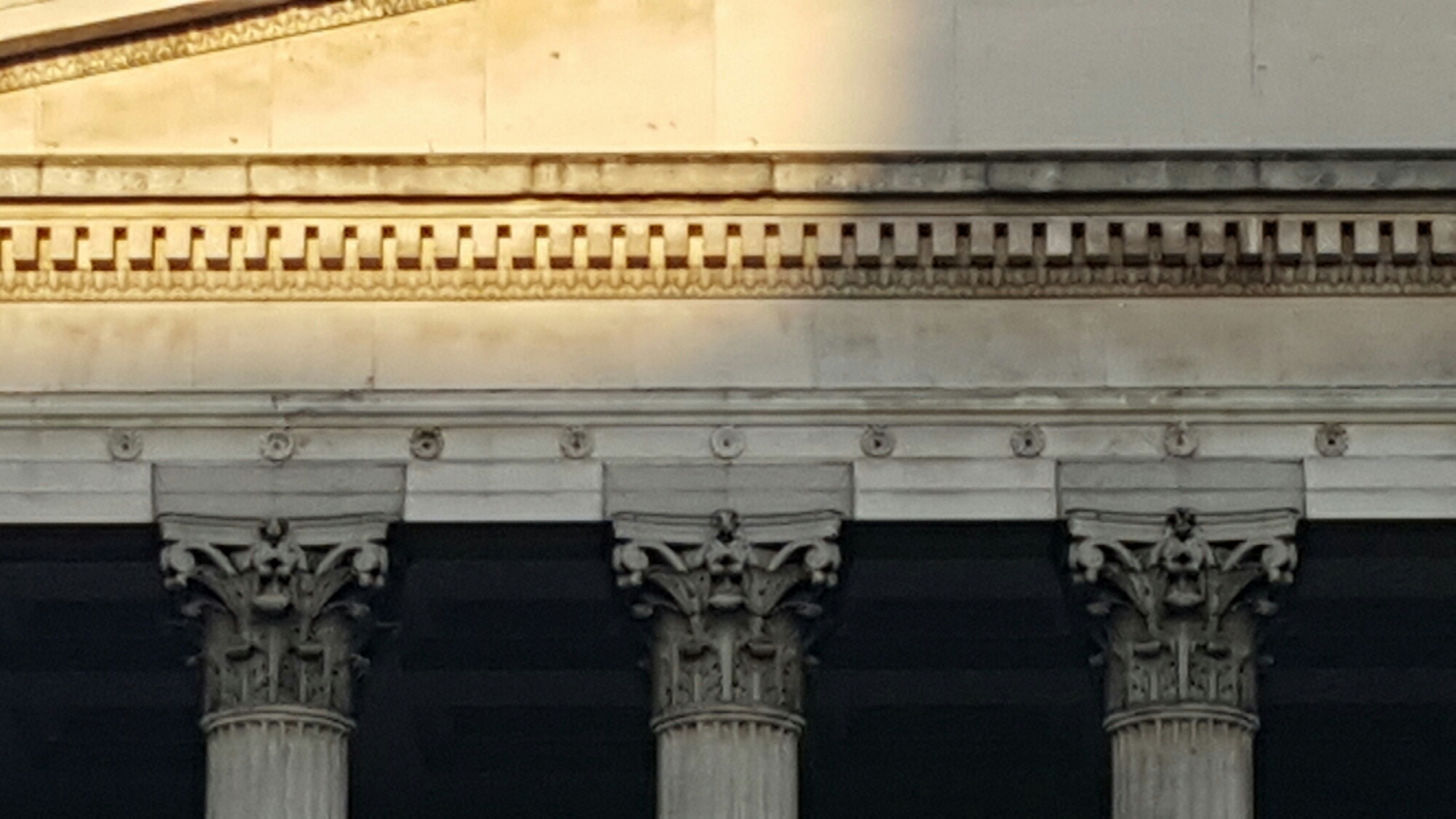
As I walked back to the underground from Birkbeck, I wandered through the labyrinth of University College and found myself in its entrance courtyard, admiring William Wilkins’s great neoclassical façade, done in conjunction with J.P. Gandy-Deering after the founding of the college in February 1826 and much more effective as an architectural composition than the later National Gallery:-
Can Culture Replace God ?
I was asked to speak this afternoon at a conference on the theme of ‘Can culture replace God ?’, which was good for the mind if not for the spirit. Much of the discussion was on the severence of culture from religion, beginning in the eighteenth century with Voltaire and extending to the writings of Lessing, Kant and Hegel and the ways in which the Romantic poets replaced the experience of religion with transcendental subjectivity and the worship of nature. I wasn’t able to contribute to this part of the discussion, but I was able to supply information and statistics on the ways in which the rise of going to museums has paralleled the decline in going to church. After my lecture at South Creake last month, I discovered that the Royal Academy undertakes market research on the extent to which visitors regard going to an exhibition as the equivalent of going to church: 32% of visitors view exhibitions as an opportunity to stimulate the imagination; 29% as an opportunity to reflect or contemplate; and 25% for inspiration. Art may not be able to provide a satisfactory meaning for existence (and nor nowadays does going to church), but it can, as in the work of Kiefer, provide an experience of the transcendent.
Art History A Level (6)
More discussions about how to ensure that art history does not die as an A Level subject in 2018. It has become clear that the issue is much broader than simply retaining art history as an A level subject, currently mainly in private schools: that is, how to ensure that there is at least some teaching and awareness of art history in state schools more generally, not just at A Level, in order to ensure visual literacy. At the moment, anecdotal evidence suggests that pupils are introduced to ideas about art history in Primary Schools. Then, there is a requirement that pupils should learn about art history as a part of Key Stage 3. But does this actually happen ? The big loss is the reduction in the amount of art history which is taught as a part of art and design education since artists are no longer expected or necessarily encouraged to know about the past.
Christmas in Dumbarton Oaks
I am prompted by comments on my blog about Anthony Bryer to say slightly more about the Christmas we spent with him in the Fellow’s apartment at Dumbarton Oaks. We were the only people there and so had the run of the house, library and garden. He had assumed that Romilly, who was with me, was a man because the well known Byzantinist Romilly Jenkins was male and was pleasantly surprised to discover otherwise. We had what my family would describe as a very Bryer-ish time (this was to capture the element of the zany), attending midnight mass at a church on Massachusetts Avenue and then taking a shortcut back across the grounds of the British Embassy and, on Boxing Day, having a drink in a bar on Wisconsin Avenue where Bryer was totally oblivious to the fact that it was striptease joint. He then shipped us off to friends of his in Virginia who had a private aerodrome.
Burlington Gardens
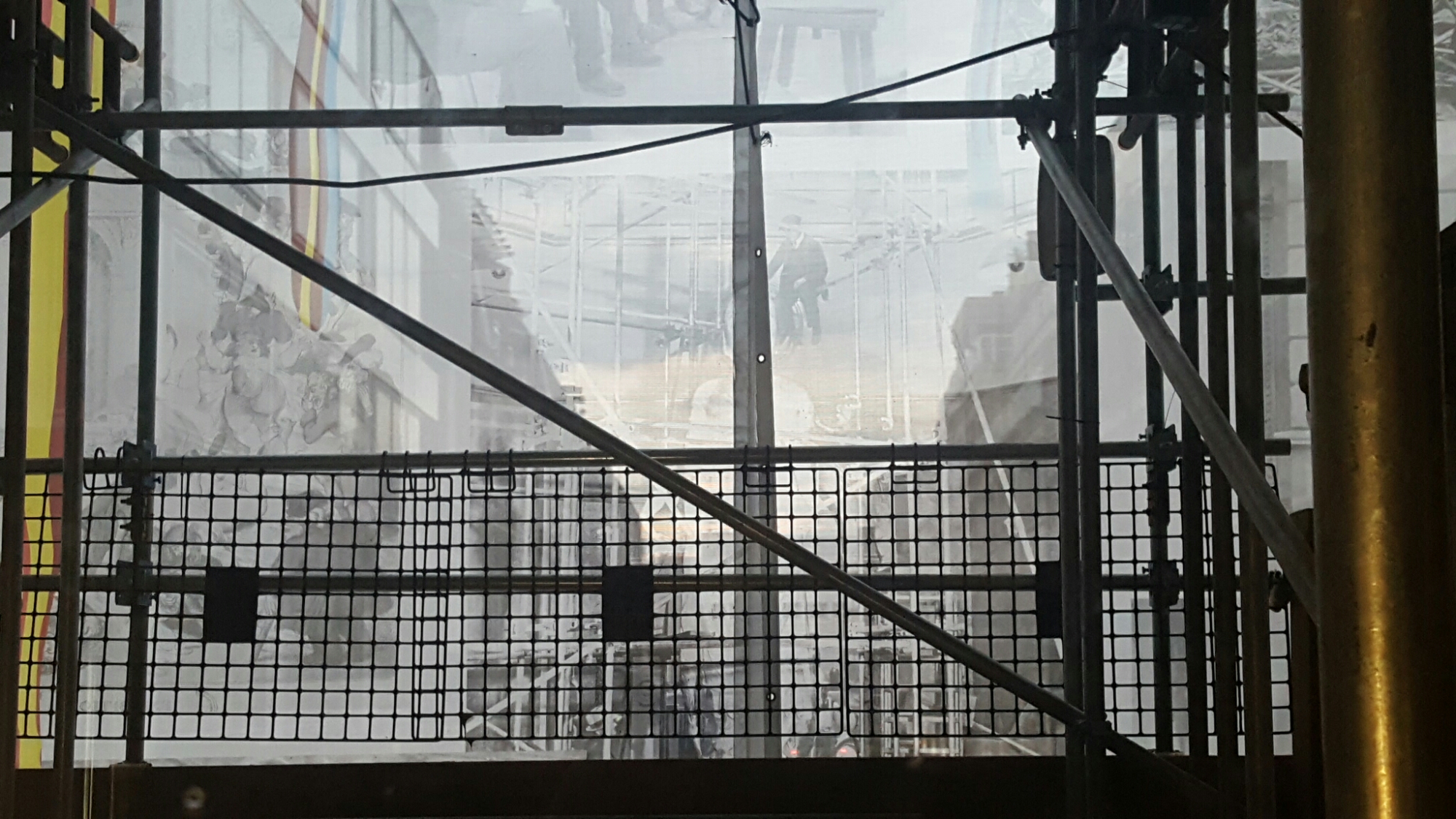
I went this afternoon to see the progress of work on our building project in Burlington Gardens. It’s gathering pace with up to 170 people working on site in conditions which resemble the ruins of an ancient city.
This is the view of the scaffolding on the north façade:-
Begonia Maculata
While I’m at it, I’m also posting a picture of the spotted leaves of a Begonia Maculata, which I admired so much during our weekend in Wiltshire that I was presented with it. It now sits in a position of honour, flowering in the drawing room:-

November
I’ve just been asked by a friend if I’m OK because my blog has gone silent for a couple of days. The truth is that I do sometimes go silent, overwhelmed by Royal Academy business. But just to prove that I’m still alive and well, I’m posting two pictures of the Thames in the fog at the weekend:-


Vanessa Bell
We went to hear Vanessa Redgrave read a selection of letters by Vanessa Bell to mark her move from London to Charleston a hundred years ago. The letters to Roger Fry, her sister Virginia and her lover Duncan Grant conveyed the pleasures and privations of their early years at Charleston in the closing years of the First World War, the birth of her daughter Angelica by Duncan Grant, the eating of grouse by T.S. Eliot and her reading of The Waves, the tragedy of the death of her oldest son Julian in the Spanish Civil War and the marriage of her daughter Angelica to Bunny Garnett, her father’s former lover. Charleston was both creative and incestuous. Redgrave’s reading conveyed the anguish of what happened there.
J.C. Cording & Co.
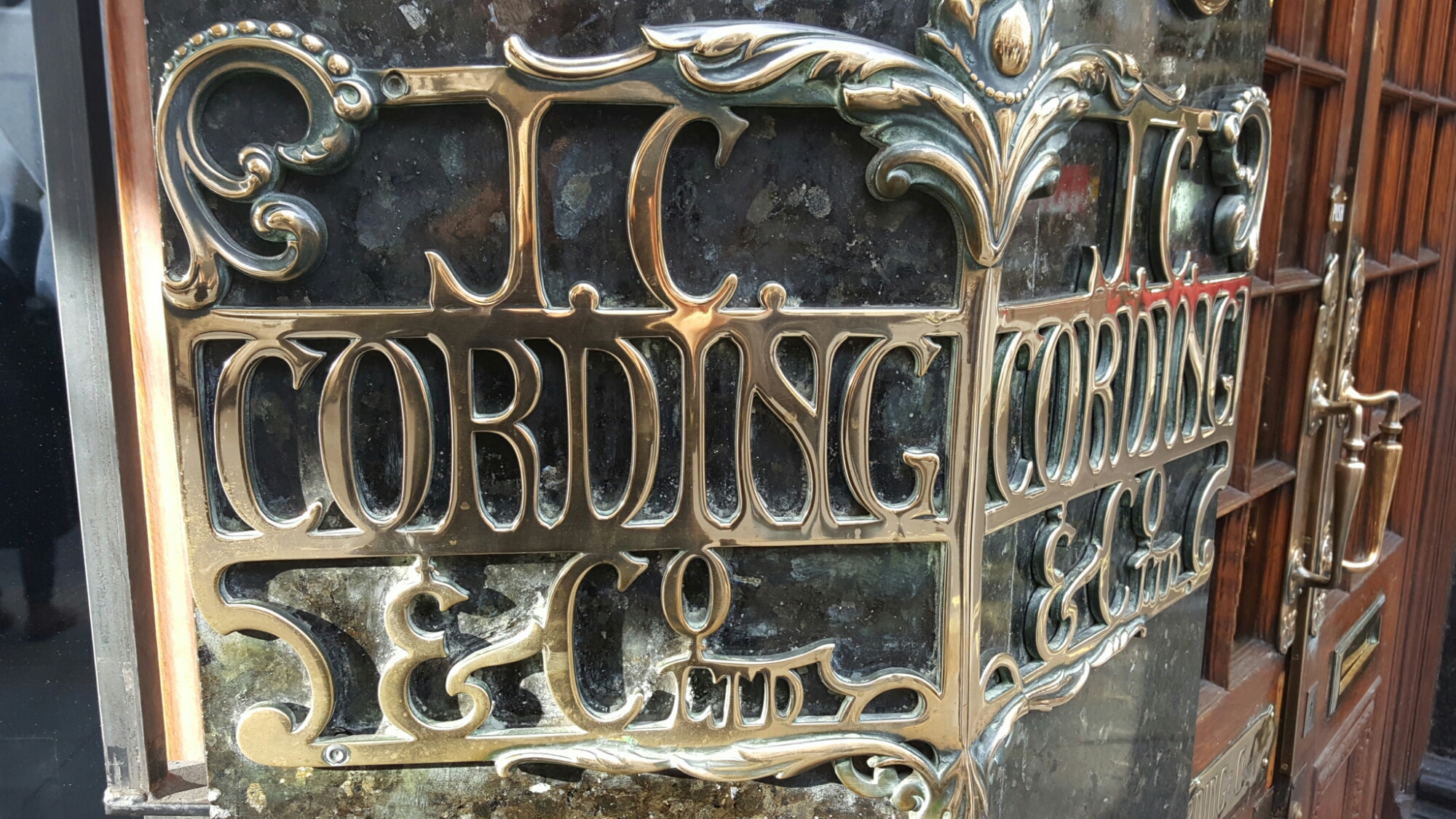
I was wandering along Piccadilly last week thinking that it is a while since I have done an architectural post (not quite true, I know) and have been meaning to find out more about J.C. Cording & Co. whose flamboyant brass lettering announces their shop. The history of the shop is, as I guessed, interesting: first established in 1839 on the Strand for the supply of waterproofs, they moved to Piccadilly in 1877. When the street was widened, Cordings resisted and kept their original façade. It’s now owned by Eric Clapton. Oddly, I can’t find out anything about the building which is omitted by Pevsner:-
 | Charles | Saumarez | Smith |
You must be logged in to post a comment.