Whitechapel Bell Foundry (83)

Much is happening vis-à-vis the Whitechapel Bell Foundry at the moment.

In particular, there is an article which has appeared in Planning, a professional journal which can only be read behind a paywall, which makes clear that the only reason that the Planning Inspector was so emphatic in his support for the Raycliff scheme was that Christopher Pincher, a junior Minister in the Department for Housing, Communities and Local Government, inadvertently told MPs that Robert Jenrick was determined to turn planning permission down, which opened the government up to the risk of judicial review. This is presumably why Jenrick is so determined to make clear that the decision was not his, even though it says it was.

But there is a problem in this. If the government was so afraid of Judicial Review that the Treasury Solicitors instructed the planning inspector to find in favour of redevelopment, then this means that the whole Planning Inquiry was in retrospect a complete farce. It was not an independent Inquiry. There was a predetermined outcome. A Freedom of Information request should be able to extract the relevant documentation.

In which case, there needs to be a judicial review to make sure that due process was followed and the outcome wasn’t cooked.

Standard

Whitechapel Bell Foundry (82)

I have been trying to figure out what exactly has gone wrong at the Department for Housing, Communities and Local Government.

The approval for the redevelopment of the Whitechapel Bell Foundry was signed and sent out in the early afternoon on Thursday. It was signed by someone called Andrew Lynch who is the Decision Officer in the Planning Casework Unit on the third floor of the Fry Building in Bristol. Obviously, the civil servants had decided to totally ignore the views of the Secretary of State and follow the technicalities of the Planning Inquiry and its chairman Paul Griffiths BSc BArch IHBC who had come to the conclusion that, in a narrow sense, what is proposed keeps the majority of the historic fabric of the building and the fact that its historic use has been abandoned by the Hughes family is not a matter of his concern. The letter of approval begins ‘I am directed by the Secretary of State’ and ends ‘This decision was made by the Secretary of State and signed on his behalf’. But obviously nobody thought that it could have been helpful to check that these were indeed the views of the Secretary of State and that he supported them. Had they done so they would have discovered that he deeply disapproved of them, as is now publicly apparent.

So, this is quite a big mess and an indication that the planning system and Historic England are disconnected from the views of their Ministers and have chosen to totally ignore them, as sometimes happens in civil service procedure.

What can be done about it ?

Maybe a Judicial Review is called for to investigate exactly how and why Historic England chose to ignore the public, political and community issues surrounding the Whitechapel Bell Foundry and adopt such a narrowly and consistently legalistic approach without regard for the historic significance of its use.

The history of England is not just about building fabric. It is about about the people who occupied those buildings, the trades they practised and their craft skills. Historic England needs to pay attention to people, including its critics, and not just the small print and narrow views of the planners on the third floor of the Fry Building in Bristol.

Standard

Triggered Economics

We went to see an exhibition by young artists on the top floor of a currently disused office building on Bruton Street, one of apparently hundreds in Mayfair which have been vacated during the pandemic.

I liked Aaron Ford’s Man with yellow shirt and blue jacket:-

Emma Witter, You Deserved Better:-

Kate Bickmore, Laid in White Bush:-

Standard

Whitechapel Bell Foundry (81)

I thought I was fired up and distressed about the fate of the Whitechapel Bell Foundry. But I have just read a piece of invective (The final toll | Brice Stratford | The Critic Magazine) which makes everything I have written pale by comparison. The odd thing is that everyone understands the symbolic significance of the Bell Foundry as a monument not just of London history, but more global, the place where the Liberty Bell was cast. But no-one seems willing or able to save it, least of all Historic England, whose job it is. Or the National Trust, whose job it could have been. Or the Heritage Lottery Fund which could have intervened. Or the Department for Housing, Communities and Local Government. Or the Department for Culture, Media and Sport.

Now Robert Jenrick has pledged on twitter to sort it out – at the very least , to find out what went wrong. The most obvious thing that went wrong was that his junior minister signed a document in Jenrick’s name on Thursday giving the destruction of the Bell Foundry planning permission.

Brice Stratford is a theatre director. I am not sure if it is tragedy or farce.

Standard

Whitechapel Bell Foundry (80)

Curiouser and curiouser.

It has just been pointed out to me that Robert Jenrick, the Secretary of State for Housing, Communities and Local Government has tweeted to say that ‘Like many I was saddened to see the foundry close. It was a unique part of our industrial heritage: 450 years of production from the Liberty Bell to Big Ben. I have commissioned a review of how the Planning Inspectorate and planning policy considers and defends heritage’.

So, the question must, and will be asked: why the hell did the Department for Housing, Communities and Local Government issue a statement yesterday in Jenrick’s name and over his signature approving the redevelopment of the Bell Foundry as a boutique hotel ?

There are several possibilities:-

The Department felt that they could not overturn the recommendation of the Planning Inspectorate however much they may have wanted to. So, the statement was issued in the Secretary of State’s name without him being aware of it. This would not be good practice, but is imaginable.

The statement was issued with his knowledge, but he is now anxious to find a better solution than the one currently proposed and obviously shares the view that the planning system has made the wrong decision.

Someone else intervened and compelled the Department to issue the approval for reasons which it is fairly easy to imagine.

This is definitely promising and I have long felt that it could be helpful for the Secretary of State to consult Bippy Siegal and see if he would consider a fifty-year lease either to Re:Form or, if there is too much bad blood, to a newly constituted heritage trust, possibly under the auspices of the National Trust, which would preserve the historic site and reinstate its original use (actually, a modern version of its original use) as has been proposed by Factum Arte. He could at the same time be allowed to build the adjacent hotel, possibly with agreement that it could be several stories higher to compensate him from his financial loss.

In this way, Robert Jenrick could be the saviour of the Bell Foundry, as it seems from his twitter statement he would like to be, not the sole signatory on its death warrant. So, could Bippy Siegal.

Let’s hope !

Standard

Whitechapel Bell Foundry (79)

Readers of my blog may recognise the attached. It has been ingeniously stitched together from my recent blogs. The twittersphere is rightly full of outrage:-

https://www.apollo-magazine.com/whitechapel-bell-foundry-decision-boutique-hotel/

Standard

Whitechapel Bell Foundry (78)

I have been trying to digest the decision by Robert Jenrick to allow the conversion of the Whitechapel Bell Foundry into a hotel. It feels like one of those moments in the history of planning law which is symbolic above and beyond the specifics of the case.

Two issues stand out. The first is that Robert Jenrick helpfully intervened when Tower Hamlets gave permission. This government presents itself as patriots – all this stuff about schools being required to raise the flag every morning, every Minister being photographed with a Union Jack in their living room, the absurdity of the monstrously tacky press room in Downing Street, covered in flags, which was abandoned as fast as it had been created by Russian contractors. But, of course, it is play-acting, a superficial veneer over rather brutal capitalists, who are happy to use British history for their own purposes, but when a decision comes about protection and preservation of a living monument of the past, instead support one of their friends, who is no doubt a party donor, an American vulture capitalist. A hotel for foreign tourists is more important than a bit of living history. You can feel the mood in the City, where so little is left of the historic City, but instead it is more like Hong Kong.

The second issue relates to Historic England. Maybe they can rebrand themselves as Ex-Historic England: a public body which gives paid advice to property developers to encourage them to get through the existing planning systems, during the time that so much of the planning controls are themselves being dismantled. I hope that the Commissioners of Historic England, who have so conspicuously failed in their public duty, might consider what went wrong: why they did nothing; why they have allowed this to happen in such a conspicuously supine way.

Standard

Historic England

I have been thinking of the role of Historic England in terms of its total failure to recognise the historic importance of the Whitechapel Bell Foundry and protect it. Last year it received £87.1 million from H.M. Treasury via the Department for Culture, Media and Sport to ‘protect, champion and save the places that define who we are’. Yet, it has sat on its hands and allowed England’s oldest place of manufacture to be butchered and turned into a hotel. Not one single one of its 884 staff has lifted a finger to protect the Foundry, but instead they have worked in league with the developer, accepting payment for their advice. So, could we maybe ask whether or not it is fulfilling its role ?

Standard

Whitechapel Bell Foundry (77)

As a way of recording and recollecting what has been lost, I am re-posting the blog I wrote on 25 February 2017, the first and only time I ever saw the inside of the Whitechapel Bell Foundry when it was still in operation. It was an extraordinary survival, still preserving what were essentially late medieval systems of production.

I don’t know anywhere which was equivalently powerful or demonstrated so clearly such traditional systems of hand-made production.

https://charlessaumarezsmith.com/2017/02/25/whitechapel-bell-foundry-6/

Standard

Whitechapel Bell Foundry (76)

I can scarcely bear it.

After four years of fighting and campaigning and sometimes weekly meetings fund-raising, the Secretary of State has made his decision. The Whitechapel Bell Foundry will be turned into a hotel. Four and a half centuries of bell-making in Whitechapel has gone to pot and another bit of British history will be turned into an ersatz coffee bar – what Historic England, in their wisdom, responsible for the preservation of the historic fabric of England, calls ‘adaptive re-use’, a totally weaselly term, which allows the Commissioners to celebrate the plundering of the past for the purposes of private enrichment, perhaps not surprising now that all trustees are going to have to take an oath of loyalty to the Prime Minister.

Before I sign off on this topic for the 76th. time, I would like to thank and celebrate the work of Re:Form and Factum Arte which put forward such cogent and well-considered plans to protect the Bell Foundry and re-instate it. And also to thank all those people who contributed large and small sums to the appeal, many of them my friends and blog-followers. Your support – and the support of all those hundreds and thousands of people who have written and campaigned to save the Bell Foundry – has been really appreciated.

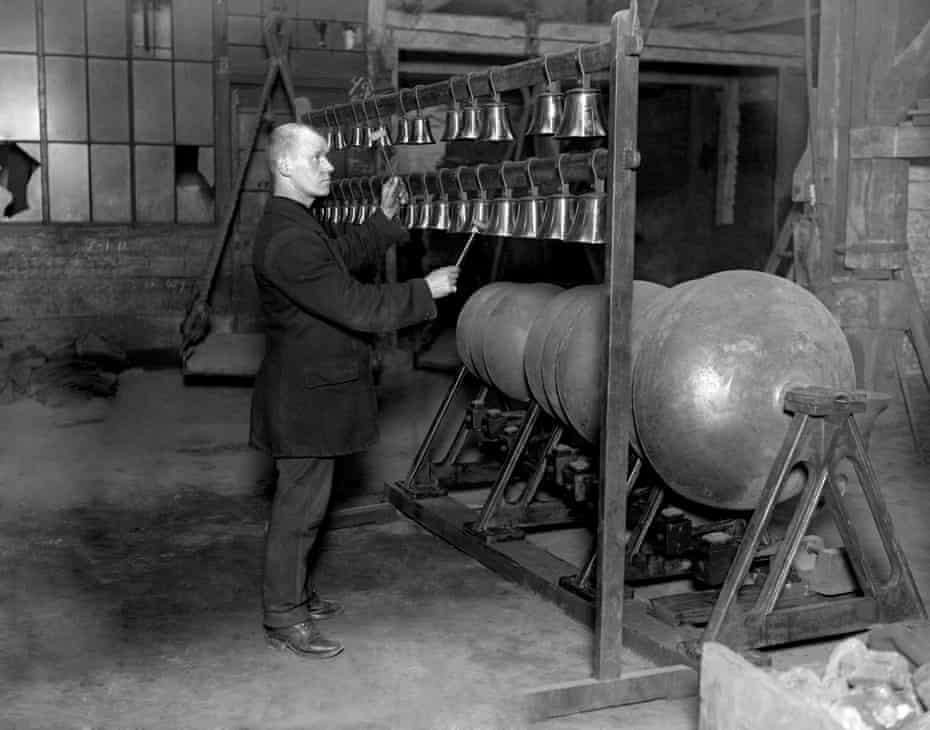
For those of you who did not see it, I attach the excellent article in the Guardian a couple of days ago (https://www.theguardian.com/news/2021/may/11/whitechapel-bell-foundry-battle-save-britains-oldest-factory). And a mournful picture from 1919 as bell making moves to China:-

A photo dated 1919 of a worker at the Whitechapel Bell Foundry.
Standard