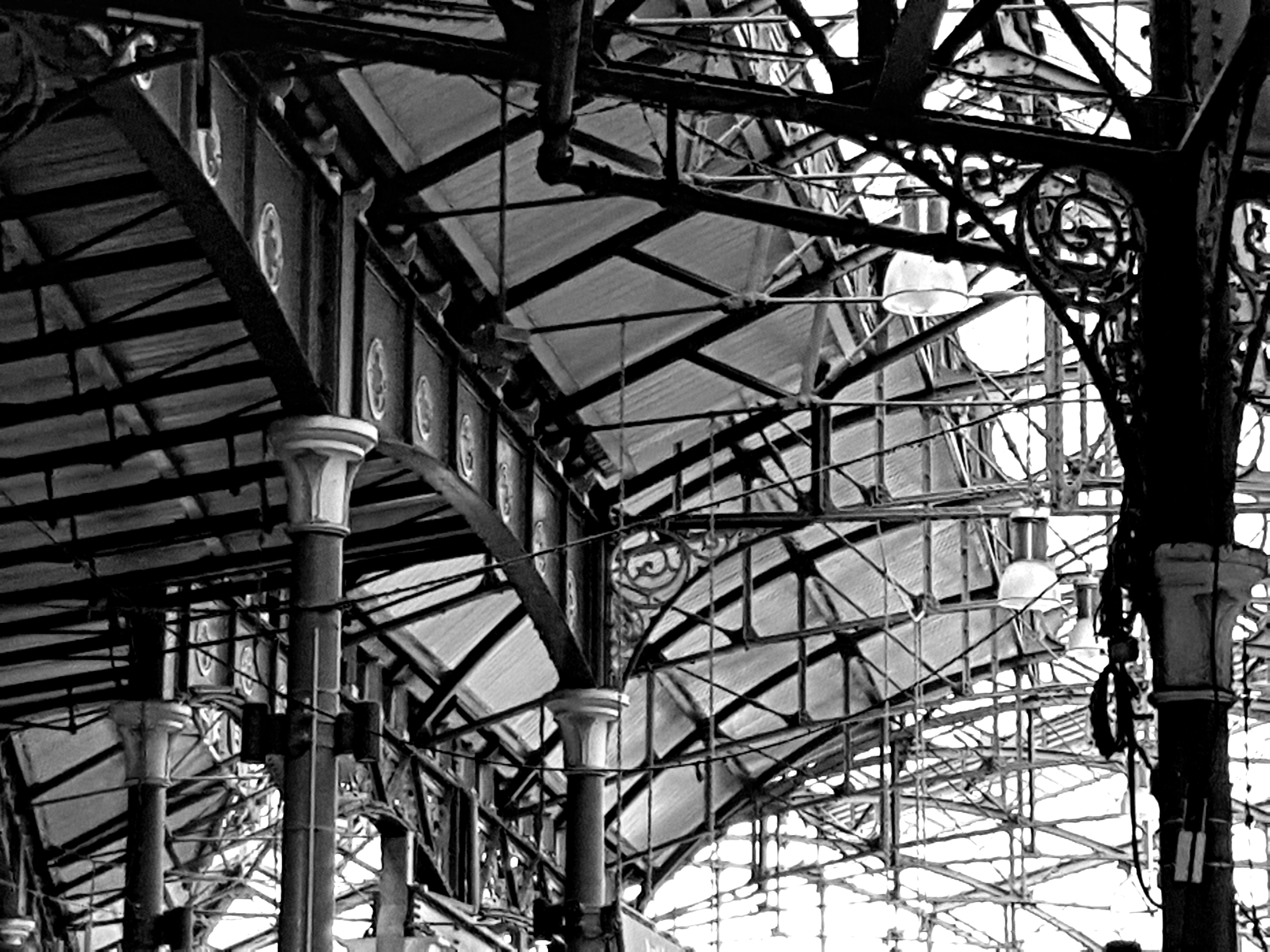
We went last night – as recommended by Rupert Christiansen on his twitter account – to a performance of Benjamin Britten’s Curlew River, an opera (is it an opera ? not really) which I didn’t know about, performed most magically in the darkness of St. Bartholomew the Great, whose Norman interiors provided an atmospheric setting for what was described by Britten as a ‘Parable for Church Performance’, with the very faint smell of incense and plastic sheeting providing the performance space down the nave. The music is said to have been deeply influenced by Britten’s visit on holiday to Japan in early 1956 and the text – by William Plomer – is based on a Japanese noh play Sumidagawa. But the mood seemed more medieval, partly because of the setting, but also the austerity of the tenor voices and use of plainchant. Very intense.
Category Archives: Uncategorized
Lynn Chadwick RA (2)
A couple of postscripts to my entry on Lynn Chadwick:-
1. I have realised that he only became an RA in May 2001 when he was already 86, so would have been elected as a Senior Member. I assume that this was when Phillip King was President and got in some of the older generation of sculptors, who had not been keen on the RA, including Anthony Caro, who declined election in 1990, but accepted in 2004. In fact, Chadwick kept himself apart from the London art world by moving from Cheyne Row to a cottage near Stroud in 1946 and then to a remote cottage near Cheltenham before buying Lyppiatt Park in 1958.
2. Because I am currently reading Mark Girouard’s brilliant biography of James Stirling (Big Jim), I am struck by the parallels in their lives (they didn’t know one another) and the incredible sense of ambition and confidence of those who had served in the war and were then demobbed, including Chadwick, who worked as an architectural draughtsman in the 1930s, served in the Fleet Air Arm as a pilot during the war, returned to work for a firm, Arcon, which specialised in designing prefabricated buildings, and started making mobiles out of balsa wood as a sideline. By 1956, he had won the International Sculpture Prize in Venice, beating Giacometti.
Lynn Chadwick RA (1)
I had been to Lypiatt, the estate that Lynn Chadwick bought in September 1958, once before in the late 1990s when he was still alive. I remembered only being driven round a remote Gloucestershire valley in a slightly hair-raising way. This time, although the weather was grey, I was again immeasurably impressed by the sense of a secret landscape, with his sculptures carefully placed at unexpected and arbitrary intervals within it.
The house is Tudor, with a neo-Tudor wing by Wyatville:-
Inside is filled with his sculptures, as well as his spirit, in the free form way in which he treated the empty spaces of the house:-
Beyond is the park, empty and atmospheric, stretching up into the Toardsmoor Valley:-
I would like to be able to identify each of the sculptures and their date, but saw them only as figures in the landscape, without name:-
Neave Brown
In trying to find out more about the work of William Barnes as Director of Housing at Camden from 1 January 1971 (I learned the date from a booklet he produced about his work called A Londoner’s Lot), I bought a copy of Mark Swenarton’s incredibly impressive Cook’s Camden: The Making of Modern Housing. I discovered nothing about Barnes who is not even listed in the index, but a great deal about Neave Brown, including the fact that, although an American, he was educated at Marlborough before being encouraged by Bill Howell, a fellow old Marlburian, to study at the AA; and that he himself lived in his first group of houses in Winscombe Road, which he designed in private practice, and that the other residents (there were only five houses and a communal garden) included Ed and Beattie Jones and Michael and Patty Hopkins – an architects’ utopia.
William Barnes
The death of Neave Brown, the architect of such good public housing, reminds me that I have occasionally meant to write something about my late lamented godfather, William Barnes, who was Director of Housing for Camden when construction began on the Alexandra Road estate. I thought I remembered going to lunch with him in the summer of 1972 and him showing me the Alexandra Road estate with the utmost pride, but the dates don’t work. I had also understood that he ended up being rather unpopular with the Council (too patrician, too high minded), but the attached blog suggests this was not so and that he resigned because the policies of the incoming Thatcher government made his work impossible. See https://redbrickblog.wordpress.com/2011/09/04/when-housing-policy-was-truly-ambitious-in-memory-of-william-barnes/. He was also responsible for establishing the London Business School.
RA250
In the interests of providing full information about activities the RA is in some way involved with or supporting round the country in our 250th. year, wonderfully supported by the generosity of the Art Fund, I am posting the link to our website which lists the full panoply of activities country-wide, together with a digital map of their location (https://www.royalacademy.org.uk/ra250uk).
Art UK (2)
Just before Christmas, I wrote a post about the new facility on Art UK which enables one to identify the location of all the works by RAs in British public collections, all 25,000 of them. When I got back from Christmas, I discovered that I had committed myself to writing about some aspect of Art UK’s involvement in our 250th. anniversary. I chose to write at greater length about the benefits of the facility, what one can discover hidden away in British collections, and to celebrate those Cambridge colleges who have agreed to their collections being listed. See https://artuk.org/about/blog/royal-academicians-on-art-uk-celebrated-for-ra250
London Library
I called in on the London Library after work, partly to deliver some books (my Christmas reading) and to pick up some more (my New Year’s resolution). Because it was after dark, I was even more impressed than usual by the number of signs telling me to TURN OFF THE LIGHTS, which looked as if they might have been put up in war-time, when there was a hunger for reading and a prohibition on lighting:-
Art talks
I was walking past the security box in our backyard just now and I saw in the window a series of slogans:-
Art builds
Art questions
Art transcends
Art works
I thought: is this our new corporate identity ? No, it turned out to be an envelope from Deutsche Bank.
Mile End Vestry Hall
Every so often on my Sunday morning walks, I go past the old Mile End Vestry Hall in Bancroft Road and am invariably impressed by the quality of its classical detailing. Pevsner is a bit snooty about this style of architecture, describing it merely as a liberal interpretation of an Italian Renaissance style, ’emulating the solid Italianate popularized by Charles Barry’s Traveller’s Club in the 1840s’, but I am impressed by how little known the architect is – J.M. Knight who was also responsible for the local Board offices in Leyton twenty years later – and well considered the detailing:-


You must be logged in to post a comment.