John Sandoe’s Bookshop

I did a talk last night upstairs at John Sandoe’s bookshop off the King’s Road in Chelsea.   It was the most select and recherché audience, consisting mainly of blog followers (thank you for coming).   I realise in talking about how the blog began in a wholly accidental and unpremeditated way that it meets a psychological need as a wholly self-imposed mental discipline, a form of mental gymnastics, compelling myself to describe things at speed.   The weakness is that my photographs so seldom show people, as if East London is post-holocaust, vacuum-pumped.   Anyway, the point of the talk was to encourage people to buy the special edition, of which John Sandoe is the sole stockist, special because the quality of paper is subtly different, the binding allows the book to fall open more conveniently, the corners are satisfyingly rounded (http://www.johnsandoe.com/product/east-london-special-edition/).   Some people did buy the Special and I am especially grateful to them.


Standard

Thaddeus Ropac

I finally made it to Thaddeus Ropac’s new gallery in Ely House in Dover Street, once the home of the Bishops of Ely, designed by Robert Taylor in the early 1770s, occupied in the early part of the twentieth century by the Albemarle Club and in the post-war period by Oxford University Press.   It has been beautifully and immaculately restored by Annabelle Selldorf, keeping all the original fireplaces, but with new flooring throughout.   I luckily arrived just as a performance by Oliver Beer was ending in which maybe six singers explore the acoustics of the building through the performance of the Diabolus in Musica:

Standard

East London

We had a discussion this evening at the RA about East London:  not the East London which I know and have written about west of the River Lea;  but the large tracts of local authority housing and industrial wasteland which lies beyond in Stratford, Maryland, Romford, Barking, Dagenham and beyond.   The discussion was focussed on three grand projets:  Here East, the Olympic Media Centre which is being converted into tech units by Hawkins\Brown;  the development of Albert Docks by Terry Farrell;  and the creation of a new town on derelict land in Barking Riverside.   The mood was in some ways optimistic:  except that nobody had a solution as to how to provide effective quality and diversity in housing projects;  and how to ensure that affordable housing is affordable.   This is managed in the Netherlands, Berlin and Scandinavia.   Surely there are ways of ensuring that – as we were told – 50% of new housing is not in the hands of six private developers.

Standard

Ragged School Museum (1)

In all the years that we have lived in East London, I have – shamefully – never been to the Ragged School Museum which is normally open only two days a week, apart from the first Sunday of the month.   Today is the first Sunday of the month.

The warehouse was apparently built in 1872 for a lime juice merchant, but was taken over in 1876 by Dr. Barnardo as one of his ragged day schools, which offered church services, Bible and sewing classes to the local poor.   His Sunday School was said to be attended by 1500 children, with the added incentive of ‘lentil or pea souo and bread varied occasionally by rice and prunes or haricot beans’.   Not long afterwards he bought the local pub and turned it into a Coffee Palace.

It was packed:-

Standard

Old Stepney (2)

One of the pleasures of walking round the neighbourhood with people who are unfamiliar with it is that it has made me notice new things.

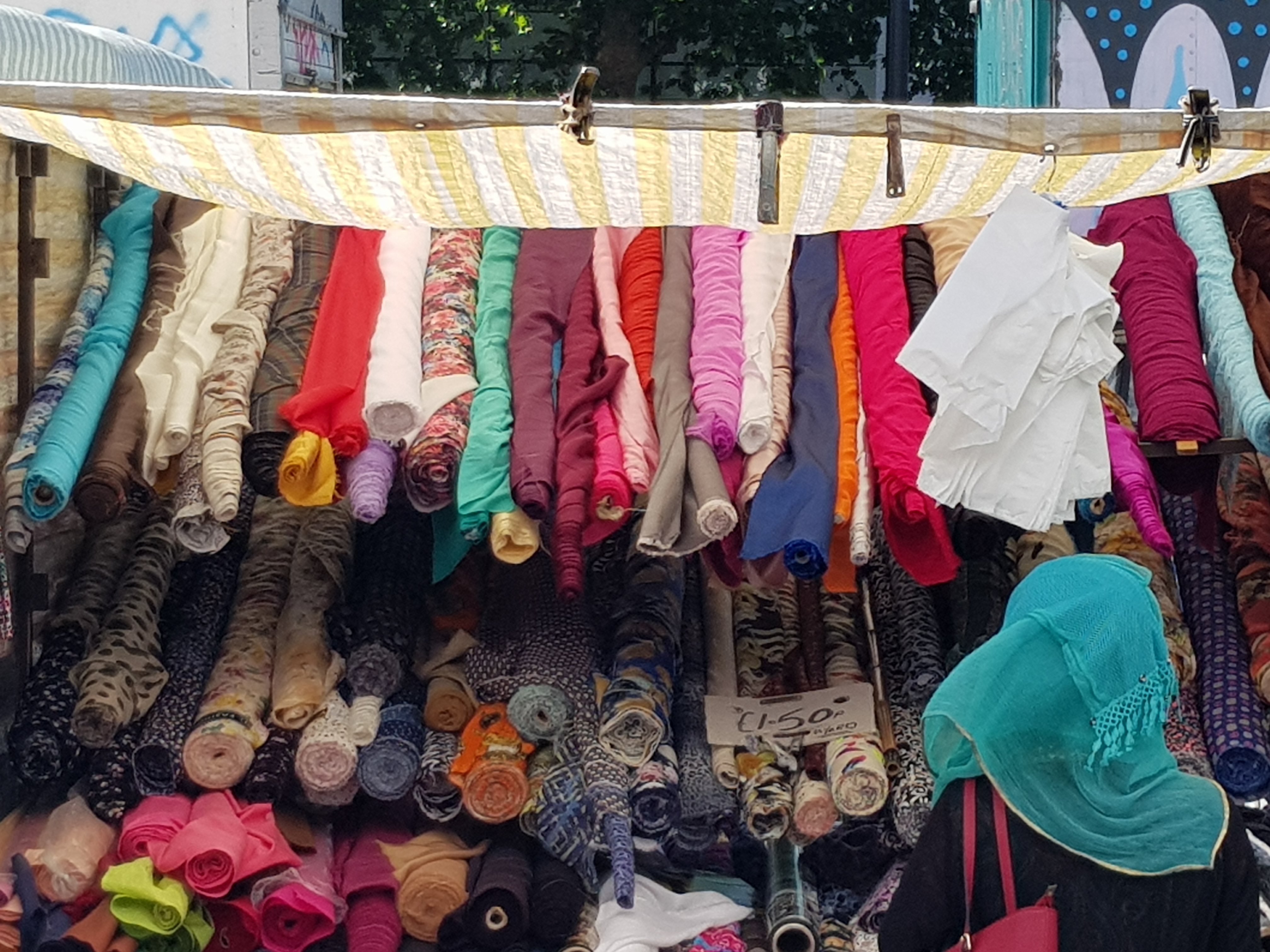
The detail of a shop front on the Mile End Road:-
The carved lunettes by the entrance doorway to St. Dunstan’s:-

And the old shop front on Durham Row:-

Standard

Old Stepney (1)

We ended the patrons’ tour of Stepney by looking at a map which was made in 1703 by Joel Gascoyne of ‘The Parish of St Dunstan Stepney alias Stebunheath Being one of the Ten Parishes in the County of Middlesex adjacent to the City of London’.   What I found more fascinating than the depiction of Stepney Green (then called Mile End Green) as it was in 1703:-

And the houses set back from the Mile End Road (Mile End old Towne)-

Was the inscription which had been added which implied that Stepney Green was a place of ill repute:-

Standard

Philip Mairet

Following Dick Humphrey’s comment on my blog last night, I have been trying to find out a bit about Philip Mairet, Ethel’s second husband, who had worked for C.R. Ashbee in the days of the Guild of Handicraft in Chipping Campden, acted as Secretary to Coomaraswamy in 1910 and martied his wife.   He avoided conscription by moving to Ditchling, but was arrested, enrolled in the Royal Sussex Regiment and imprisoned in Wormwood Scrubs.   After his release, he became an actor at the Old Vic, helped pioneer ideas of European integration as a member of the New Europe Group, and had an affair with  Gwendoline Norsworthy, who had helped Ethel Mairet establish the New Handworker’s Gallery in Percy Square.   He worked as Orage’s assistant on the New English Weekly, succeeded as editor in 1934, published the work of T.S.Eliot and supported organic farming.   Indeed, an interesting person.

Standard

Ethel Mairet

I’m sure I should have known that Ethel Mairet also lived at Ditchling, attracted by the presence of Gill, in a house called Gospels in Beacon Road, where she trained apprentices and student teachers in the mechanics of weaving.   Nor did I know that, before marrying Philip Mairet, she was married to Ananda Coomaraswamy, the Anglo-Ceylonese geologist turned art historian, and that together they lived in Chipping Campden in the circle of Ashbee, before Coomaraswamy suggested that he became a bigamist.   Anyway, I much admired the examples of Mairet’s work on display:-

Standard

Eric Gill:  The Body

Alongside the display of Cathie Pilkington’s work is a small, but intellectually challenging display of objects which deal with the explicit, or sublimated eroticism of much of Gill’s work and how it should be regarded following the publication of Fiona MacCarthy’s biography of Gill in 1989 with its revelations of the scale of Gill’s predatory sexual practices and abuse, not least of two of his daughters.   In 1989, the biography caused a stir, but looking back at it now, it is concerned with creating a more complex view of Gill and his work.   The exhibition confronts the issue more directly as to whether or not one’s view of an artist’s work should be influenced by knowledge of their life.

This is an illustration (relatively anodyne) from Sonnets and Verses:-

This is a cast from a wood-engraving called Divine Lovers (it’s in a section forbidden to unaccompanied minors):-

This is a Doll’s Head, thought to be by David Jones:-

And Joseph Cribb’s Madonna and the Christ Child, 1927:-

Standard

Doll for Petra

About a year ago – it must have been in June – we called in at the Ditchling Museum en route to Charleston, but too briefly to get a proper sense of the highly intelligent new building by Adam Richards and the wealth of the collection.   So, I was really pleased to be asked to the opening of Cathie Pilkington’s installation Doll for Petra which is a way of commenting on, and interpreting, the small wooden doll which Eric Gill made for his daughter, Petra, in 1910, when she was four, in relation to the fact that, as the label baldly states, ‘over a decade later, he sexually abused her’.   Pilkington’s own work is ideally well suited to this task, being figural, but also surreal and, unlike much contemporary art, sexually charged.

This is the Gill doll:-

And these are the dolls done by Cathie in response:-

Standard