Green Park

When it’s sunny, as it is this morning and was yesterday, I take a short detour on my morning walk in order to walk up the side of Green Park.   I like the views of the grand mansions which back on to the park, shut up tight after the entertainment of the night before.   It starts with Lancaster House, built for the Duke of York in 1825 by Benjamin Dean Wyatt with an interior by Charles Barry and now used by the Foreign Office.

image

Immediately to the north is Bridgewater House by Barry, where parts of the Orleans collection were hung and could be visited by artists on the recommendation of an RA:

image

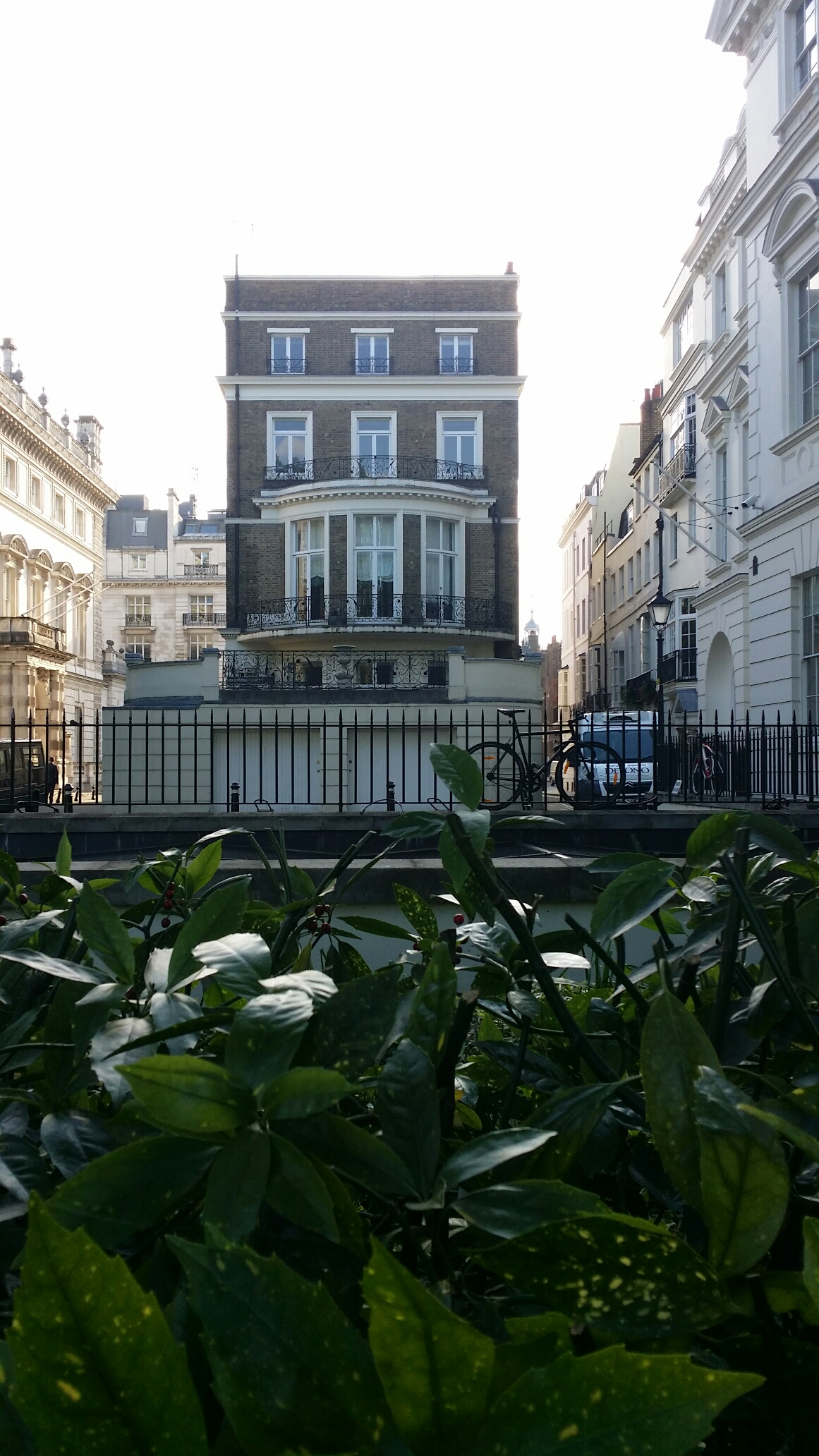
There’s a curious building just south of Bridgewater House which looks as if it’s stranded on the beachfront at Brighton:
image

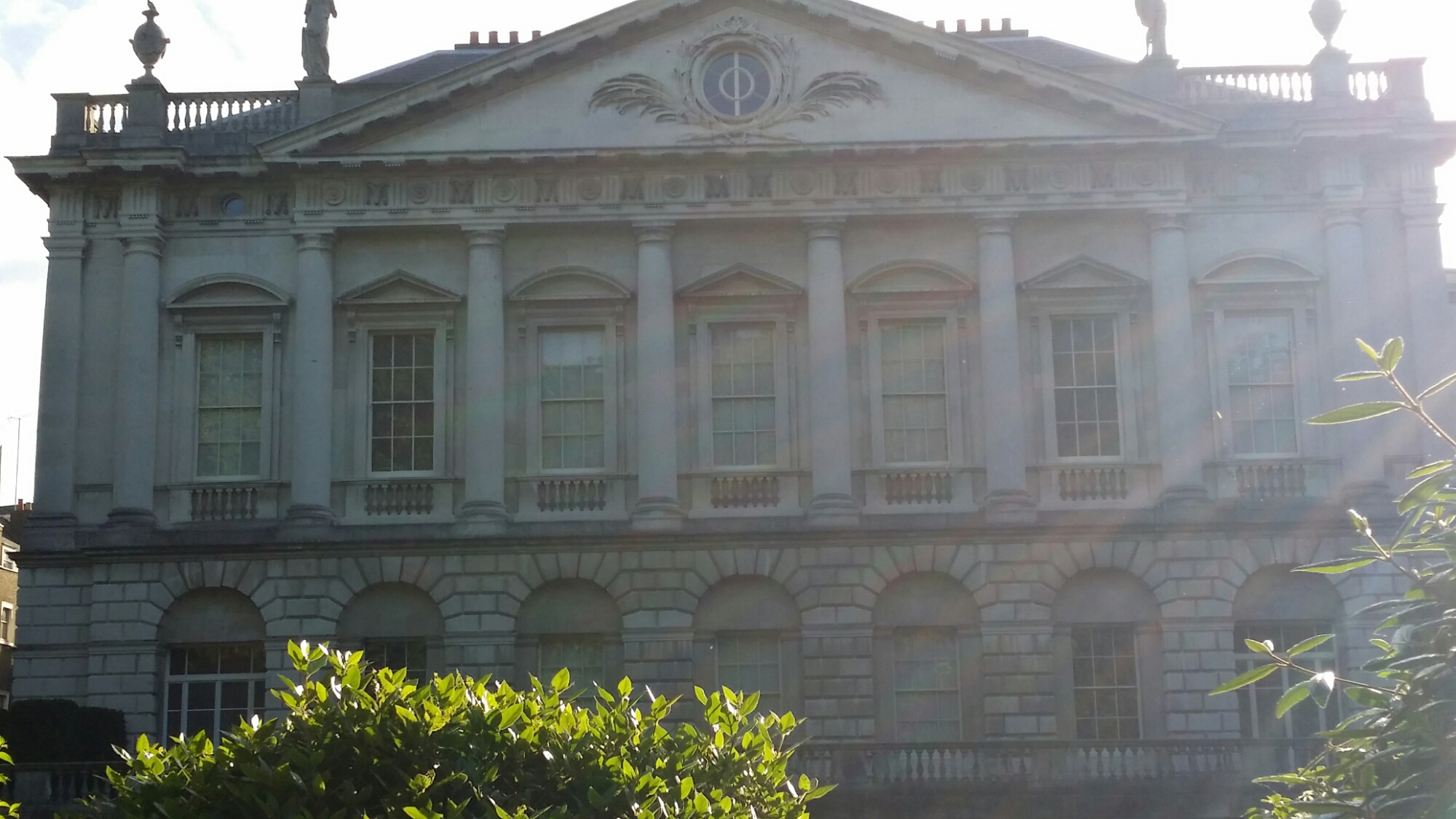
The facade of Spencer House is hard to see, protected as it is by shrubbery.   But at least one can see bits of John Vardy’s detailing and remember that for much of the postwar period it was converted into offices for the Economist:
image

Standard

Catherine Goodman (9)

I’ve sneaked an extra hour at lunchtime to attend another sitting as time is running out.   Catherine said I look completely different, probably because I am in work mode, half way through a difficult day.   Hannah Rothschild, who is a fellow sitter, part of the invisible community which flits in and out of Rossetti Studios, aware of one another but never meeting, has asked me why I say ‘I am sitting to Catherine Goodman’ not ‘I am sitting for Catherine Goodman’.   The former feels correct.   I am sitting to her, as an honour, not performing a service for her, as a task.

Standard

The Golden Child

Some time before Christmas, I was approached out of the blue by an editor at Harper Collins and asked if I would consider writing an introduction to a new paperback edition of Penelope Fitzgerald’s first novel, The Golden Child.   I accepted because I am a great admirer of The Blue Flower and my interest was piqued.   It’s a novel about the internal workings of the British Museum.   My text was more severely edited than anything I have ever written and a passage was deleted at the request of the company lawyers.   Now, only a few months later, the edition has appeared.

image

Standard

Docklands Light Railway

It’s a long time since I used to use the Docklands Light Railway, travelling in to work on two toy trains from Westferry to Bank, scrunching as it turned the corners on the track.   I remember how at a dinner party in the mid-1980s a junior official at the Treasury told me that she had tried to cancel it as a public project on the grounds that there was no possibility of it being of discernible use.   Now it extends all the way south of the river, weaving its way through Canary Wharf and past the new huge station designed by Norman Foster for Crossrail.   I have been able to travel from Bank to Cutty Sark, past what used to be the wastelands of the Isle of Dogs and the Mudchute, and up Crooms Hill through the rain to the Manor House overlooking London.

Standard

Michael Craig-Martin

I’ve been told that my choice of works for the Director’s Cut on the Public Catalogue Foundation is too historical and doesn’t sufficiently convey the character of the contemporary Royal Academy.   So, I’m going to add Michael Craig-Martin’s self-portrait, which he gave as his diploma work in December 2007.   I like the fact that it’s a self-portrait.   I remember one of the RA’s saying how delighted he was that portraits had been eradicated from the Summer Exhibition, so Craig-Martin is characteristically going against the trend.   I admire his intellectual rigour and independence of mind, so this is an unashamed tribute:

image

Photo: R.A./John Hammond © The Artist


Standard

Ja-Kyung Shin

We spent much of the day – this year as in other years – at Collect, the Crafts Council’s annual exhibition, now at the Saatchi Gallery.   It has the great benefit of being increasingly international with galleries from Amsterdam, Frankfurt and Korea.   As last year, we particularly admired a set of teaspoons designed and made by a young Korean silversmith called Ja-kyung Shin in which the bowl of the spoon is replaced by crumpled silver:

image

Standard

Catherine Goodman (8)

I’ve quite missed my sittings with Catherine.   It’s an opportunity for two hours of reverie and gossip.   This time I actually got an incredibly brief glimpse of my portrait, but at the precise moment when I realised who it was, she too realised that she had left it on the easel and whisked it away.   So I only have a flash of it like a mirage.   I now feel that if I were ever to see it properly, it would disappear before my eyes.   Time is running out before her exhibition in June and I don’t like to ask if I will be included.   Afterwards, I retreat for a macaroon and Collect.

Standard

Baden-Badener Unternehmer Gespräche

The third group I have talked to in the last 48 hours was a group of high-powered Germany industrialists who came to the Royal Academy as an optional part of their programe of study in London.    The group was set up in the early 1950s as part of the angst of post-war Germany about the extent to which industrialists had supported Hitler.   The idea was that young business leaders would meet their counterparts in other countries and discuss moral and ethical issues of common concern.   I was impressed by the way Germany business leaders are often more intellectually oriented than their British counterparts, more like academics, and they asked good questions about the system of training in the Royal Academy Schools, the extent to which we provide any business training (I suspect not much) and what motivates Friends.   They couldn’t quite grasp that the Royal Academy has no system of public funding and never has, apart from its debts being underwritten by George III.

Standard

The Apposition

Yesterday, the Bethnal Green Academy.   Today, St. Paul’s School on the green fields of Barnes beside the Thames.   I had been asked to be the Apposer, who is required to listen to four expositions on recondite subjects in public and then comment on them.   Not an easy task as the subjects included quantum computers, the extent to which T.S. Eliot was a truly modernist poet, the building of robots in synthetic biology, and the theory of a just war.   It’s impossible not to compare the discrepancies in opportunity between the state and the private system, except to note that St. Paul’s was, at least in its origins, the product of a highly egalitarian desire for free education of poor scholars from ‘all nacions and countries indifferently’.

Standard

Bethnal Green Academy

Some time ago, I was asked if I would sign up for a scheme called Speakers in Schools, whereby there is a register which allows state-funded schools to ask people in public life to speak to them.   I have only been asked to speak once before to a school in Wimbledon.   This morning I was asked to speak in the Bethnal Green Academy.

I walked there.   Past the legacy of Victorian social improvement:

image

image

Continue reading

Standard