
I have just been to a talk by Thomas Heatherwick RA. I have been aware of his work for a long time, ever since we were driving down from Scotland In 1994 and stopped at Belsay, a ruined Greek Revival house outside Newcastle. English Heritage had commissioned a number of young designers to build so-called ‘sitooteries’, a Scottish term for a small garden pavilion. Thomas had designed the first and the only one I remember: a febrile hedgehog of a building which was the precursor of his Expo Pavilion in Shanghai. But I had never heard him talk before. I have seldom heard someone talk so inspiringly about the processes of design and making. He started as a student constructing a small-scale building, because he believed that buildings should be as much about the process of construction as the intellectual analysis of space. It’s obvious that he’s right, but it’s seldom said. And he went on to describe his thought process in a whole series of projects up until the Garden Bridge across the Thames.
Tag Archives: London
RA Schools (1)
Each year, there is a small ceremony for the graduating students of the Royal Academy Schools to receive their diplomas. Each year, I find it unexpectedly moving witnessing a year group of 17 students, who have moved as a cohort through the experience of the Royal Academy and its art school: the first year studios with the casts from Sir Thomas Lawrence’s collection hanging on the walls; the Premiums when their work is exhibited in Burlington Gardens through to their final show in the nineteenth-century studios underneath the exhibition galleries. Everyone seems to win a prize: a residency in New York or money for travel. I once made the mistake of saying that it was privileged (they pay no fees) and saw 17 people looking at me furiously because it’s not privileged having to survive for three years without secure funding. But at the end it looks and feels worth it.
Catherine Goodman (16)
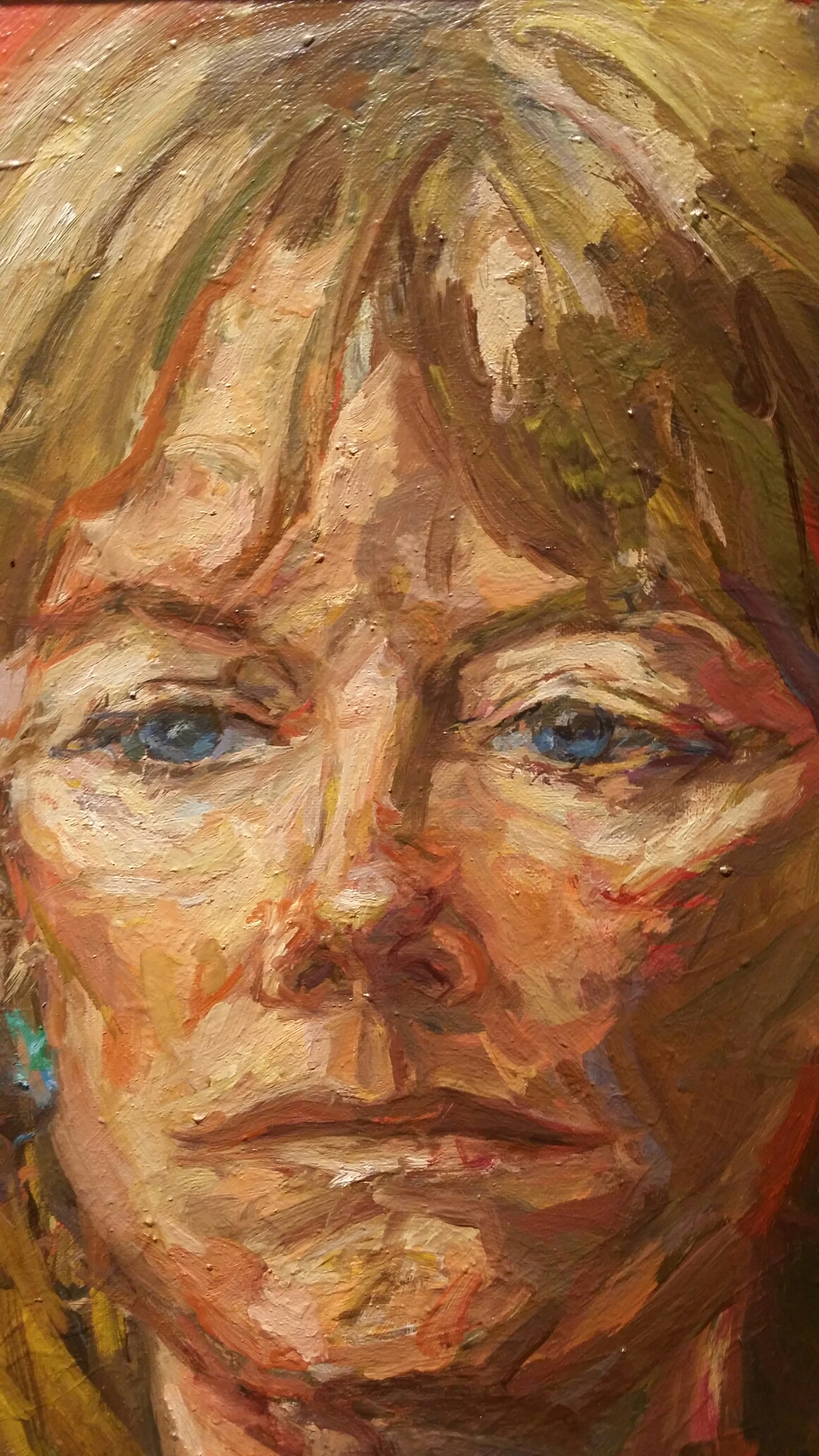
I’ve at last come face-to-face with my portrait. It is (of course) much better than in reproduction and also better in combination with the gallery of other sitters, where it is quite clear that they are effective and successful interpretations of character, based, as was mine, on ties of friendship and a long process of observation and record:

I hang next door to Hannah Rothschild who I regard as my companion-at-arms through the process because she took as long and was nearly as difficult to complete:
Whitechapel Road
In walking to the local post office under the absurd delusion that there might still be a collection on Sunday, I noticed how well the façades of the Whitechapel Road look now that they have been cleaned up under an HLF scheme, dating back from when the road was planned to be Olympic boulevard. It reveals some of the history of the east end:


Veronese
We finally made it to the Veronese exhibition yesterday on the penultimate day before it closes: a wonderful and nicely judged collection of paintings, demonstrating Veronese’s brilliant ability to create massed compositions, rich in visual incident, for the Venetian aristocracy in their villas and estates. Full of small children, horses, dogs, spectators on distant balconies and beautifully painted fabric (but badly painted hands), many of the paintings are owned by the National Gallery itself, thanks to Charles Eastlake’s autumn shopping trips to northern Italy, armed with government money, when he was able to extract pictures from the impoverished Italian nobility. Whilst many artists benefit from seeing their work en masse, I wasn’t convinced that this was true for Veronese. Seeing them all together makes one realise the extent to which he replicates the same compositional formulae, using a wardrobe of cloaks and robes which reappear in different pictures.
Sir Richard MacCormac (1)
I have just been to the launch of a book that Richard MacCormac (RA) has produced about the house he has lived in in Heneage Street, Spitalfields, and, more importantly, the house next door where Jocasta Innes, his partner for the last three decades, lived. It’s called Two Houses in Spitalfields. She bought no.5, which had been built for a brewer, in the late 1970s. Her daughter, Tabitha, evoked the heroic days of Spitalfields preservation, when their house had few amenities but electric light, Brick Lane had only curry houses, and much of the area was faced by demolition. The neighbours met one another in a nearby pub and Richard’s house could apparently be reached from Jocasta’s via a secret door made out of a fireplace. Jocasta died in April 2013. Her house is now up for sale. The book is a photographic record.
Catherine Goodman (15)
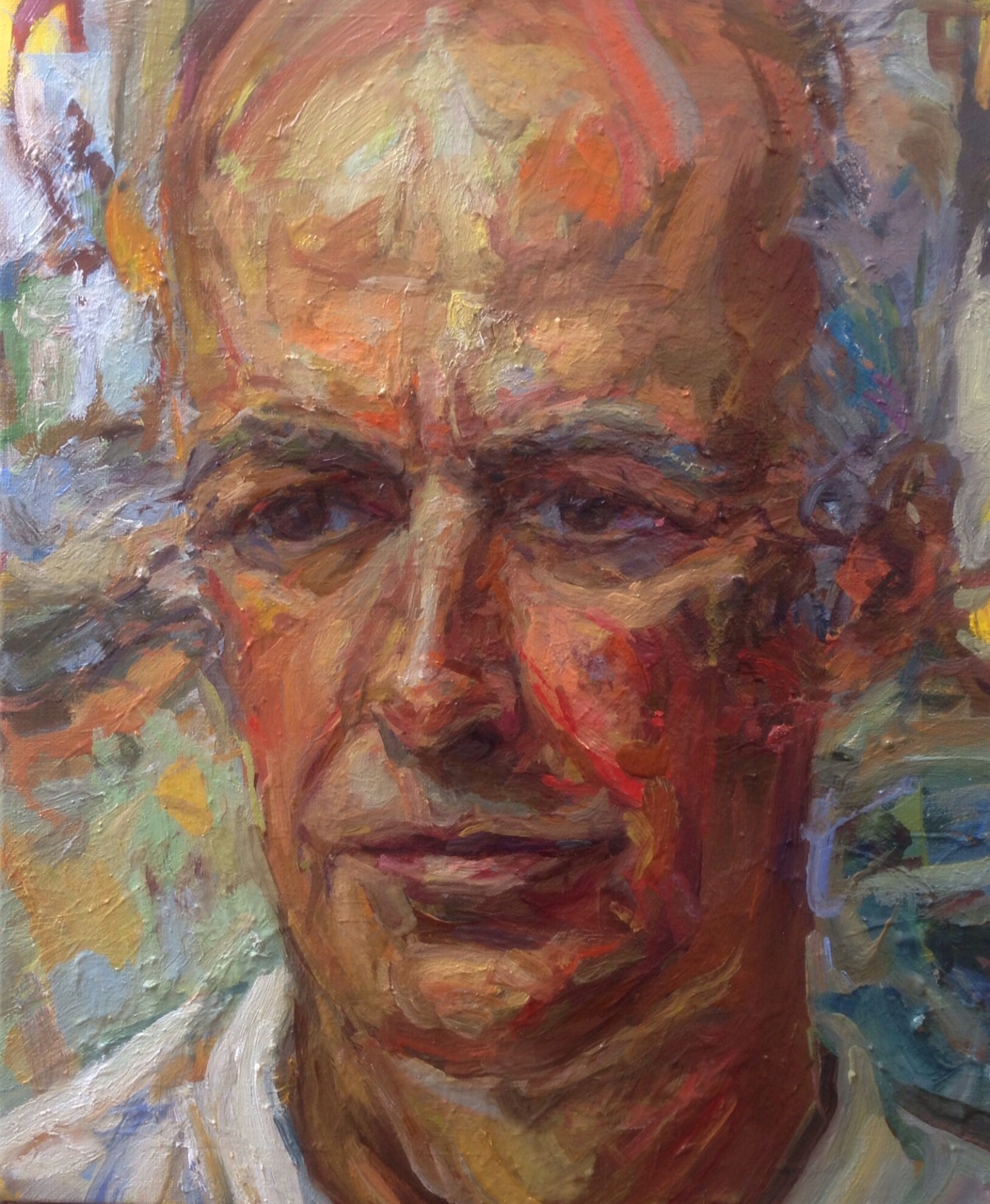
The first sight of my portrait is by j-peg. Catherine has sent me a digital image to inspect. What’s the verdict ? First off, it’s a bit of a shock. She said my brow had been getting higher and higher. But the Mekon ? Then I remember that the sitter is the least good judge of a portrait, being familiar only with the image in the mirror in the morning and photographs, which always lie. It’s as much an interpretation of character as it is a strict likeness. It’s good on the physicality of a head, its three-dimensionality. Besides, it’s quite wrong to judge it without seeing it. The verdict at home is that it’s particularly good on the eyes and eyebrows:
Catherine Goodman (14)
It’s finished ! At least, she says it’s finished. This morning there was more inspection from afar, more pursed lips and slight narrowing of the eyes. Half way through, I was told ‘it’s nearly there’, then that my chin had been resolved, then that there were at least five portraits on top of one another, then, just before time, I was told it was all over and I was released into the outside world. No more sittings. But I still haven’t been allowed to see the final result. I have to wait.
Catherine Goodman (13)
I thought my portrait was finished. It isn’t. I was called back for another sitting yesterday, as has Hannah Rothschild. There was a great deal of inspection of the nearly finished portrait from near, from afar and as seen in the large mirror behind the easel, which enables me nearly to see a reflection of the portrait, but not quite. The back tape round its edge was gradually stripped off. I asked why. She said that she’ll tell me one day. At one point, she applied a large dab of bright yellow pigment which looked dangerous and wholly unnecessary. I had thought that my very severe haircut might be a disadvantage, as had she. It’s not long now that the invisible college of her sitters – the dealer, the gardener, the film director and literary agent, but not the Duchess of Cornwall – will be revealed on the walls of the National Portrait Gallery. We might finally all meet.
Here is what the artist looks like from the viewpoint of the sitter:

The Foundling Hospital
I don’t go to the Foundling Hospital as often as I ought to. I was invited to a so-called VIP evening, but after the third person asked me who I was and what I was doing there, I thought that perhaps I had been invited in error. Anyway, it enabled me to revisit the Court Room, which is more or less all that survives of the original Jacobsen building and to see and admire the wonderful terracotta bust of Handel by Roubiliac, done in preparation for his full-length statue in Vauxhall Gardens:


You must be logged in to post a comment.