Prorogation (1)

I have been asked for my views on the Prorogation of parliament, but the truth is that I have rather given up commenting on politics after Edward Chaney, a passionate pro-Brexiteer and, as he claims, a founder member of UKIP, pointed out, which I do not deny, that I am not especially well informed on politics and do not speak, and so therefore, cannot write with any particular authority on it. I am also conscious that I represent exactly the constituency of people that the Brexiteers detest: a London-based, middle-class professional who is pro-Europe as much for historical and cultural reasons as for its economic and political benefits, which are, and always have been, more disputed.

The truth is that I feel, as many others must do, a colossal sense of anxiety and disillusion. I have never previously experienced what feels like a putsch from a group of highly motivated, politically dedicated, well-organised and passionate believers in a cause I do not share. I am sure they regard themselves as well-intentioned, fighting for what they believe to be a just cause. I know some of them. But we have lived at least since the seventeenth century in a parliamentary democracy and I had understood that that was what the Brexiteers most wanted to preserve: the sovereignty of parliament. So, to suspend parliament and to think that this will help create a spirit of national unity behind a forced Brexit is, so far as I am concerned, deeply anti-democratic, probably, but not necessarily, fatally misguided. But I am not yet out on the streets protesting. Just worried.

Standard

The Thames in Rotherhithe

Before Monteverdi, I walked down to the shore of the Thames, which is reached past the Mayflower and warehouses and was beautiful at dusk, the quiet of the river, with Tower Bridge in the distance and the Shard looming over it all:-

Standard

Monteverdi in Rotherhithe

I was invited – and was very pleased to have been – to a performance of Monteverdi’s Il combattimento di Tancredi e Clorinda (1638) by Ante Terminum Productions, a group of young singers, dancers and musicians assembled by Frederick Waxman. It was in the most astonishing space – a vacant drum, belonging to the Brunel Museum in Rotherhithe, which I think must be the original Grand Entrance Hall to the tunnel under the Thames, which was designed by Brunel for the East London line, with a fine red staircase recently added by Tate Harmer.

It provided a wonderful resonance, even in spite of the noise of the trains, for Monteverdi’s music, dance and singing:-

Standard

Pork Pies

Since pork pies are much in the news at the moment (and we know what an expert Boris Johnson is on them), I feel I should recommend our local Anglesey pork pies, made by The Fat Pig at the Marram Grass, and as good as any I have tasted, although probably not in Thailand:-

Standard

Sunday Morning

I walked yesterday. But it looked different having been away and in the bright late summer sun.

Stepney Green:-

The churchyard:-

York Square, The Old Ship and the view into Barnes Street:-

The willow tree by the lock on the canal:-

And the lock gate on the point of being opened:-

Standard

Kerry Downes (4)

In re-shelving my copy of Owen Hopkins book, I discovered that I had a mint copy of the catalogue of the 1962 Arts Council Hawksmoor exhibition, together with an invitation to the private view on Friday 7th. September 1962 (I was only 8 at the time). It’s a bit of a period piece, listing the sponsors of the Hawksmoor Committee, including T.S. Eliot, who had refused to sign the letter to the Times on the grounds of its illiteracy and including a typed insert regretting the fact that they had failed to include Denys Lasdun, the Bishop of London and the Duke of Marlborough in the list. Ian Nairn was treasurer. I like the description of Hawksmoor in the Introduction, which was by J.H.V. Davies (Vaughan Davies was a civil servant who had published an article on the dating of the Greenwich Hospital), not Kerry Downes, as ‘a man of monumental single-mindedness’.

Standard

Kerry Downes (3)

Now that I’m back in London, I’ve been looking back at Kerry Downes’s books, following his death on August 11th.

The best account of how Downes came to study Hawksmoor appears in Owen Hopkins’s book, From the Shadows: The Architecture and Afterlife of Nichooas Hawksmoor, which, based on letters Downes wrote to him, describes how he and his father, who was organist at the Brompton Oratory – this helps to explain his susceptibility to the baroque – visited the Hawksmoor churches on cycling expeditions – they were long ones – from Ealing, where they lived and where Downes attended Ealing Priory School. What I had forgotten is that there was a plan to pull down Christ Church, Spitalfields in 1960, which led to the establishment of The Hawksmoor Committee, with John Betjeman, of course, as its chairman and Kerry Downes as an active member, organising a small exhibition of Hawksmoor drawings for the Arts Council in September 1962. Hard to remember that there was a time when Hawksmoor was not so appreciated.

Standard

Hereford Cathedral (3)

Now that I have acquired a more recent edition of Pevsner – the revised 2012 edition – I can add a few more pictures of Hereford Cathedral.

As seen from Church Street:-

A coffin-lid in the north-east transept, described as late 13th. century, but which we both thought looked earlier:-

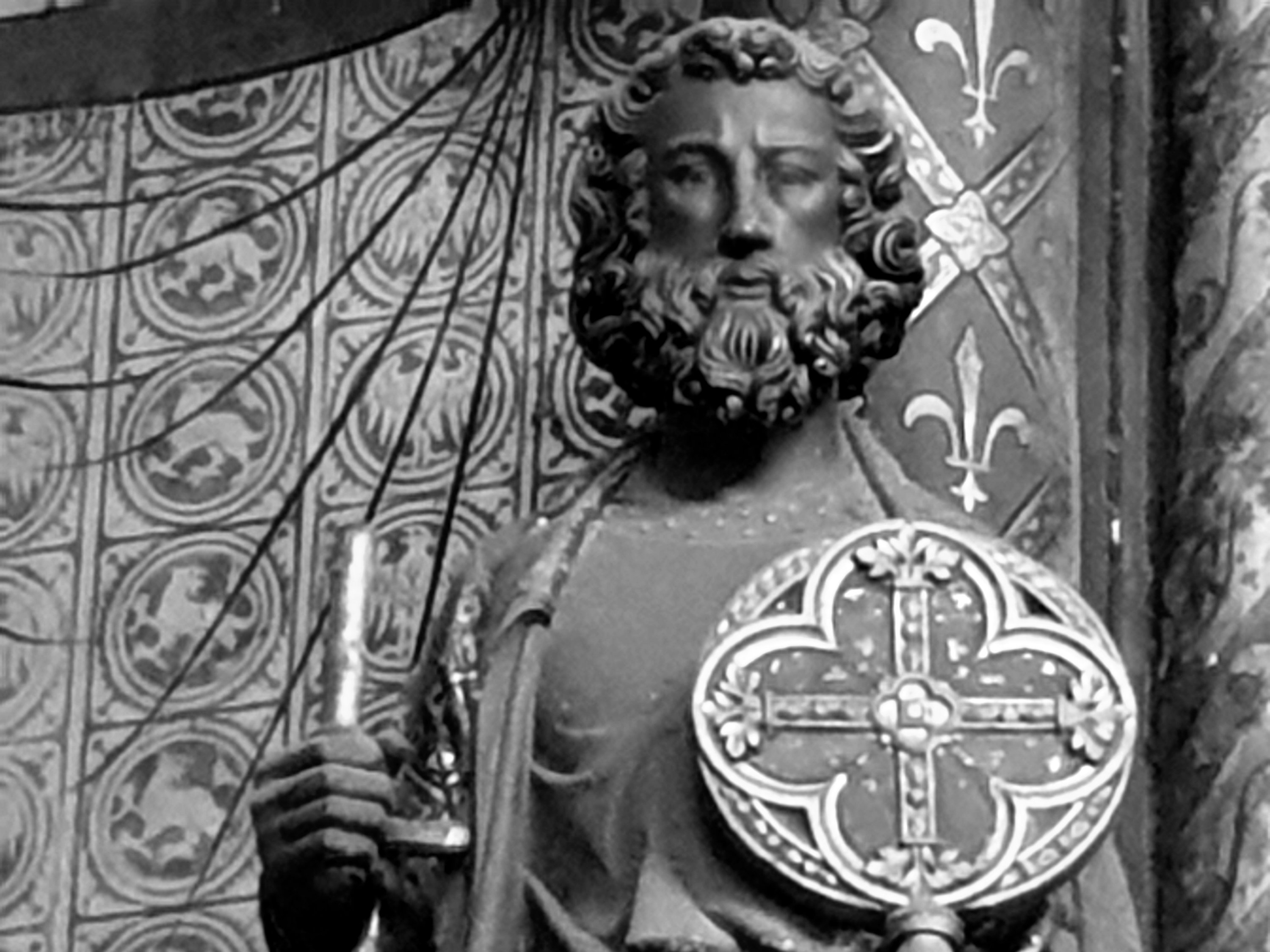
A fifteenth-century statue of John the Baptist down in the crypt:-

And the walls of the corridors in the College of the Vicars Choral, where twenty-six vicars lived in cell-like accommodation:-

Standard

Pages of Cheshire Street

I had heard on the grapevine that Pages of Hackney, a very nice, small, well stocked, independent bookshop on the Lower Clapton Road had opened a branch in Cheshire Street off Brick Lane. I went to investigate. It’s devoted to women’s literature and writing across a wide range of subject matter, including a small art section at the back:-

Standard

The Bell Foundry Petition (2)

Every time I write something about the Whitechapel Bell Foundry, I am impressed by the scale of the response. Yesterday, it was all over the twittersphere: a sense of pain and anguish that we have somehow allowed a working Foundry, which has been in continuous existence for over four hundred years and produced the bells of Big Ben, to be closed down and sold to a New York venture capitalist to be butchered as a boutique hotel. But worse than this, it has been done with the consent and co-operation of the authorities: Historic England, who believe that it is better to co-operate with the destroyers, rather than, as is their moral and statutory duty, resist them.

I hope that now at least there is a possibility that local democracy will come into play and Tower Hamlets will do what it can to reinstate the Foundry by supporting the detailed plans which have been drawn up by the United Kingdom Historic Building Preservation Trust, following the model of what they have done at Middleport Pottery in Stoke-on-Trent.

Do please sign the petition if you’re eligible.

Standard