Venice (4)

This is my last post from Venice as, annoyingly, I have to return to London.

I took the opportunity to make some last peregrinations, motivated by no more than getting to know the city better, which always seems an impossible task.

First, three more heads:-
I passed S. Zulian, a church by Sansovino and assumed that it was S. Zulian over the door, but, in fact, it’s Tommaso Rangone, a physician and philologist (the prominence of donors is not a twentieth-century phenomenon):-

Then I arrived at the back of S. Salvador:-

In S. Salvador itself, there is a statue of S. Sebastian by Alessandro Vittoria:-

The tomb of Andrea and Benedetta Dolfin with statuary by Giulio del Moro (again):-

That’s it. The vaporetto awaits.

Standard

S. Giorgio Maggiore

Of course, there is much else to see in S. Giorgio besides Sean Scully’s fine exhibition.The beautiful austerity of Palladio’s façade with statuary by Giulio del Moro:-

Inside, there is a fifteenth-century wooden crucifix which spurts blood on feast days:-

I noticed two statuettes on the balustrade dividing the choir from the chancel. They are by Niccoló Roccatagliata of 1593:-

I couldn’t resist going up the tower to see Venice laid out below, including a good view of Il Redentore:-

Some more miscellaneous pieces of stone carving which I haven’t been able to identify:-

And the monastic garden with chickens beyond:-

Standard

Sean Scully

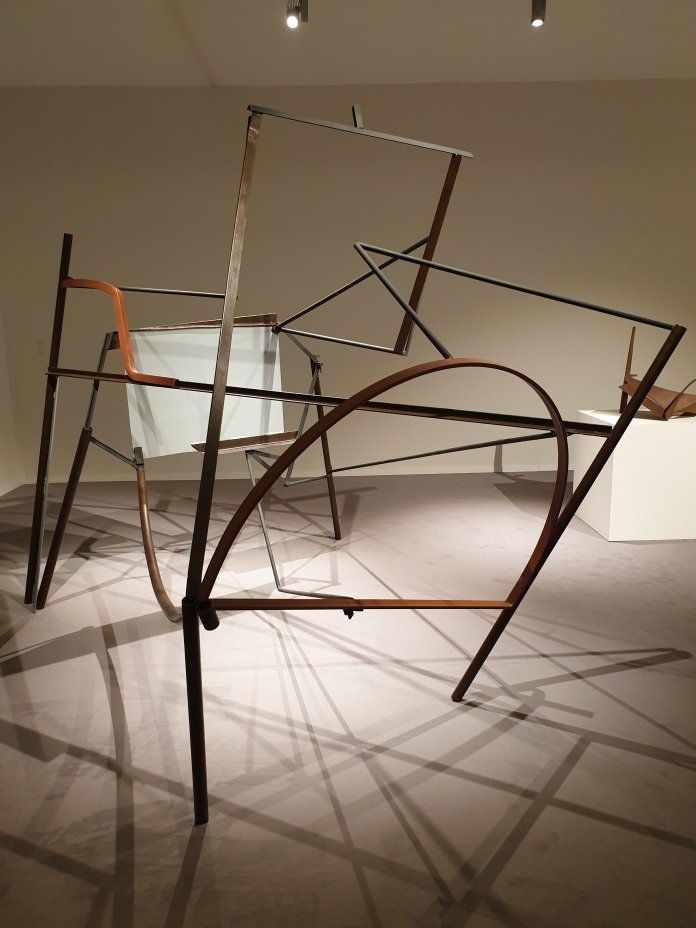
My main raison d’être for coming to Venice is to see Sean Scully’s work in S. Giorgio Maggiore, Palladio’s great church begun in 1566 and incomplete at the time of his death in 1580.

The nave is filled by a single work, Opulent Ascension:-

Behind the high altar is a manuscript which sits within the monks’ stalls:-

Outside is Brown Tower:-

And Landline paintings in the Manica Lunga:-

Window Beneath:

And Sleeper Stack in the garden:-

Standard

Venice (3)

My third post from Venice is more miscellaneous – things seen on taking a long route from the ghetto to the Arsenale, because I discovered – I should have known – that you can’t get a ticket for the vaporetto from Orto.

First, a head on an unidentified palazzo on the Strada Nova:-

Another head on a gateway alongside the Scuola Vecchia de la Misericordia:-

And a column on the façade:-

The façade of S. Maria Valverde:-

This is the side of the Palazzo da Lezze:-

The rest I can’t identify:-

Standard

Edmund de Waal

I somehow found myself at the tail end of the press trip to Edmund de Waal’s installation in the upper part of the Jewish Museum in the old ghetto in Cannareggio.

It was a profound experience, not just for the opportunity of seeing the latest manifestation of Edmund’s work in gold, marble and porcelain, but as much for the opportunity of seeing the Canton Synagogue, a deeply symbolic space whose origins go back to the establishment of the ghetto:-

Through the windows, one sees – I should say witnesses – the vitrines of Edmund’s work in response:-

Standard

Venice (2)

I set off early to explore more:-

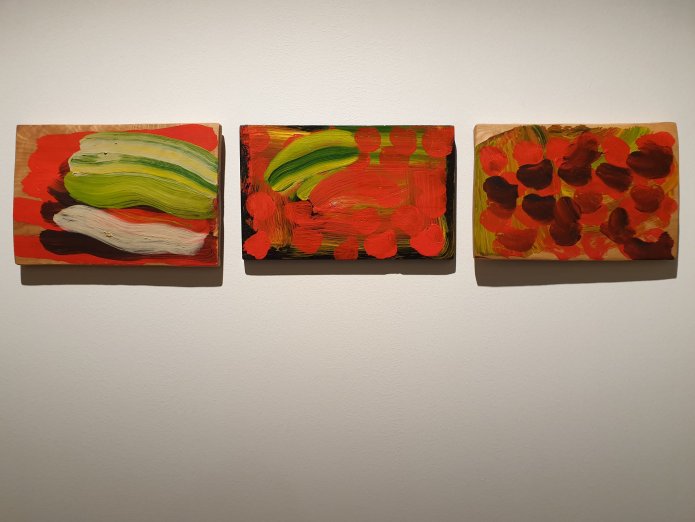
The entryway to the Palazzo Grimani, which is showing paintings by Helen Frankenthaler:-

As one comes in to the Campo S. Maria Formosa, the Palazzo Malipiero is on the left:-

The Campo itself is surprisingly open and spacious opening up urban space at the heart of the city:-

I walked through to S. Giovanni Crisostomo:-

Some nice lettering at the entrance to S. Giovanni Crisostomo:-

And then then the pearl of S. Maria dei Miracoli, Pietro Lombardo’s marble masterpiece:-

Standard

S. Giorgio degli Schiavoni

I discovered by chance that S. Giorgio degli Schiavoni was open over lunch, contrary to what I had read in the guidebooks, so I was able to enjoy it on my own, not having been back to it in many moons.

It makes the greatest possible impact because of the sense that the cycle of paintings which Carpaccio painted between 1502 and 1507 survives intact in a good state of preservation in situ in the oratory underneath the main church, although I remembered from Links that this is not strictly true because they were originally painted for an upper hall and only installed here in 1552 fifty years after they were painted.

St George killing the dragon:-

The Triumph of St. George:-

St. George baptising the Gentiles:-

The miracle of St. Tryphone (or, as Links calls it St. Tryphonius subduing the basilisk):-

St. Jerome leads the Lion into the Convent:-

The Death of St. Jerome:-

The Vision of St. Augustine:-

Standard

S. Zaccaria

I have never knowingly been to S. Zaccaria before, a treat, not least for its great Bellini.

First, the façade begin in the 1440s, completed towards the end of the century with its multiple decks of round-headed windows:-

Bellini’s Virgin and Child with SS. Peter, Catherine, Lucy and Jerome:-

The fifteenth-century choirstalls and gilt seats for the doge and his entourage in the Nun’s choir:-

Through to the Cappella di S. Tarasio:-

And a glimpse through to the High Altar:-

Standard

Venice (1)

Since nothing in the Biennale seems to open till tomorrow, I took myself off on a walking tour of Castello, having previously kept to the peripheries, starting with S. Zaccaria (see separate post).

Then, exploring the hinterland.

S. Giorgio dei Greci, with its beautifully peaceful courtyard, as if private:-

Next door is the Scuola della Confraternita dei Greci by Longhena:-

The facade of the Scuola di S. Giorgio degli Schiavoni:-

Then up rougher streets towards S. Francesco della Vigna:-

The façade of S. Francesco by Palladio, but which nobody seems to much admire:-

And its interior:-

In walking south down the Calle dei Scudi, a nice Ruskinian set of windows:-

And a head which I had spotted on the nearby canal:-

The façade of the Scuola de San Giovanni Battista in Campo Bandiera e Moro:-

And the font in S. Giovanni in Bragora:-

The view through to the campanile of S. Giorgio Maggiore:-

And, last, before my legs collapsed, the fenestration of the Palazzo Priuli:-

Standard