
I need to complete my sequence of posts on John Brinckerhoff Jackson, because I have discovered that he is crucial to the invention of what he called ‘odology’, that is, the study of the American road. ‘Odology is the science or study of roads or journeys and, by extension, the study of streets and superhighways and trails and paths, how they are used, where they lead, and how they come into existence. Odology is part geography, planning, and part engineering – engineering as in construction, and unhappily as in social engineering as well. That is why the discipline has a brilliant future’. For cross-continental travel, he recommends George Stewart’s US 40: Cross Section of the United States of America which he described as the ‘best and most original guide book yet produced’. And it hasn’t escaped my attention that he influenced, if not inspired, Robert Venturi and Denise Scott Brown’s Learning from Las Vegas, although naughtily he did not credit Denise in his review (he had his faults).
Burlington Gardens
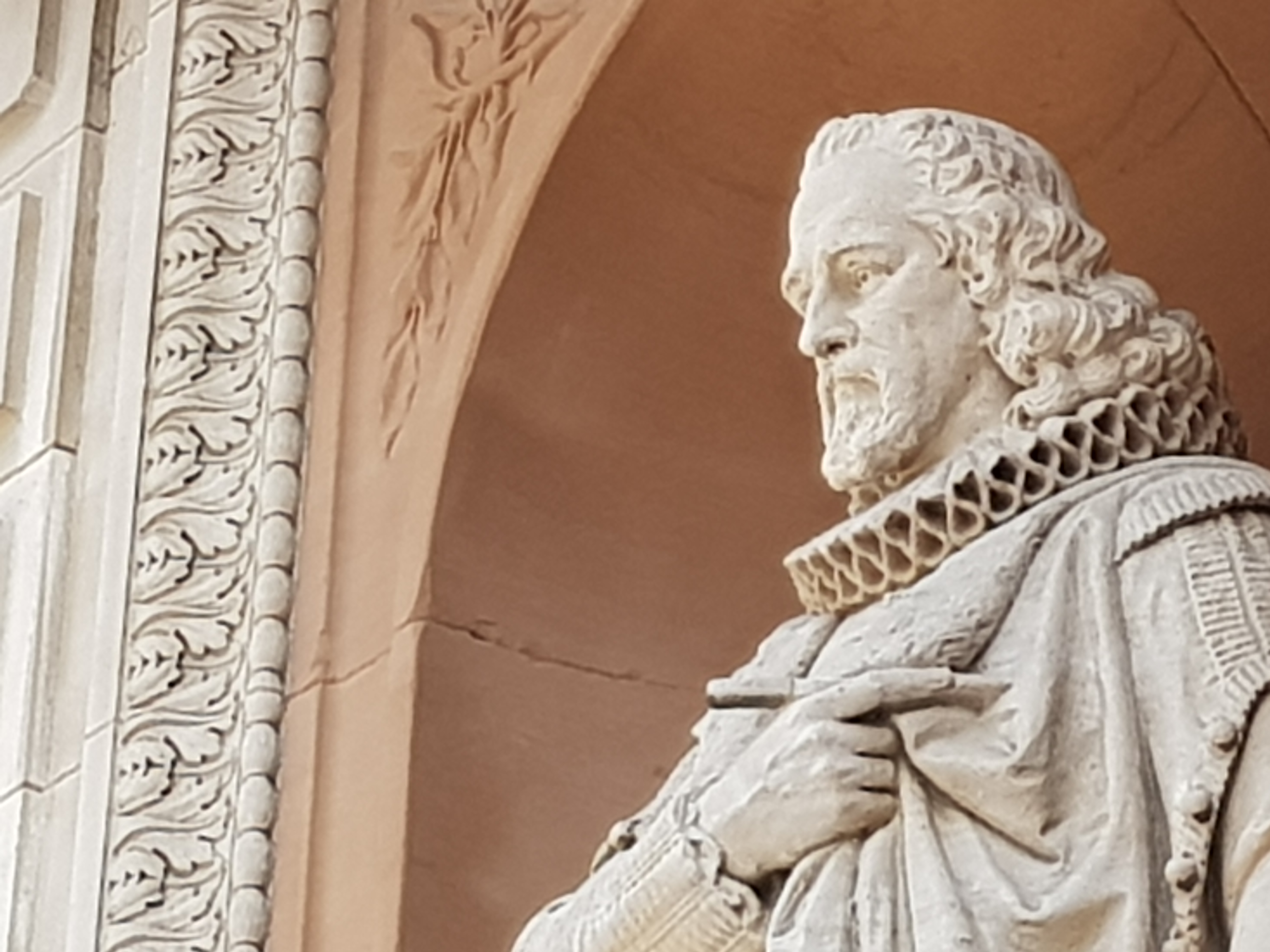
It’s coming along. Francis Bacon is all cleaned up:-
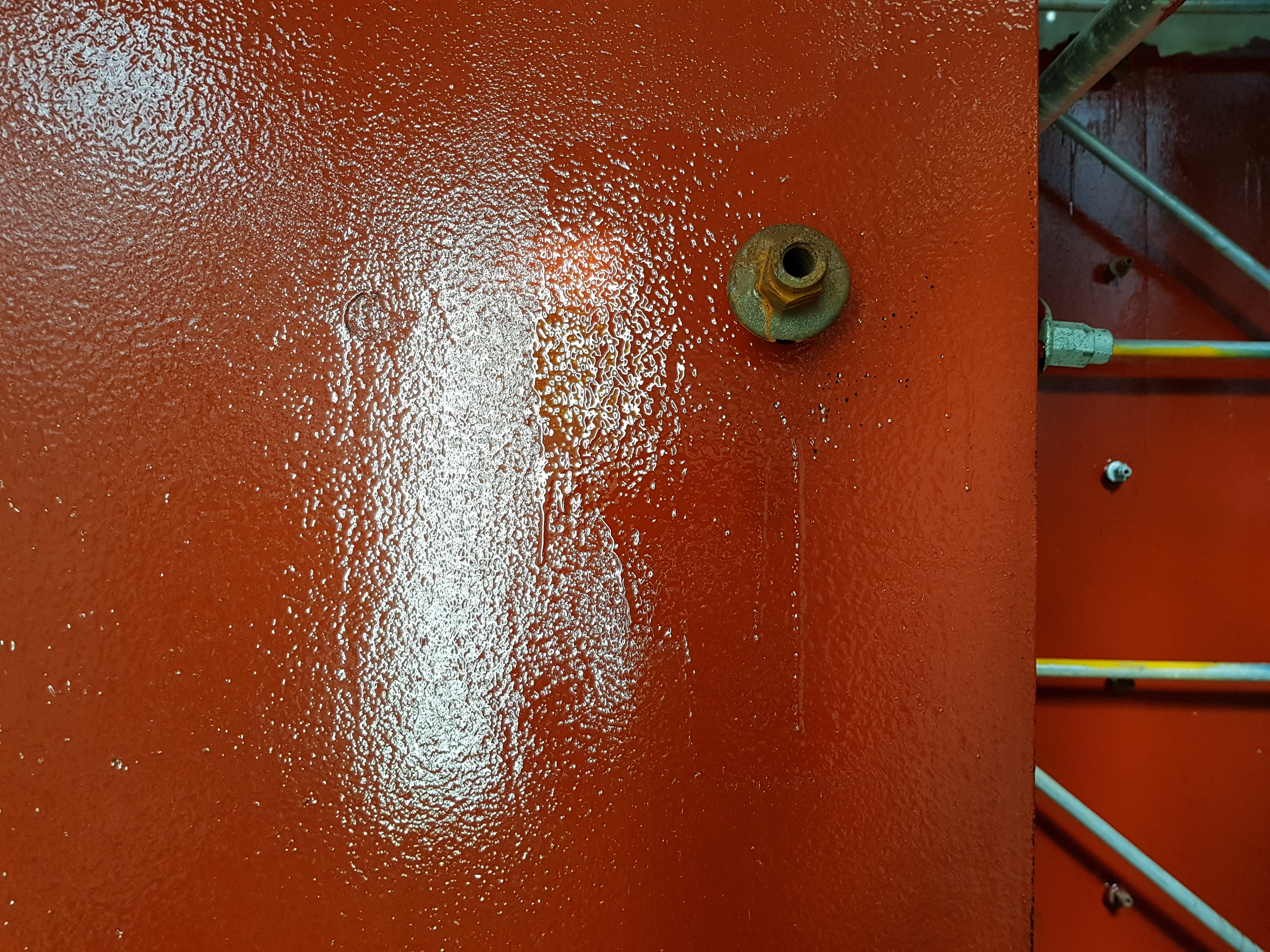
This is the current surface of the new Link Bridge:-
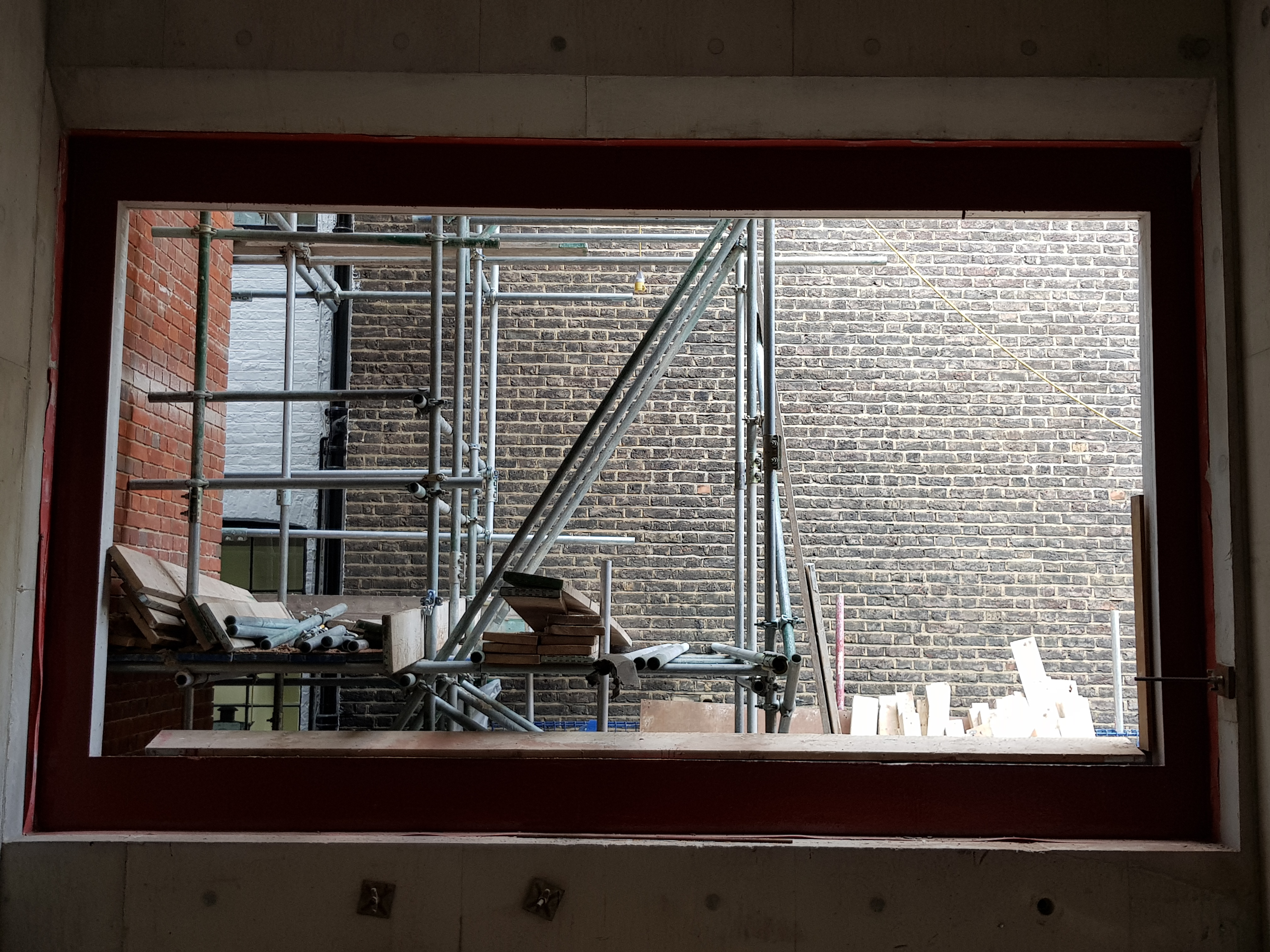
This is the view out of the British Academy Room:-
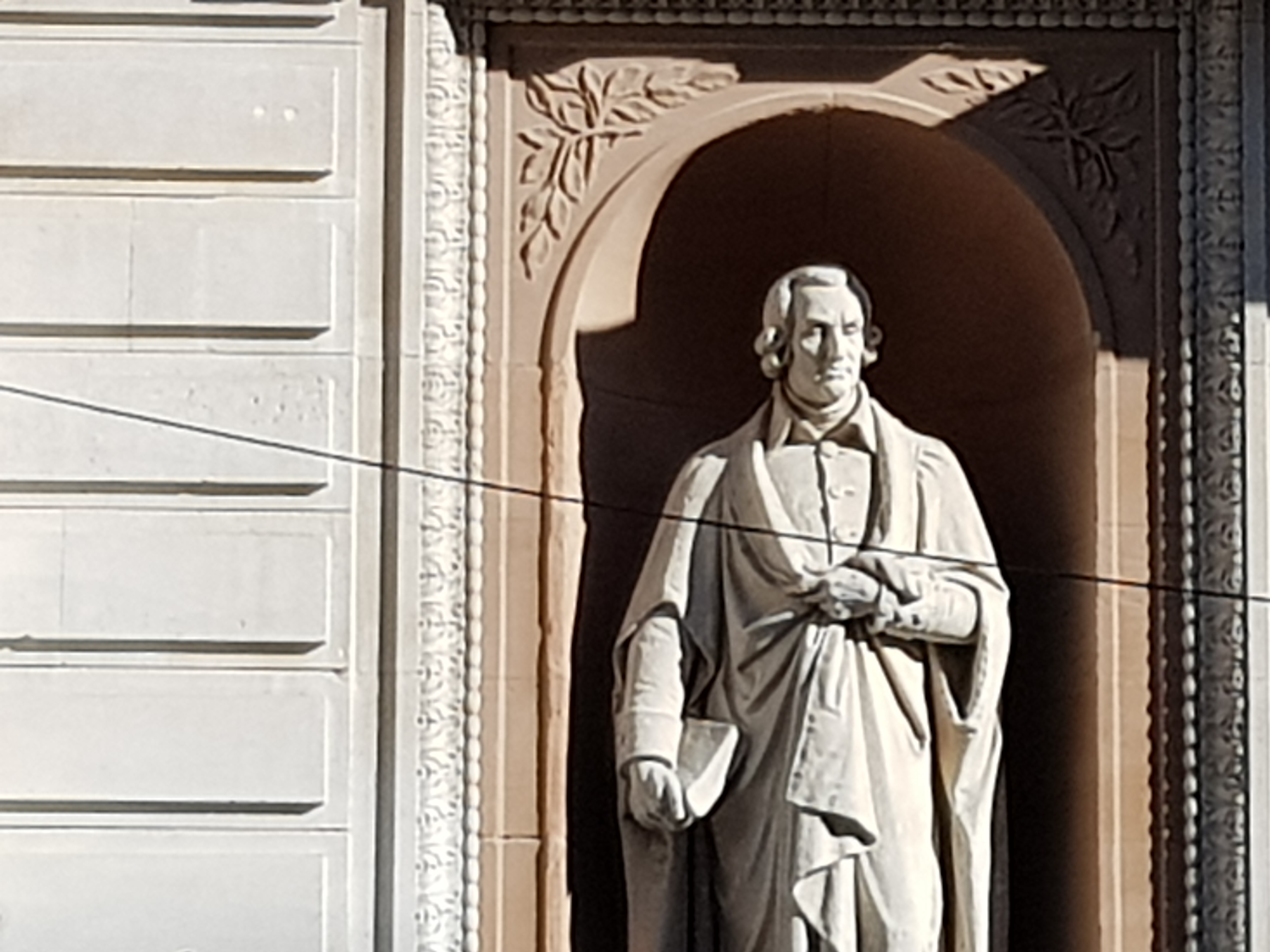
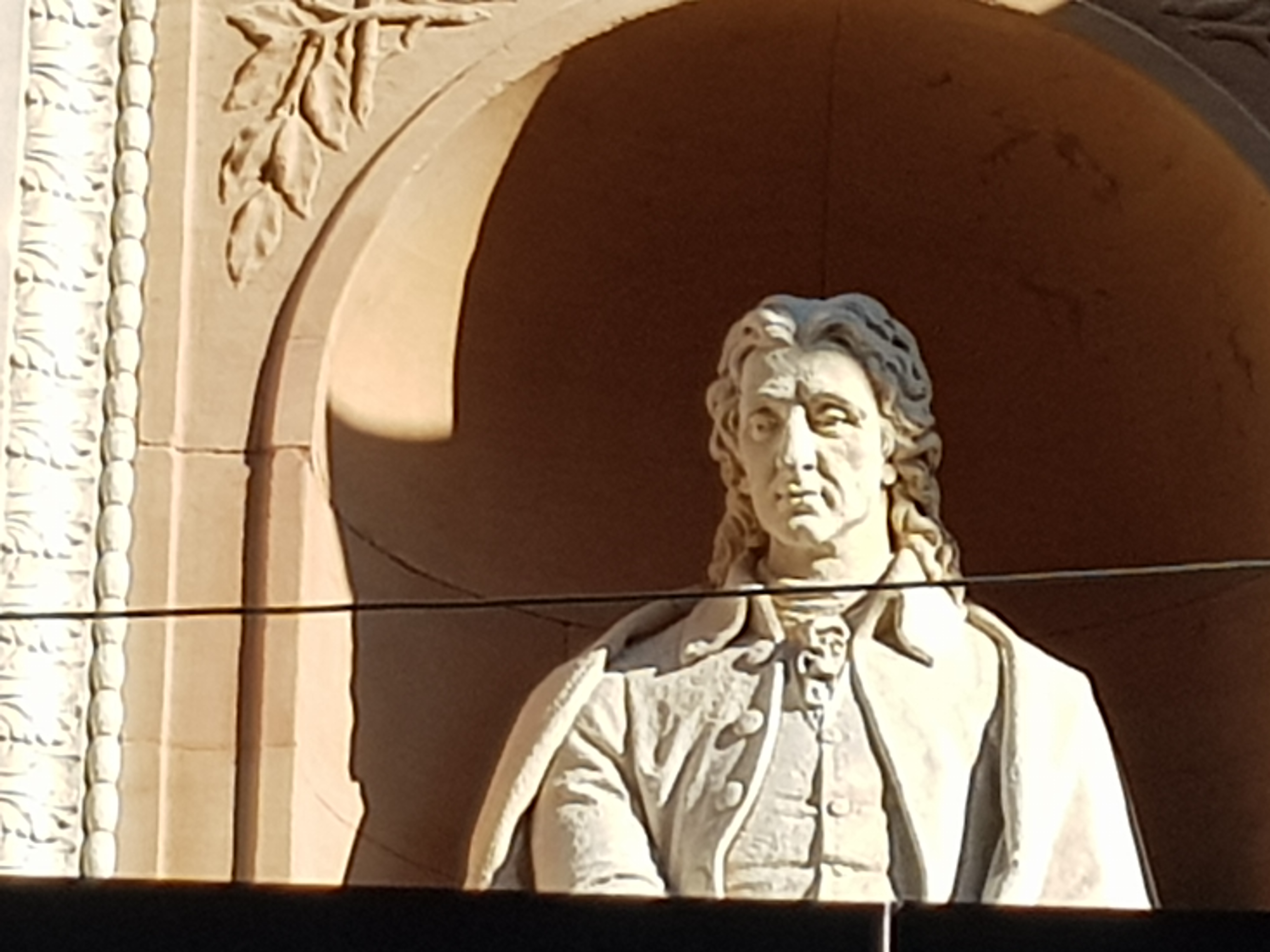
Adam Smith:-
John Locke:-
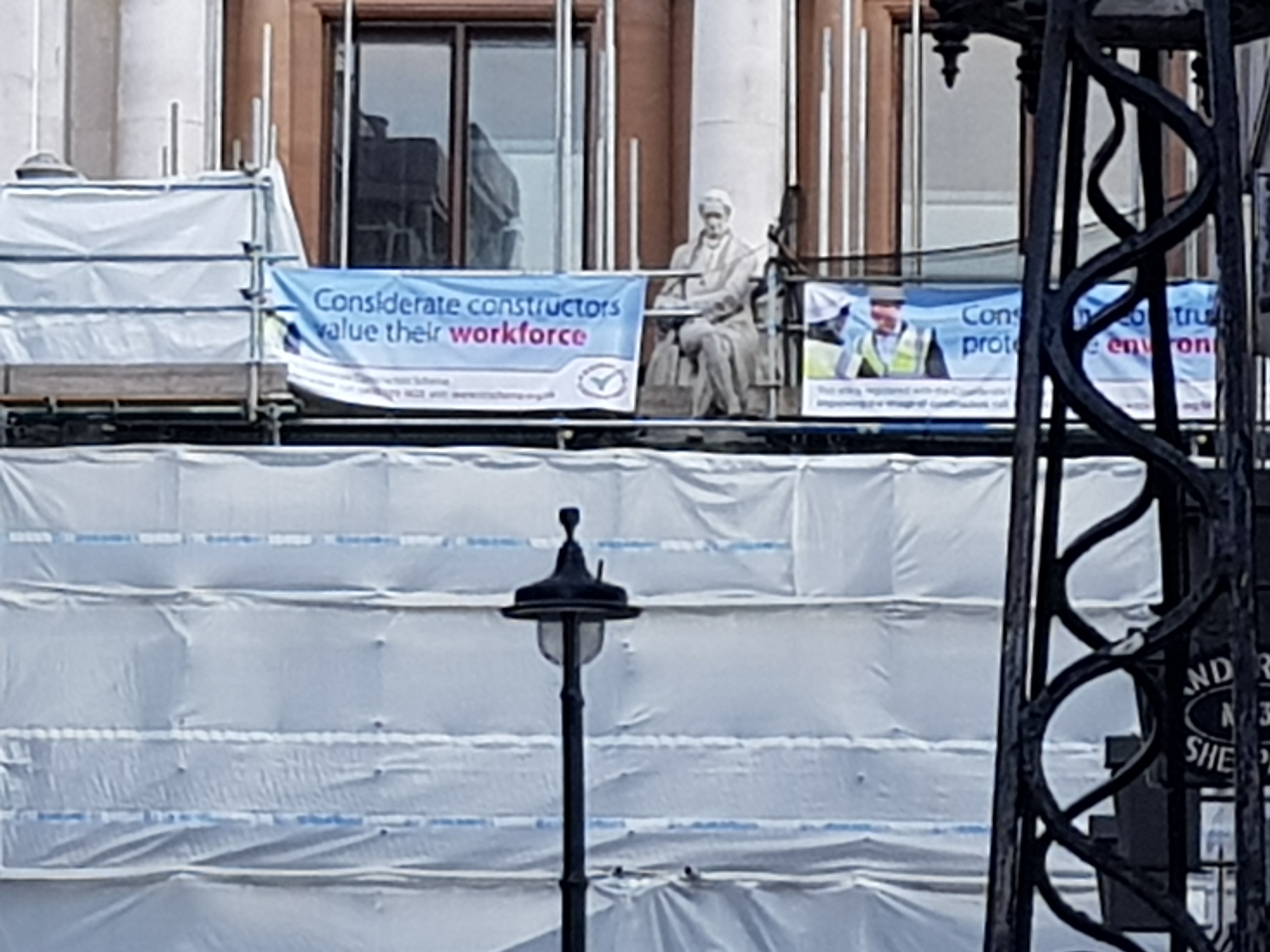
And the building from Old Burlington Street:-
John Brinckerhoff Jackson (3)
I’ve got absorbed in finding out more about John Brinckerhoff Jackson and have acquired a volume of essays produced after his death by the University of New Mexico – Everyday America: Cutural Landscape Studies after J.B. Jackson. ed Chris Wilson and Paul Roth, Berkeley, 2003. He was anti-modernist, turning against a house designed by Le Corbusier in the Paris Exposition of Modern Art in 1926. ‘I didn’t like it’. In 1934, he travelled round Europe and saw the Stuttgart Wissenhof exhibition of modern housing and city planning, including work by Gropius and Mies van der Rohe. He regarded it as ‘ridiculous, intellectual architecture’. After the war, he contributed pseudonymous reviews to Landscape, the journal of which he was himself the publsher and the editor, in which he attacked modernist architcture on the grounds that it was not ‘designed to improve the lot of Man but a desire to create pure geometrical forms, an autonomous art of cubes and cylinders and two dimensional planes; independent of the past, independent of the earth and of life’. This was what led him to his interest in the vernacular and the ways in which ‘all the while there enters through the back door of the modern dwelling a troop of interior decorators, landscape architects, home consultants, psychologists, appliance and television salesemen, each of them bent on making the modern home as complex and irrational and individual as possible’. This was in 1952.
Across America (3)
David Lowenthal has sent me his translation of an interview with the two curators of the exhibition Beyond Asphalt, which was held in Montpellier earlier this year. The interview provides other candidates for making documentary, as opposed to artistic, photographs of American roadtrips.
I didn’t know about Donald Appleyard, a British-born urban planner who studied at MIT, taught at Berkeley, and published The View from the Road in 1964.
Most people will probably know, but I didn’t, about the exhibition New Topographics: Photographs of a Man-Altered Landscape, held in Rochester NY in 1975, which introduced a style of deadpan topographical photography ‘eschewing entirely the aspects of beauty, emotion and opinion’.
My third candidate is Chester Liebs who produced a book Main Street to Miracle Mile in 1985.
All of this research derives from David Lowenthal diplomatically pointing out that there are plenty of other people, himself included, who have established a tradition of non-fine art – maybe anti-fine art – documentary photography.
Across America (2)
I”m one step closer to solving the problem of who took the documentary photographs crossing America, which I remembered seeing a reference to. Richard Bram has managed to find out through a contact of his that Reed Estabrook, a student at the Rhode Island School of Design, planned a coast-to-coast trip in the early 1970s with a camera connected to his odometer fixed in the right side rear window of his ’57 Chevy, taking a wide-angle photo every 1/4 mile, which he then planned to exhibit in a continuous floor-to-ceiling strip (see http://www.reedestabrook.net/projects/earlywork.php). This is definitely as good an answer as I am likely to get.
Richard Bram (2)
As of today you can have the pleasure of a different sequence of photographs as the opener to the blog (although weirdly I don’t see it myself): more informal; more summery; taken in the streets of Stepney, rather than the purlieus of St. James. Bram adopts what he calls the Jane Bown technique – that is, taking the photograph before one has a chance to pose.
Blue Bricks
I have been encouraged to comment on the glazed blue bricks which one finds on the side street on Stepney Green. I thought these came from Newcastle, but now realise they may come from Newcastle-under-Lyme, since it was Staffordshire which specialised in making and supplying hard-wearing, glazed blue bricks which were made from Etruria Marl, a local red clay fired at high temperature:-

Richard Bram (1)
A year or so ago someone commented on the blog that he was bored of the very formal photographs on the opening page which look as if they were taken for an annual report, and indeed were. I have been puzzling what to do about this and mentioned it to Richard Bram, an American street photographer, who generously offered to take more informal photographs. So, we spent the first part of the morning scouting locations, as observed by his eagle eye, and then taking quick informal photographs with his digital Leica. He taught me the term ‘chimping’ which is when a photographer checks the quality of the photograph on screen immediately after taking it, which professionals generally frown on, and ‘shunpiking’ which is used for the avoidance of the tolls on the turnpike in order to travel on minor roads.
Across America (1)
I have been tormented during the week by the memory of a reference to a book by a social geographer who took photographs as he travelled across America during the 1950s, mile by mile, as a documentary rather than an artistic record. I’ve been unable to track down the reference. But, in the course of my research, I hve bought a book called The Open Road: Photography and the American Road Trip (New York: Aperture, 2014), which goes some way to answering the question. Early in the century, when it first became possible to cross the continent by road, Rand McNally produced Photo-Auto Guides, which illustrated automobile routes with deliberately nondescript photographs. Then, in 1930, a Swiss journalist, Felix Moeschlin, travelled across America with a photographer, Dr. Kurt Richter. They produced Amerika vom Auto Aus, with photographs of small towns, gas stations, and African-American workers. I’m aware that there were plenty of major photographers who took photographs based on road trips, including Berenice Abbott, who photographed Route 1 in 1954, and Robert Frank who produced The Americans after being awarded a Guggenheim Fellowship to travel across America in 1955. But these were art photographers. I am still looking for the ordinariness of the everyday record.
Brick Lane
Last night, I walked back down Princelet Street, always a pleasure:-

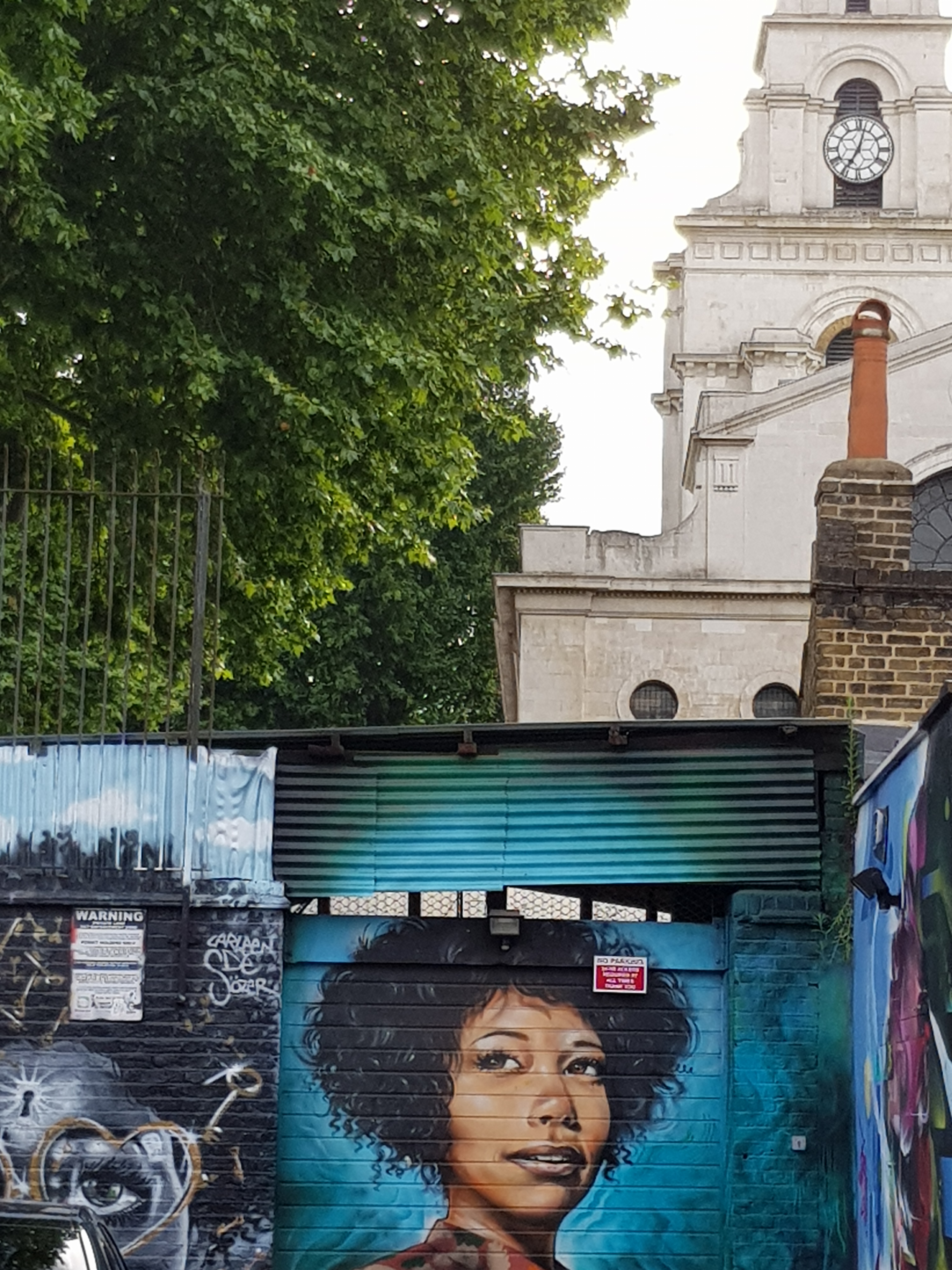
Looked down Fournier Street towards the Christ Church:-

I don’t always like graffiti, but can see the drama of this in the yard behind the church:-
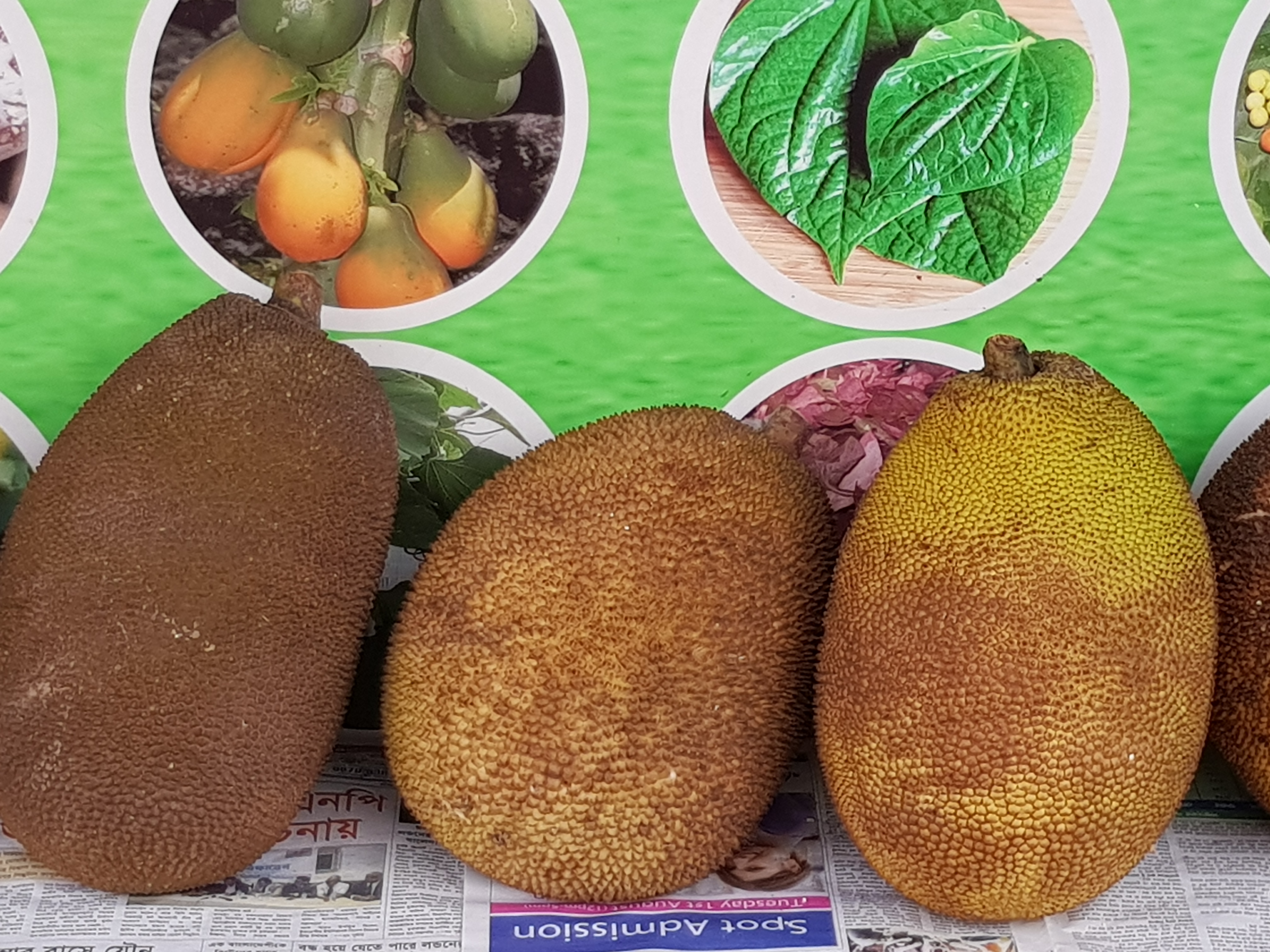
Past the jackfruit:-
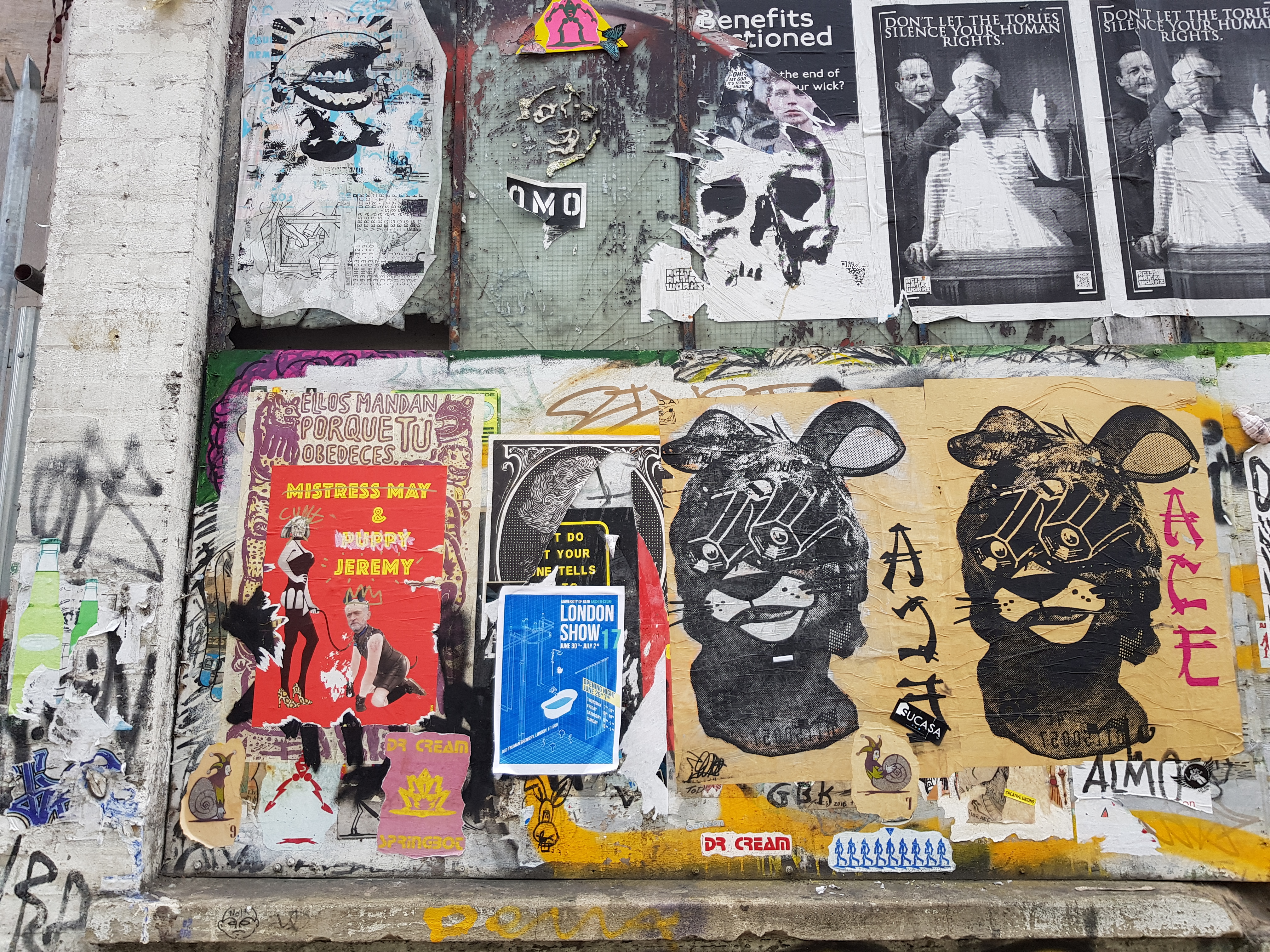
And a hoarding of political posters:-
 | Charles | Saumarez | Smith |
You must be logged in to post a comment.