On Friday night Otto and I went to Joyce DiDonato performing at the Barbican. I didn’t know what to expect and was unprepared for the force of her voice and the magnificence of her stage presence singing Ravel’s Shéhérazade and then, by special request of the conductor, Alan Gilbert, an encore of Strauss’s Morgen. It was impossible to match in the second half of the more conventional NYPO orchestra.
Bassae Frieze (2)
It was only on my return from Greece that I discovered, which I should probably have known, that the Royal Academy itself has casts of the Bassae Frieze. Once the Frieze had arrived in the British Museum in 1815, the Academy commissioned a complete set of casts to be done by Richard Westmacott RA, a neoclassical sculptor who had studied at the Accademia di San Luca in Rome, was a friend of Canova, and published An Account of the Arrangement of the Collection of Ancient Sculpture in the British Museum in 1808. An active RA from when he first exhibited a bust of William Chambers in 1797, he believed that it was better for students to learn to draw from casts than the original. So, whilst the originals were on display in Bloomsbury, students in the RA Schools would be taught to draw from copies in Somerset House on the Strand.
Greenwich Peninsula
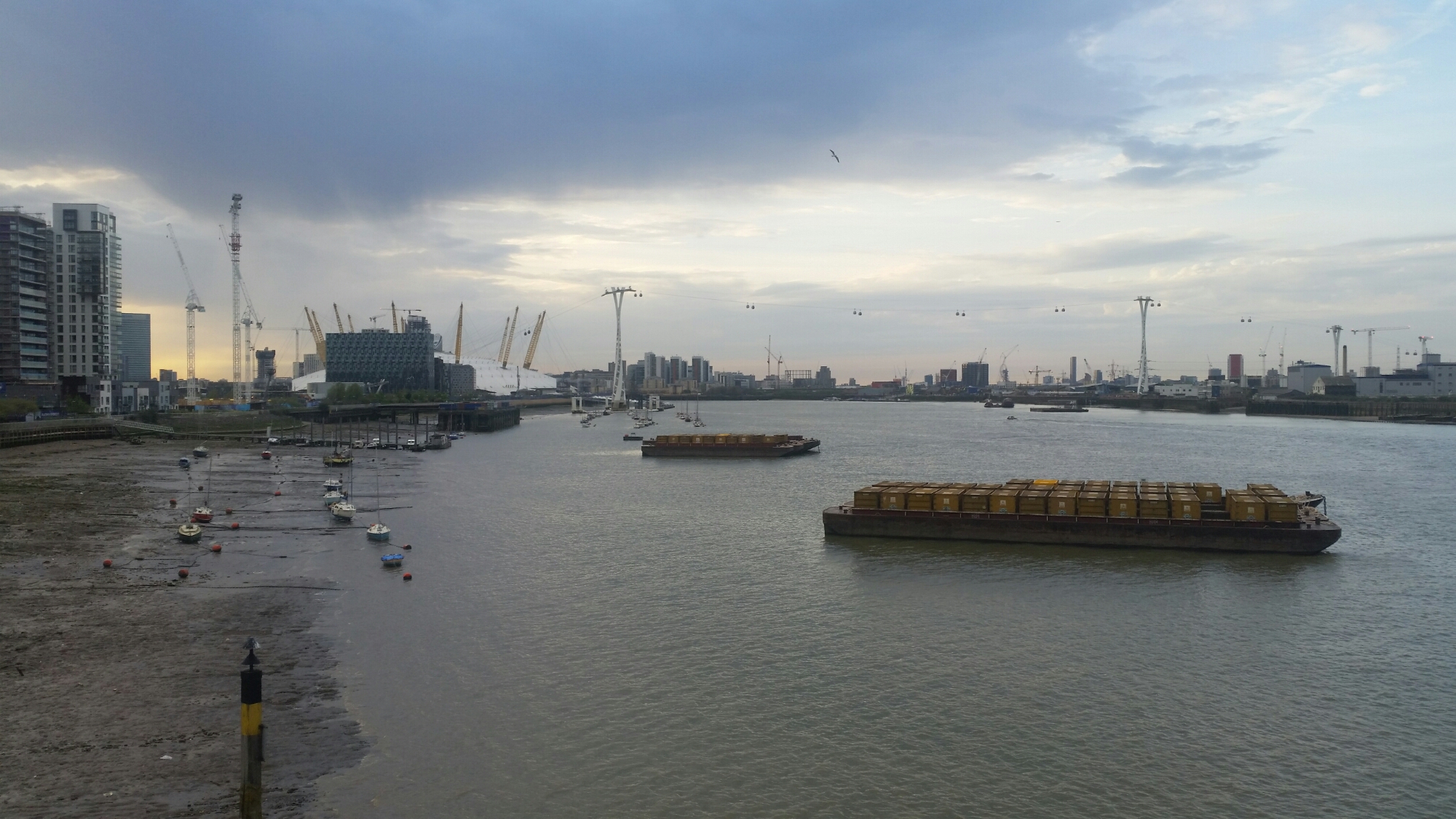
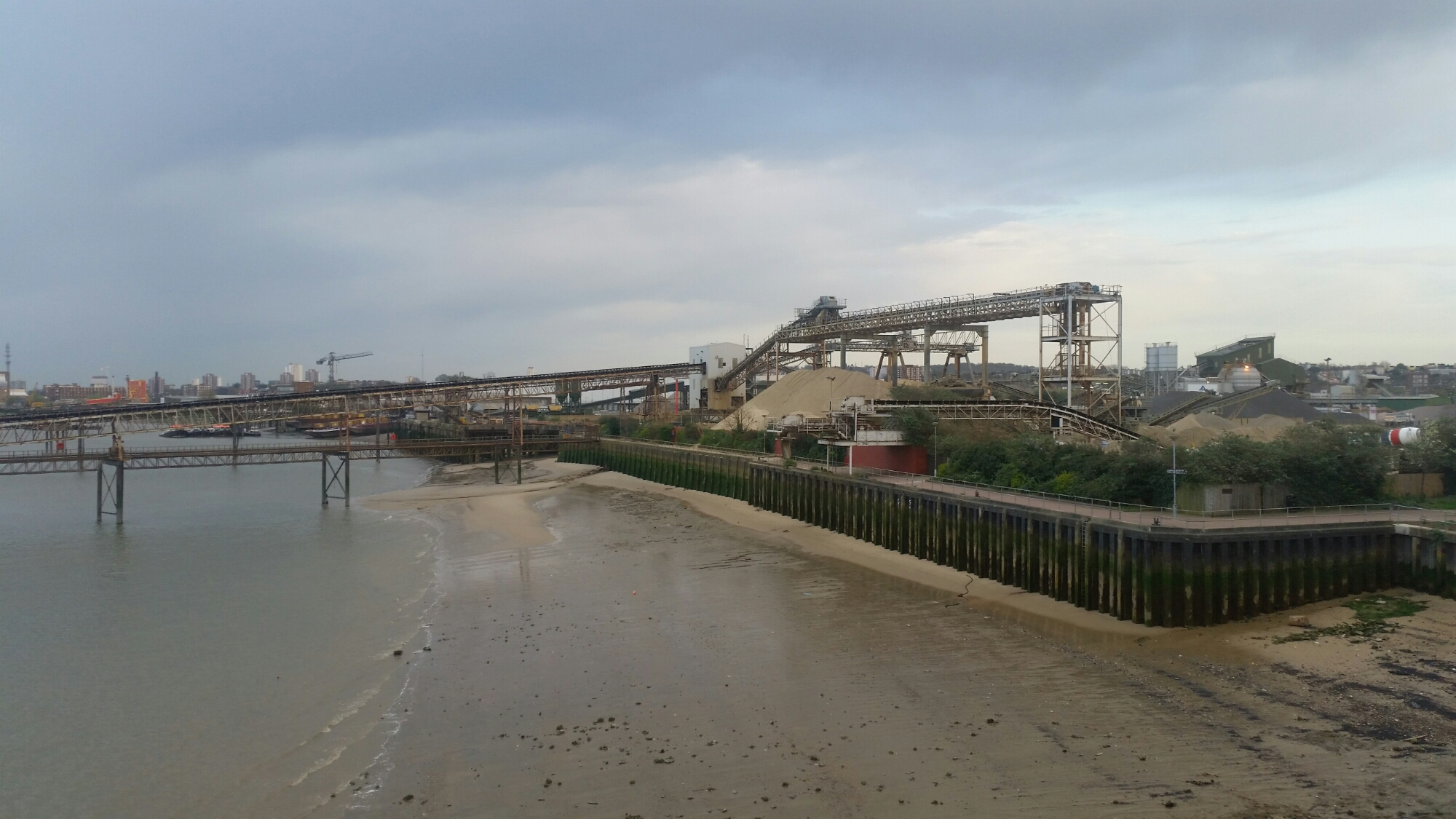
We went to the launch of a volume of poetry called The Observances written by Kate Miller and published by Carcanet Press. As a book which is partly about water, the launch was held in Greenwich Yacht Club, in the stretch of river beyond the Millennium Dome where barges take London rubbish out to sea. There was a view east beyond the cement works towards the Thames Barrier and to the west the Millennium Village designed by Ralph Erskine at the end of his career:-
Sir Philip Dowson PPRA
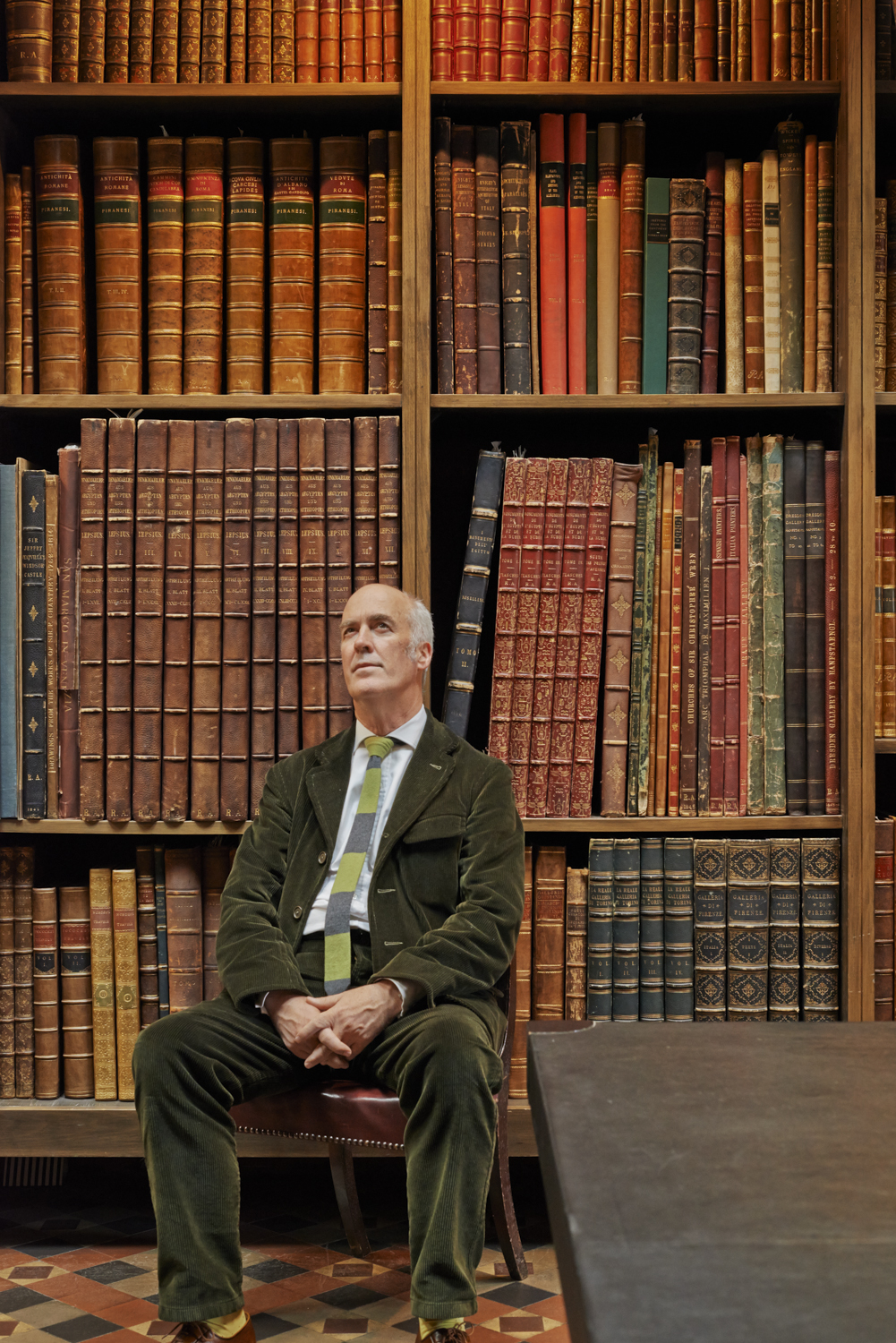
We had the memorial service today of Sir Philip Dowson, the oldest living former President of the Royal Academy who till recently would loyally attend all the formal occasions, particularly the annual dinner about which he had strong views. I got to know him in the 1990s when I was Director of the National Portrait Gallery and he was ex officio one of my Trustees. He would come to meetings, but, more importantly, he chaired the committee for the selection of an architect to design the Ondaatje Wing. He did this with admirable acumen. The anonymity of his work as Chief Architect in Arup Associates mean that his work is much less well known than younger big-name architects, but he would have disapproved of the cult of the individual creator. Otto SS took me on a tour recently of postwar buildings in Cambridge and showed me, which I had never seen, the amazingly brutal zoomorphic structure of Dowson’s Zoology building. He also did the library at Clare (where he had been an undergraduate) in the 1980s, inserted into Gilbert Scott’s Memorial Court, and the original Maltings at Snape. It was a good service, with music by Mozart, Bach and Vaughan Williams, an address by Sir Jack Zunz, whose house Philip designed, and another by Norman Ackroyd, remembering that it was under Philip that Burlington Gardens was acquired.
Saving Faces
Last night we had the annual Arts, Medicine and Society lecture organised jointly by the RA and the Royal College of Medicine and held at the latter. It was given this year by Iain Hutchison, the charismatic surgeon in charge of facial reconstruction at the London Hospital, who twenty years or so ago started using the work of an artist, Mark Gilbert, to help patients (and the public) understand their facial disfigurement. Gilbert’s work was first shown fifteen years ago at the National Portrait Gallery at the same time as the Mario Testino exhibition and has been travelling round the world ever since. I found it very moving to be reminded of the immense dignity of the sitters, particularly Henry de Lotbinière, a barrister whose portrait demonstrates very clearly how the human spirit can rise above the circumstances of their affliction.
Norman Foster RA
My first event back in London has been to attend the launch of a book by Paul Goldberger, the former architecture critic of the New York Times, about Norman Foster’s approach to building projects which has frequently involved the preservation of the old alongside the creation of the new (at Nîmes, the British Museum, the Reichstag, the National Portrait Gallery in Washington and the Museum of Fine Arts in Boston). The launch was held – very appropriately – at the RA because the design of the Sackler Wing, which opened in 1991, was key to the practice’s approach to how to work within the organism of an historic building. The answer was not to mimic, or be deferential, but be confident in the contribution of the new to the old. This may now sound obvious, but at the time was very important in producing a change in attitude not just to old buildings – that they can, and should, evolve – but also to new buildings – that they exist in a continuum and should be treated with equivalent respect.
Stuart and Revett
The last of my posts about visitors to Delos concerns James ‘Athenian’ Stuart and Nicholas Revett, who were commissioned by the Society of Dilettanti to record Greek antiquities and visited Delos in 1754. In the third volume of their Antiquities of Athens, not published till 1794 (the first volume had appeared in 1762) they recorded how ‘No contrast can be more striking than that which exists between the descriptions of the Sacred Isle in its ancient state, and the miserable aspect of barrenness and dilapidation which it actually presents. Delos, the mythologic birth-place of Apollo and Diana, was enriched by commerce and superstition; temples and consecrated monuments adorned its rugged and unproductive surface; and so awful was its sanctity, that even the Persian ravager respected the hallowed soil. Of all this, nothing now remains but an indiscriminate wreck…’ They published drawings of the Temple of Apollo and Revett based both the east portico of Standlych, Wiltshire and his church at Ayot St. Lawrence on it.
Lord Charlemont
Amongst the many eighteenth-century visitors to Delos was Lord Charlemont in 1749 on his Grand Tour. He had chartered a French frigate called L’Aimable Vainqueur and kept an unpublished account of his travels in a volume which he entitled A Traveller’s Essays Containing an Account of Manners rather than Things. They went first to Constantinople, then toured round the Greek islands, spending a few days in Mykonos where he had ‘An Amorous Adventure’ (island girls were freely available for temporary marriage) and then travelling out on a small boat to Delos where he admired ‘Pillars, some of very great size, altars without number but miserably decayed, and heaps of stones’. They slept on beds of dry seaweed ‘under an awning made of the sail of our boat’ and spent three nights there enjoying ‘the sprightly whimsical music’ of the crew in the evening.
Earl of Sandwich
In reading about eighteenth-century travellers to Greece, I am surprised how many of them made it to Delos, island hopping (there is an excellent article by David Noy, ‘Dreams inspired by Phoebus: Western visitors to Delos from the seventeenth to nineteenth century’ in International Journal of the Classical Tradition, 18:3, September 2011, pp.372-392). John Montagu, fourth earl of Sandwich, who was later to be an important naval administrator and patron of cricket, as well as the putative inventor of the sandwich (he apparently asked for meat between two pieces of bread whilst gambling) arrived in 1738 en route to Egypt. He described how ‘the most remarkable ornaments of this city were the temple of Apollo, a theatre, a naumachium, gymnasium, several very grand porticos, a temple on honour of Apollo and Diana, besides a great number of altars and statues dedicated to different gods and heroes’.
Rev. William Petty
While Thomas Roe was acquiring antiquities for the Duke of Buckingham, the Rev. William Petty was doing the same for the Earl of Arundel, furnished with permits issued by Roe and, to begin with, an expectation, rejected by Arundel, that his findings should be split jointly between the two collectors. Petty, who was Arundel’s chaplain, travelled out to Venice in 1624 and then to Constantinople and throughout the Mediterranean. According to Roe, he was ‘able to judge of pieces of worth, and spares no labour…He hath gotten many things, going himself into the islands’. What Petty acquired was shipped to London in 1627 and attracted huge interest, catalogued the following year by John Selden as Marmorae Arundelliana. In the eighteenth century, William Stukeley described how the collection of Arundel Marbles at Easton Neston included ‘an intire column of marble in two pieces, fluted, taken from among the ruins of the temple of Apollo at Delos’.
 | Charles | Saumarez | Smith |
You must be logged in to post a comment.