
I’ve just been to a most unusual and surprising fundraising event, which consisted not at all of asking for money, but instead an evening of meditation and poetry round the photographs of Dennis Hopper. Brett Rogers, the Director of the Photographers’ Gallery, spoke around the theme of loss and rediscovery, the ways in which contemporary culture is interested in the forgotten archive, the box of negatives left in a Chicago lock-up, the fascination with the fact that Hopper’s photographs are as he left them. Peter Aspden of the Financial Times talked about the contrast between New York of the 1960s, the dominant culture of the period, and Los Angeles, more laid back and hippy, the culture of Pacific time. And then Jean Wainwright talked about the encounter of Warhol and Hopper. What struck me is how close and yet how remote Hopper’s world is, fifty years on.
John Gibson RA
Another unsung hero of the RA’s history is the neoclassical sculptor, John Gibson. Born near Conway in north Wales, apprenticed to a cabinetmaker in Liverpool, he was encouraged to turn to sculpture by Samuel Franceys and the collector, William Roscoe. He exhibited at the Liverpool Academy in 1810 and attended its lectures in anatomy. In 1817, he gravitated to London and to the circle of neoclassicists round Flaxman. The next step was Rome, where he studied under Canova, helped found the British Academy of Arts in Rome with Charles Eastlake and Joseph Severn, and received innumerable commissions from British aristocrats on the grand tour. He stayed in Rome for the rest of his life, grew rich and famous, was made a member of eleven academies and left his entire estate to the Royal Academy to allow them to build an extra storey on the top of Burlington House (where the Sackler Gallery now is) to show his work.

Portrait of John Gibson, R.A. ca. 1850. by Sir Edwin Landseer R.A. Ⓒ Royal Academy of Arts
Sydney Smirke RA
In talking about the Summer Exhibition last night, I realised how much of its quality and character derives from the scale and variety of the great exhibition galleries which were added to the back of Burlington House by Sydney Smirke, opening in 1868. I had always thought, quite erroneously, that he was the son of Robert Smirke, the architect of the British Museum. Wrong. He was the son of Robert Smirke RA, an early student of the Royal Academy Schools, who had eight children, including Robert and Sydney (and Sir Edward, an archaeologist). Sydney was trained in the office of his older brother and took over as project architect at the British Museum after his brother’s retirement in 1846, so was responsible for the construction, if not the design, of the round reading-room. But he also undertook a host of other projects, including churches in Lancashire, large country houses and three St. James’s clubs – the Oxford and Cambridge (with Robert), the Conservative Club (with Basevi), and the Carlton (on his own). A major, and rather underestimated, classical architect.
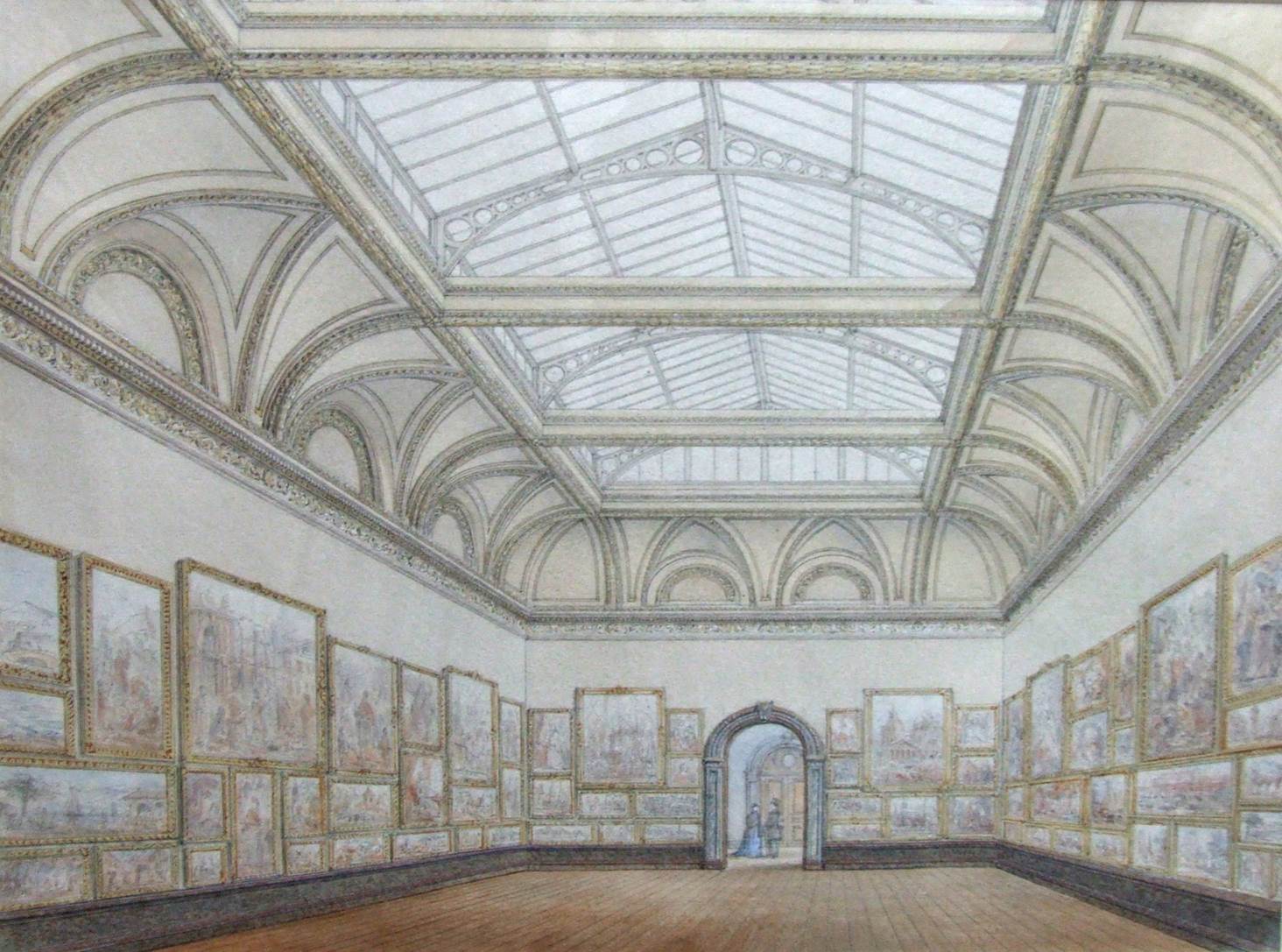
Sydney Smirke RA, Design for Gallery III, Burlington House, Piccadilly, Westminster, London: perspective of gallery looking east, c.1866-67.
Summer Exhibition
I was asked to give the Annual Arts Lecture at Hurlingham last night and was encouraged to talk about the Summer Exhibition, which I have never done before. I kept on getting in a muddle between ‘we’ and ‘they’, because it is we, the Royal Academy, who put it on and they, the Royal Academicians, who arrange, oversee and orchestrate it. But I hope I managed to convey something of a) its extraordinarily long history b) the continuity in its system of organisation and ethos and b) the curious tension which has existed forever between its extreme democracy, in that anyone can enter and does, and its extreme selectivity, in that it has always been dominated not just in its process but also in what it shows by the relatively small number of RAs.
Edmund Burke
I’ve been reading the new book on Edmund Burke by David Bromwich, a Professor at Yale (The Intellectual Life of Edmund Burke: From the Sublime and Beautiful to American Independence). I’m struck by how everyone knows everyone in eighteenth-century London. When Burke wants to write a letter to congratulate Adam Smith on his Theory of Moral Sentiments in 1759, he gets his address from David Hume. When he gives his first speech in the House of Commons, Samuel Johnson writes how pleased he is that ‘Now we who know Burke, know that he will be one of the first men in the country’. And one of his closest friends was Joshua Reynolds at whose house he endlessly arrived for dinner uninvited, imposing his poor Irish relations on Reynolds as well.
Singapore (2)
In the past, I have always been taken round Singapore. With a day to spare before the flight back, I took myself off to explore.
First, because it was close to the hotel, I wandered the streets of Kampong Glam, the still surviving lowrise Arab neighbourhood, including Haji Lane:


World Architecture Festival
After 48 hours of attending an endless round of events at the World Architecture Festival, I have a better sense of how architecture operates. First, it is astonishingly international. Mariana Simas, the Brazilian architect from Sao Paolo with whom I was a judge, was familiar with small local projects, and the architects who had built them, in Vietnam. Second, the geography of influence has tilted strongly towards Asia and Australasia. The Americans seem conspicuous by their absence. Third, architecture as a profession, at least in terms of the bigtime global operators, is predominantly male (look at the line-up of winners), except where it relates to interiors. Fourth (and this is a statement of pure prejudice), much of the most interesting and thoughtful architecture is being done in Australia and New Zealand, both of which have strong and independent national traditions, support their own architects, believe in innovation, and are interested in the relationship between architecture and the natural environment. The winner of the World Building of the Year Award was a21studio for their chapel in Vietnam.
Colour in Architecture
I’ve been on the jury for most of the day for an award for the use of colour in architecture. First, we were shown a project in Lund in Sweden where colour is used to enliven a pedestrian bridge across the main railway line. Then, two bank projects from the southern hemisphere – the new National Australia Bank headquarters in Melbourne, Australia and the new ASB headquarters in Auckland, New Zealand – both of which use colour inventively to break down corporate uniformity. Peter Cook (in bright floral shirt) did a presentation on a new university building which he and his partner, Gavin Rowbotham, have done for the University of Vienna which uses intense colour throughout from the brightest orange to brilliant yellow. A young Vietnamese practice then showed a more temporary community project which uses colour in fabric. We ended with a large multi-generational private house in Kuala Lumpur and a repurposed factory on the outskirts of Adelaide. Luckily, the decision of the judges was totally straightforward. We all agreed that only Peter Cook’s law faculty building used colour with total conviction, making colour integral to the conception of the project rather than applied to it. It was unanimous.
Gardens by the Bay
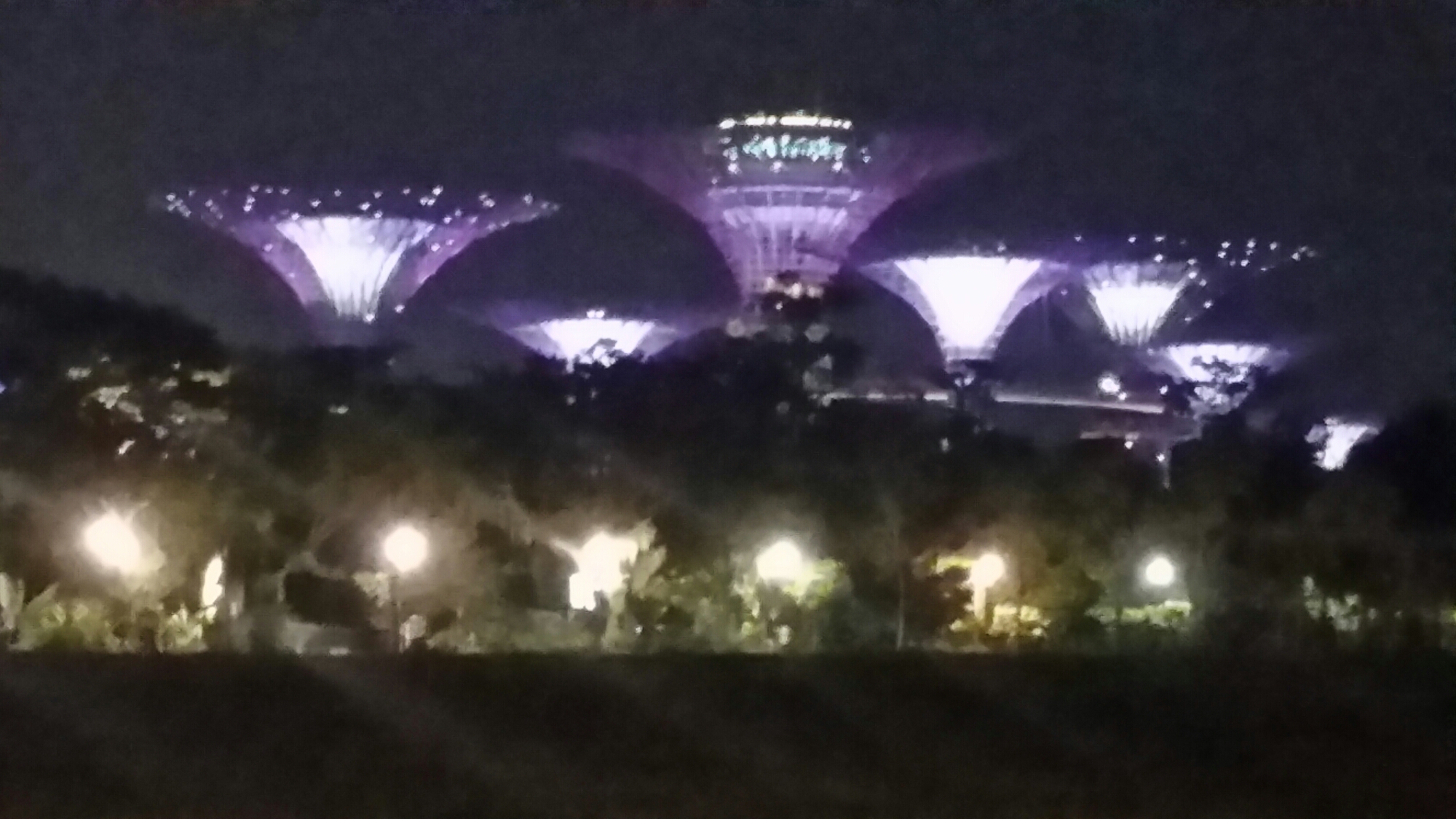
I walked through the Gardens by the Bay during the day and even more by night, pleasure gardens on a grand scale, in a tradition which goes back to Kew, full of exotica and buildings of no purpose, but a form of visual delight. This is a view by day:

And by night:
Richard Rogers RA
Richard Rogers gave the keynote address to a packed audience on the subject of ‘Citizens and the Compact City’. It was an extraordinarily impressive account of his career, ending where it could have begun with the house he designed for his parents in Wimbledon which was motivated by so many of the ideas which he has subsequently explored, including transparency, single span roofs, and a strong sense of community use even in a family house. Almost all of what he said seemed wholly relevant now: the use of brown field sites, opening up high streets, protecting green spaces. Of course, it’s all about use and planning and people as much as it is about architectural design, but that’s what has differentiated him as an urbanist (going back to Masaccio) from his peers.
 | Charles | Saumarez | Smith |
You must be logged in to post a comment.