
It’s a long time since I’ve been on the Today programme, two minutes of ephemeral fame, talking about Tony Hall’s proposal that the BBC should remake Kenneth Clark’s Civilisation ‘for the digital age’. Of course, the whole point of Civilisation is that it’s not about the digital age, because it’s about the message, not the medium. And nobody made the point that nowadays Kenneth Clark wouldn’t get the role: wrong voice, wrong class, wrong teeth, wrong views. My candidates, for what they’re worth, are Jessica Rawson, Lisa Jardine or Mary Beard.
Shanghai Art Museums
Shanghai is undergoing an extraordinary boom in private museums. Given land and buildings by the municipal authorities, private collectors are then free to shape the museum according to their taste and collection. The first we visited was the Yuz Museum. I thought it was opening in 2017. I misheard. It is opening on May 17th. An aircraft size building, it was indeed constructed by the Russians in the 1950s. A beautiful large, industrial building with large galleries to the north and a new build by a Japanese architect at the front to accommodate bookshop, cafe, ticketing, restaurant and private members’ room on interleaved decks. The Power Station of Art is actually a public museum, built at great speed by the banks of the Yangtse to coincide with the opening of the Shanghai Bienniale on 1st. October 2012. We met Li Xu, the deputy director, who spoke charmingly and openly and in impeccable English about the problems of state funding, which are the same everywhere: an interest more in the building than the programme; a lack of commitment to the project’s sustainability; hardware more than software. By the time we got to the Jingan Sculpture Park, the sun was out, blue sky and blossom. Continue reading
Zhang Huan
In Shanghai we took the van into the deep suburbs to visit Zhang Huan in his new studio complex. The gates opened and there was a camera crew to record our arrival. We were taken first to a large, long space, as large as the Turbine Hall, where he was showing a monumental work based on a photograph of Mao and party officials, infinitely mournful, in ash, the lost dreams of his parents’ generation and of his youth. it was hard to tell whether it was political or merely nostalgic. Philip quoted Susan Sonntag.
Continue reading
Zeng Fanzhi
I felt a Proustian moment of recognition as we approached Zeng Fanzhi’s studio. I had been here before. I had. I visited with Fabien Fryns, who also brought him on a private visit to the RA. He’s got an unusually developed interest in the history of art and since my last visit has acquired a wonderful Caspar David Friedrich drawing, two Morandis and an Egon Schiele. He’s in the process of designing a museum for the exhibition of his own and other people’s work. It’s being designed by Tadao Ando.
798
We spent the morning in 798 district – larger, more established and more obviously a tourist destination than it was three years ago (and perhaps inevitably less interesting). I’m finding it hard to make sense of the different strands of Chinese art practice. There’s a traditional strand of beaux arts practice brought in by the French in the 1940s and represented by the amazing rotunda of casts in the Academy, and which was added to recently from Copenhagen (hard to imagine us adding to our collection of casts). It seems that students are still encouraged to – or possibly required to – draw from the antique following the conventions of traditional academic practice, now abandoned in the west. There’s traditional Chinese ink painting, still practised traditionally, but also being reinvented, as evident in a recent exhibition Ink Art in Contemporary China at the Met. There’s contemporary abstract art. And there’s art in a more international, experimental manner as represented in private collections. But it’s very hard to work out how they interact, if at all, except all strands seem to be represented at the Academy.
The Private Museum of Mr. Zhu
We have just come back from a wonderful outing to meet Mr. Zhu. We drove deep into the countryside outside Beijing where the landscape becomes hilly and full of vineyards. This is where Mr. Zhu has the headquarters of his agricultural empire, including camels. When the communist regime began to encourage private enterprise, he saw the opportunity of marketing juice. Now he supplies all the fruit juice in China. From this benign agricultural activity, he has built his own private museum of geological specimens, the most remarkable fossils, as well as rare bottles of wine and juice packaging from around the world. The British Ambassador arrived and we had the most delicious meal of the finest thin beef and fresh vegetables gathered straight from the fields, cooked in little stewpots in front of one. We drank the best French and Italian wines washed down with plentiful toasts.
Ai Weiwei (1)
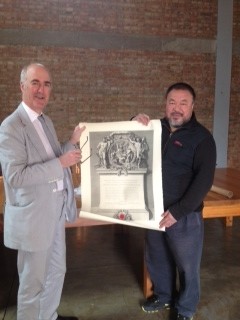
Ai Weiwei receiving his RA diploma
We took Ai Weiwei’s diploma to his studio in a house somewhere in the deep outskirts of Beijing. He was elected an RA a couple of years ago, just after he came out of prison, but we don’t like to consign the diploma to the vagaries of the international post. It was unexpectedly moving handing it over to him. He asked how many there are. The answer is not many, about 25, because we are only allowed to elect two a year, and we don’t always remember those two. He is the first Asian artist. I read out the Obligation, which I luckily remembered was printed in the copy of my book which I had brought to give him, although I’m not convinced it was strictly necessary. Continue reading
Whang Atong
By a weird coincidence, as I arrive in Beijing, I am reading an excellent biography of Sir William Jones by Michael Franklin and discover that Jones was not only interested in Persian and Arabic, which I already knew, but translated a Chinese ode when he was in Paris in 1770 having had dinner at the house of Joshua Reynolds with Whang Atong, a visitor from Canton. Jones collected Chinese manuscripts whilst a judge in Calcutta and tried to persuade Whang to translate more early Chinese poetry into English, long, long before Arthur Waley.
Hong Kong (2)
On Sunday morning, we were taken for a basic Chinese breakfast of excessively sweet tea and dumplings by the sea in Shek-O.
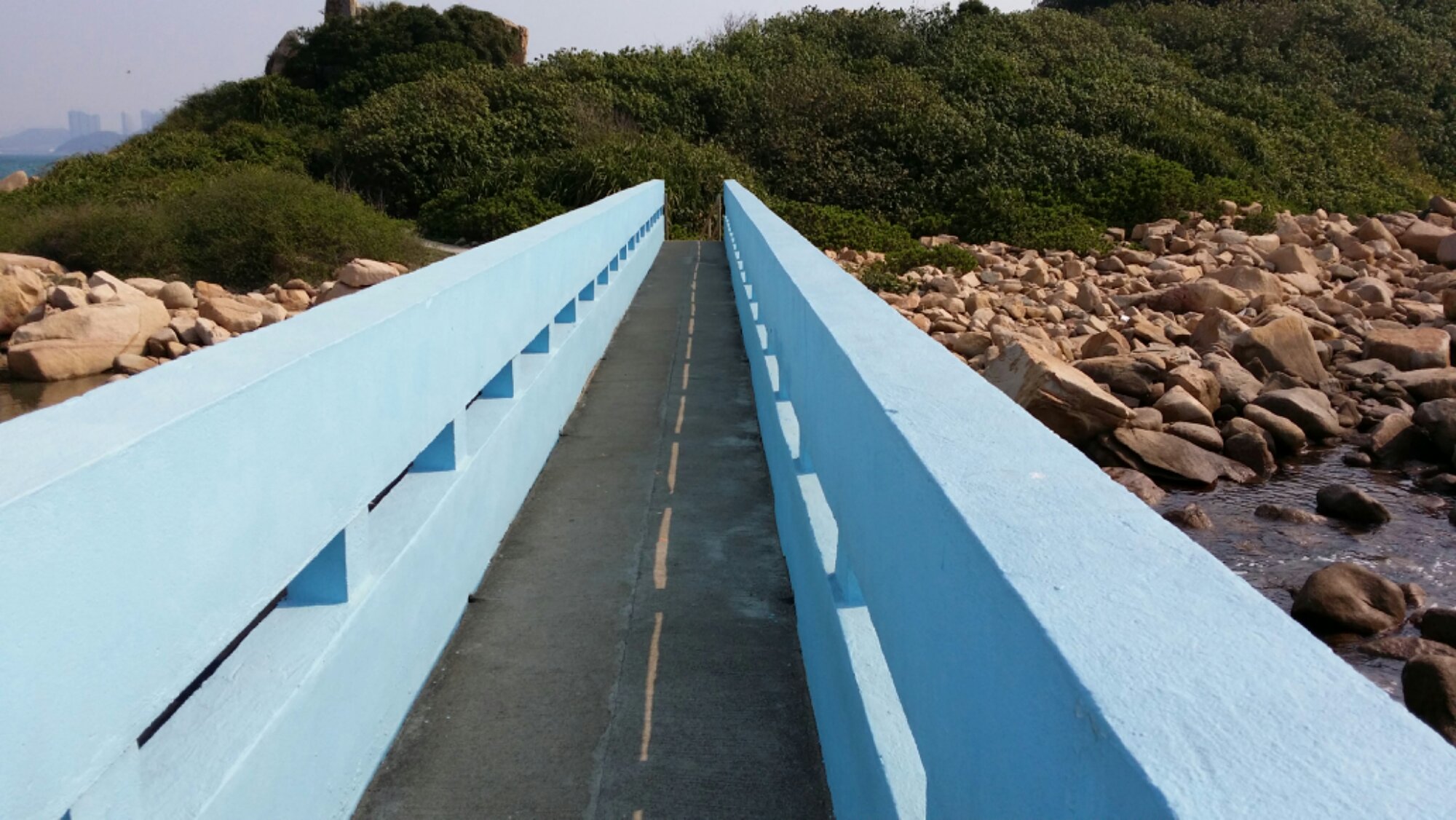
We then had a breezy walk by the cliff across a blue modernist bridge built by the Japanese during the war.
Beijing
It all came back to me from my one and only previous visit to Beijing: the immensity: the airport which is twice as big as any airport anywhere; the ten lane highways; not knowing where one is going, north or south. Luckily, Philip Dodd was there to meet us, tell us our schedule and explain the ropes. My hearing has gone altogether and it is eerily quiet.
 | Charles | Saumarez | Smith |
You must be logged in to post a comment.