I am relieved to discover that I am not alone in being shocked by the enormity and lumpen scale of the set of buildings proposed by Make on a site nearly adjacent to the National Theatre. It is their scale which is shocking – six tower blocks aggregated in such a way that it will completely overwhelm the more modest Denys Lasdun National Theatre. It now apparently depends on Sadiq Khan to approve it.
Of course, you could say that the battle to save any kind of human scale in the City has been lost. What seems to me important is the way that this construction will tower over not just the National Theatre next door, but also Somerset House opposite. And it will not be insignificant in relation to the Houses of Parliament and St. Paul’s.
We went to a very beautiful, very intense but also faintly melancholy performance of Winterreise last night – melancholy because it was commemorative of Ann Tusa, a historian of Germany, as was revealed by Ian Bostridge before the start of the performance, which was only interrupted by the loud rustling of pages turning as nearly everyone was intently following the translation. Bostridge was accompanied wonderfully by Angela Hewitt. I can’t think of a more moving way to be commemorated.
I am very upset to learn out of the blue of the death of Philip Hewat-Jaboor, who we got to know in the 1980s through the artist, Philip Core. He was a collector who was passionately knowledgeable about porphyry and chaired the Masterpiece Art Fair with intelligence and aplomb. He lived in Jersey. I realise that I actually don’t know much about him, except that there was something interesting about him: a sense of cosmopolitan interests and fastidious expertise, which is evident in his entry for The Aesthete in the Weekend FT (https://www.ft.com/content/fe530cdb-72f7-48f0-af77-e1708da2c82a). He was a real aesthete.
I missed the opening of ‘Fashioning the Rose’; but was pleased to see its eclectic mix of recent fashion items inspired by roses.
A necklace made of brass, designed to wound its wearer, inspired by a short story by Oscar Wilde. The original nightingale has been eaten by termites, so has been replaced by a dead finch:-
Roses by Phoebe Cummings which decay because they are unglazed, which gives them an ephemeral beauty:-
And a hat by Christian Lacroix, a wonderful, theatrical designer, who used to design the pyjamas for Air France:-
We went to the Louise Bourgeois exhibition at the Hayward – The Woven Child. It was such a pleasure to see an older generation artist working so incredibly inventively in her eighties and nineties, right up to the time of her death in 2010, exploring her subconscious, using materials inventively in a way which is unusually free and un-self-important, as if she retained her originality of thought, self-exploratory, right up to the end.
I would have taken more photographs if I hadn’t left my charger at home:-
I am taking the liberty of reproducing the ground plan of Nithurst Farm, because it helps to make clear the coalition between openness and complexity which is an essential part of its character. There is a big open main hall for public gatherings, with kitchen and eating located on opposite sides; a playroom disguised by a settle; entered by a tight lobby which creates a sense of contrast when one enters the big hall space.
Then there is a minstrel’s gallery, an unusual feature of a modern house:-
And the entry to the staircase is treated theatrically, with tapering used to confuse the perspective:-
It’s not a machine for living in, but a place to explore and get lost in:-
I have written before about the battle raging over the future of the Wolseley. I don’t think I had quite registered the enormity of what was at stake until I read that Jeremy King will no longer be allowed to enter the restaurants he co-founded: not just the Wolseley, but Zédel, the more democratic alternative, and Delaunay, where headhunters do business, and Fischers at the top end of Marylebone High Street, more truly Viennese. I’m sure they will carry on in some form, but they will have lost something of their character and family feel, which, as the accompanying article well describes, was owing to Jeremy King and Chris Corbin’s benign stewardship and sense that running a restaurant was about atmosphere and the quality of service, the greeting at the door, at least as much as the food, which they first taught London at the Ivy and Caprice, now sadly a part of folklore and restaurant history.
A month or so ago, I went to see the Burrell Collection for the press opening and before the collection had been fully installed. I was very impressed: by its scale; by the amazing quality and range of the collection; and by the way it had been restored, although I was already aware that one of the three architects, John Meunier, was critical of its restoration.
The biggest change is to open a new front entrance. This makes good sense – to make it look and feel more accessible to the surrounding park. The second big change is to remove the old lecture theatre and replace it with an open forum space in the centre of the building. Again, this makes good sense. And I think maybe one or two of the period rooms have been removed. The result has been to open the building up and make it feel more generous. I hope John Meunier will visit it and be pleased by the result.
There is a wonderful small, but very focussed and thoughtful exhibition of the work of Frank Auerbach in the Newlands Gallery in Petworth. It is based on two groups of work. The first is his long-standing fascination with the composition of works in the National Gallery – Constable’ Hay Wain, his Salisbury Cathedral from the Meadows (1831) and the work of Turner, including The Fighting Temeraire. The second is a very substantial group of paintings collected by David Wilkie, an insurance clerk in Brentwood who befriended Auerbach, paid for work over time and bequeathed his collection to the Tate where it is mostly unseen, although it includes some excellent and memorable pictures.
This is the picture he commissioned of Rimbaud:-
This is a painting he asked Auerbach to do of a painting Titian might have done – Callisto’s death – but as seen from Hampstead Heath (it includes Michael Foot in the foreground):-
I arranged to see Nithurst Farm, Adam Richards’s strange and brilliant house buried in a secret valley surrounded by woods just outside the park at Petworth.
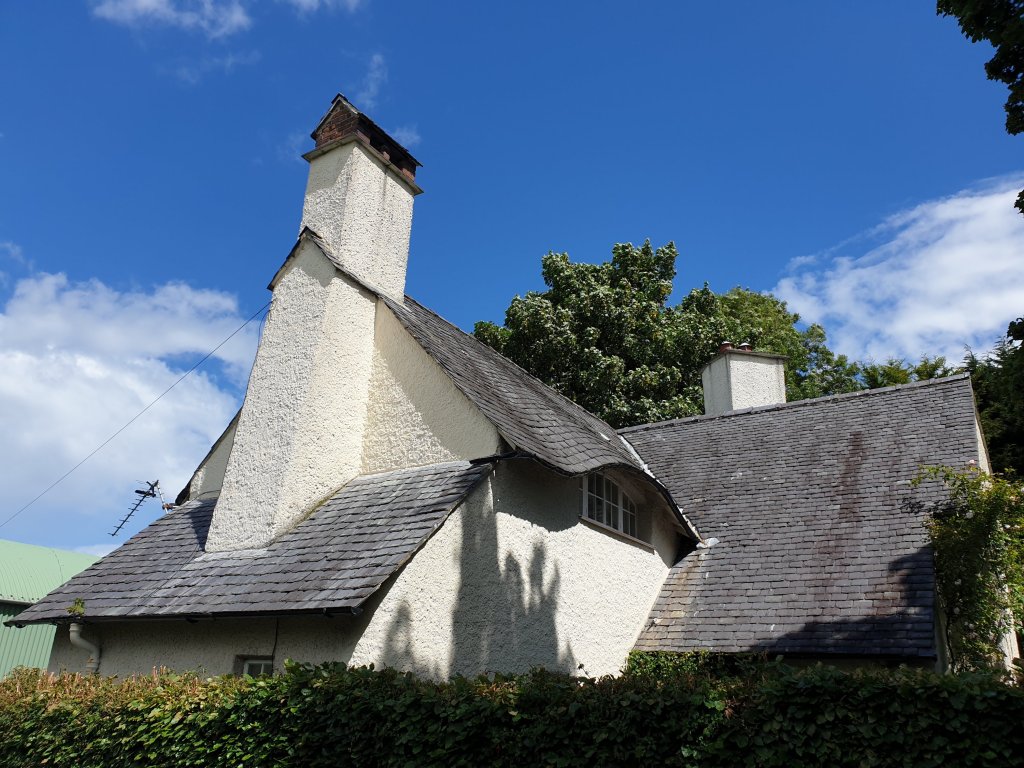
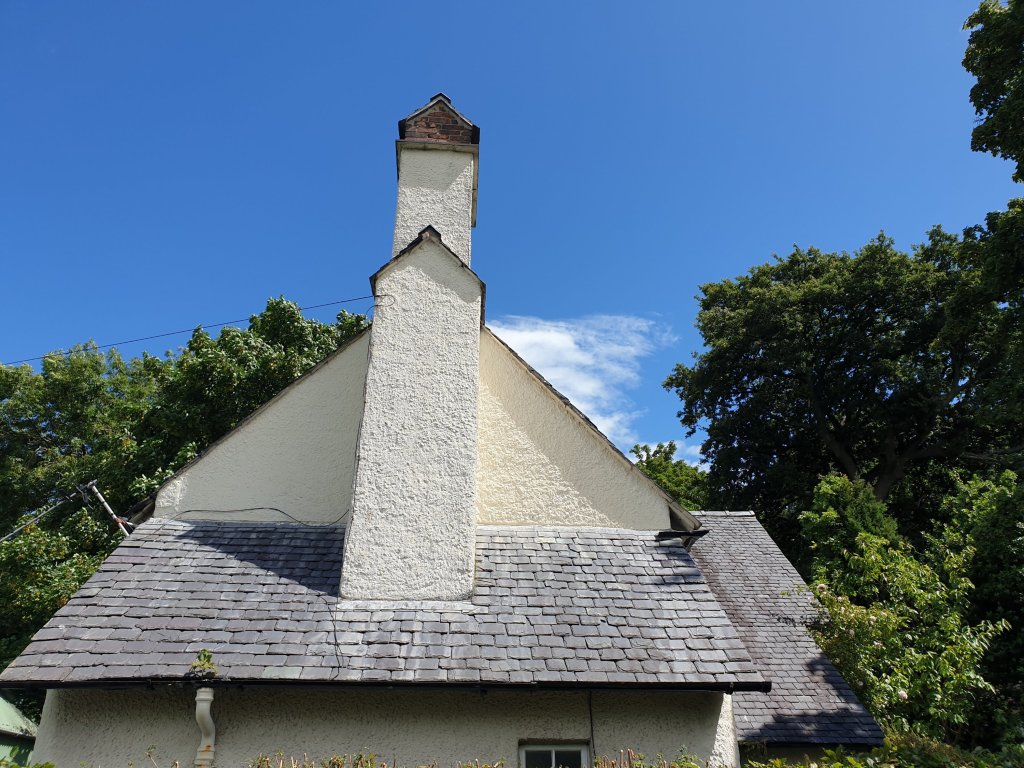
Apparently, a balloonist fell down in the fields nearby and said that he always told people that it was the pumping station for Petworth. This is indeed its idiom: an abstracted form of industrial geometry; partly as if it was a classical survival with its deeply recessed Diocletian windows; partly based on Palladio in that its ground plan echoes the big central ground floor space of the Villa Maser, but is very slightly tapered, with rooms offset; and it is partly maybe also a subconscious – or conscious – homage to Vanbrugh as if it is a project which has strayed from Vanbrugh’s estate of abstract castellated buildings on a hill overlooking Greenwich (Richards himself references Vanbrugh’s garden tower at Claremont).
Richards was a student of Dalibor Vesely at Cambridge and the house is deeply influenced by a belief that architecture is not just a question of solving problems, but about the language of architectural form. This was apparently Vesely’s first lesson, as Vesely was a philosopher, teacher and engineer, interested in the poetry of architecture, its hermeneutics.
This is the approach from the hill above:-
This is a view of the garden façade, pure Aldo Rossi, with the windows of the garden room full height and asymmetric:-
Like Vanbrugh, it manages to be both miniature and monumental:-
This is the view of it as a tug boat, an analogy I didn’t initially recognise until I saw the model:-
It’s a rich project, but also quite simple, both at the same time, which is what makes it memorable.
You must be logged in to post a comment.