St. Paul’s Cathedral (7)

We sat on a balcony last night on the other side of Blackfriars Bridge from St. Paul’s and were able to admire the way that it still just about commands the horizon against the towers of the Barbican, looking more like Bramante’s Tempietto when seen from a distance, not that Wren had seen it, but he would have known it perfectly well from engravings in his extensive library of travel and architectural books:-

Standard

Façadism

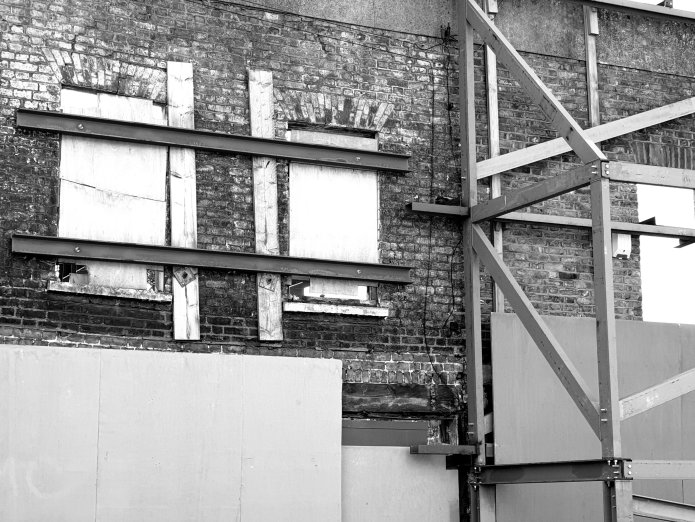
I have been following with interest the Gentle Author’s campaign against what he describes as ‘the creeping plague of ghastly facadism’. It is one of those things which, once noticed, is surprisingly common, a result presumably of developers doing deals with local authorities whereby they gut properties on condition that they retain the façade.

One of the odder examples is on Commercial Road on the edge of the Mercer’s estate, where there was an odd and old-fashioned group of shops, including a fishmonger’s open to the fumes of the passing traffic. It has nearly all been demolished, apart from one half-timbered shop which scarcely seems worth the effort of preserving :-

And two façades on White Horse Road where the old bakery used to be which also don’t seem to merit the effort of preserving:-

http://spitalfieldslife.com/2019/06/16/help-me-publish-a-book-of-the-creeping-plague-of-ghastly-facadism/

Standard

Peter Smithson at the RA

A question from Ellis Woodman as to whether or not there are still people alive who were students at the RA Schools when Albert Richardson taught architecture reminded me that Peter Smithson, the well known brutalist, enrolled as a student in 1948, after completing his studies, interrupted by the war, at the King’s College School of Architecture in Newcastle. What on earth will he have made of the teaching of Richardson who liked to be carried round Ampthill in a Sedan Chair ? Anyway, it was at the RA that Smithson met Anthony Caro, another improbable product of its conservative teaching.

Standard

3 Directors

Here we are, three directors of the NPG, Roy Strong, who was Director from 1967 to 1974, me from 1994 to 2002, Nick Cullinan who took over in 2015, together representing a mere fifty two years of the gallery’s history, only missing the late John Hayes and Sandy Nairne:-

Standard

Ian McKeever

I went to visit Ian McKeever, an artist whose work I have long admired, long before I knew him at the RA and before I read his writings on art when I was at the National Gallery. But I had never been to his studio, deep in the deepest Dorset countryside, somewhere near Shaftesbury, where he produces work which it is easier to understand when seen in situ, produced in an atmosphere of the utmost calm and long spells of working on series of abstract works, which are like musical performances, layers of single colours in veils of paint and clouds.

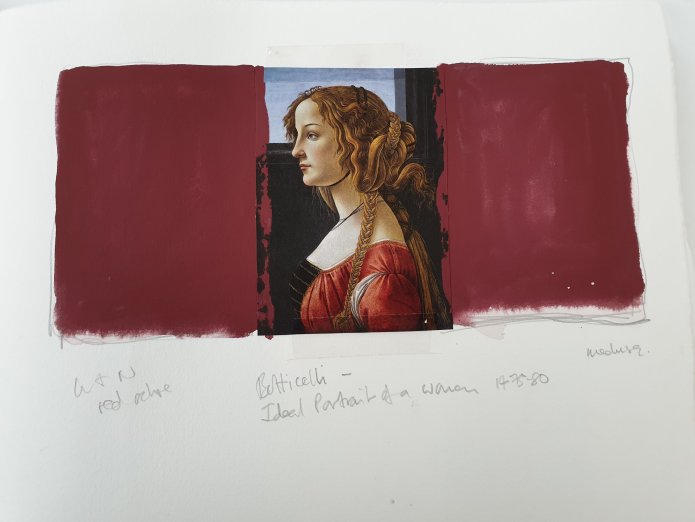
I had only half known, and greatly admired, the way the work is informed by his knowledge of Old Master painting, including a series of gouaches which work with, and in doing so interpret, images of historical portraits:-

Standard

37, Harley Street

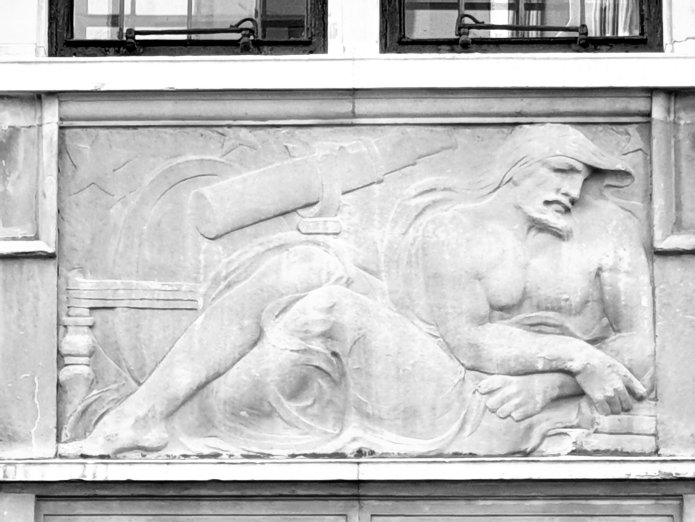
Walking up Harley Street, I stopped to admire the sculptural reliefs on no.37, a house designed by Arthur Beresford Pite and with sculptural decoration by Frederick E.E. Schenk, including a winged figure over the oriel window:-

And other good bas reliefs:-

Standard

Epstein, Madonna and Child

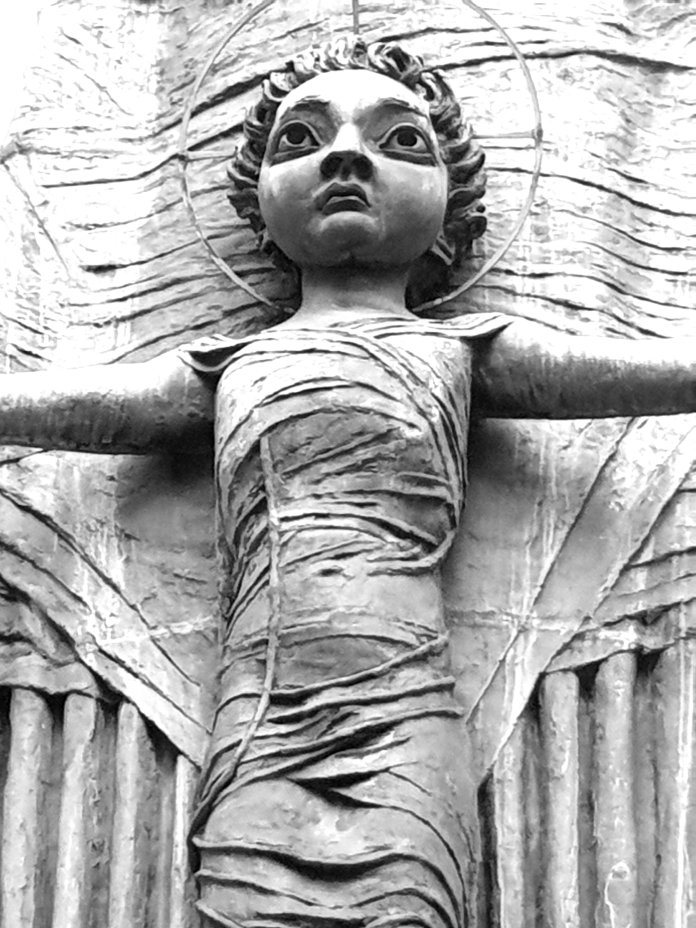
I was sitting in Cavendish Square, waiting until it was time for dinner – nor a very satisfactory square owing to extensive bomb damage and the creation of an underground car park – when my eye was caught by the fine sculpture of the Madonna and Child which Jacob Epstein did for the Convent of the Holy Child of Jesus after the war, when Louis Osman was commissioned to design a bridge connecting Nos. 12 and 13 and commissioned Epstein without telling the Mother Superior that he was Jewish:-

Standard

Whitechapel Bell Foundry (6)

Well, well, the hearing of the planning application for the development of the Bell Foundry which was due to take place on 30th. July in a fortnight’s time has been postponed. Let’s hope this is good news: that Tower Hamlets has realised that a catastrophe has been due to take place and the historic fabric of the Foundry changed beyond recognition. Now, there is at least an opportunity for some negotiation to take place whereby ownership of the Bell Foundry is sold or transferred to United Kingdom Historic Building Preservation Trust and it becomes a proper working foundry once again, retaining the skills, as well as the fabric of the building, which would otherwise be lost.

Standard

Whitechapel Bell Foundry (5)

I am learning from the amazing amount of traffic on my twitter account how much the Whitechapel Bell Foundry means to people: not just as a set of historic buildings, but because it represents such a strong sense of historic continuity, which has now been ruptured. Much the most popular tweet came from someone who goes under the soubriquet of Boiled beans (@Fulmedames) and I reproduce it here as a record of some of the feelings which the closure of the Foundry has generated:-

Those bells spoke to the people in a time when there was no other way to reach so many at once. They tolled the time, peeled the weddings, told who had died, sent out warnings, opened & closed markets.

Now we silence the makers for profit.

Standard

Whitechapel Bell Foundry (4)

I have been fascinated by the extraordinary amount of ill feeling which has been generated by the decision of Historic England to throw in its lot with the plans of a New York venture capitalist to turn the Bell Foundry into an ersatz hotel, rather than help and support the plans of the United Kingdom Historic Building Trust to revive it as a working foundry.

Historic England claims that no money has so far passed hands, but it was drawn in at an early stage to give advice on the developer’s proposals and having given advice, it was presumably difficult for them not to support what was planned, however much it butchers what survives.

Let me quote, as it happens, Historic England’s own description of the historic interest of the site: ‘for the national cultural and industrial significance as the mid C18 site of a specialised industry known to have been located elsewhere in Whitechapel since the medieval period, where well-known bells including Big Ben and the Liberty Bell, Philadelphia, were cast’.

And on its architectural interest: ‘a distinctive, cohesive complex of domestic and industrial buildings spanning nearly 300 years of occupation including the dignified residence of the foundry owner at nos 32-34 Whitechapel Road, no 2 Fieldgate Street and the industrial ranges to the rear’.

If these were the reasons for listing the property, are they not also the reasons for making efforts to preserve it intact as a working foundry, not demolish half of it and turn the rest into a bogus tourist attraction ?
Standard