Charles I (3)

I was asked last weekend about the history of the equestrian statue of Charles I in Trafalgar Square.   The answer is relatively straightforward.   It’s by Hubert Le Sueur, who came to London in the retinue of Henrietta Maria in 1625. The statue was commissioned by Lord Weston, the Lord Treasurer, who agreed a contract with Le Sueur ‘for the casting of a Horsse in Brasse bigger then a great Horsse by a foot, and the figure of his Maj King Charles proportionable full six foot’. A plate under the horse’s left foot gives the date, 1633. After the execution of the King, it was ordered to be broken up by the brazier, John Rivet, who did a good trade in knives and forks supposedly made from it. But, in fact, he kept it, it was bought by Charles II, and erected in Charing Cross in 1675:-

image

Standard

Clichy Estate

It’s strange how one can live in a part of London and still not know it.   This morning I walked from the library to the farmer’s market by way of the Clichy estate – a model of the post-war redevelopment of Stepney, still surviving intact.   I was thinking about Gavin Stamp’s late conversion to the welfare state as himself a product of the 1944 Education Act, educated at Dulwich College at the state’s expense (I am quoting Jonathan Meades), and the fact that post-war planners thought that they were constructing the New Jerusalem:-

image

image

image

Standard

Dublin Capitals

I was incredibly impressed by the quality of the carving of the capitals on the door surrounds, as well as the delicacy of the fanlights, in Ely Place and found myself photographing one after another, not least because each was so different in character.   The street was laid out in 1768:-

image

image

image

image

Turning east, one comes into Baggot Street:-

image

image

And then into Fitzwilliam Street, the subject of a famous planning enquiry in 1965, chaired by Hugh Casson, which recommended the demolition of a long run of Georgian houses, supported by John Summerson, the author of Georgian London, who famously dismissed the street as ‘simply one damned house after another’, a comment for which some have never forgiven him.   The buildings which replaced the Georgian houses designed by Stephenson Gibney & Associates (Gibney was President of the Royal Hibernian Academy) for the Electricity Supply Board have now themselves been demolished and are to be replaced by a modern version of a Georgian front by Grafton architects.   Sic transit.

Ending in Merrion Square:-

image

image

Standard

Anglesey

I am not the type normally to take photographs out of the windows of aeroplanes – not least because I could never match the maestro of the genre, Scott Mead, who has an exhibition of his from all over the world at Hamilton’s Gallery.   But this morning I happened to look out of the window as we were flying over Anglesey and there it was so perfectly laid out, so miniaturistically and so complete, that I could hardly resist snapping it:-

image

Standard

National Gallery of Ireland (2)

In the afternoon, I had no time to linger, only to whip through the Old Master galleries and enjoy a small number of things, including a limewood carving of John the Evangelist by Ligier Richier, a French sculptor:-

image

The galleries are in remarkably good order after what was apparently a long renovation project (7 years at a cost of c.€30M) overseen by Heneghan Peng.

Standard

Royal Hibernian Academy

The reason I was in Dublin is that I was attending a meeting at the Royal Hibernian Academy, our sister Academy across the Irish Sea.   It has a parallel history:  founded on 5 August 1823 as a result of thirty artists petitioning government to obtain a charter of incorporation, it is still more tied into government than the RA – it has to seek government approval for changes to its Laws (it still only has 35 members, plus ten Associates) and its exhibition programme is part funded by the Irish Arts Council (ours isn’t).   It lost its original building, Academy House, in Lower Abbey Street as a result of a fire during the 1916 Easter Uprising.   In 1939, it acquired a grand neo-Tudor house in Ely Place, which was demolished, to be replaced by a new building designed by Raymond McGrath, the Australian architect, who was elected as a Fellow of Clare College, Cambridge, remodelled ‘Finella’ for Mansfield Forbes, worked with Wells Coates and Serge Chermayeff on the interiors of Broadcasting House, before applying after the war to be Senior Architect in the Office of Irish Public Works.   The Royal Hibernian Academy is his most substantial surviving building, with fine upstairs, daylit galleries, only completed in 1989:-

image

And a very active set of studios on the top floor, used for life drawing:-

image

Standard

National Gallery of Ireland (1)

I spent the morning in the National Gallery of Ireland, admiring its fine collection of eighteenth-century paintings and being reminded how many prominent artists working in London were Irish, including George Barret RA, one of the founders of the Royal Academy, James Barry RA, one of only two artists to be expelled, Nathaniel Hone RA, another of the founders, and Francis Wheatley RA.

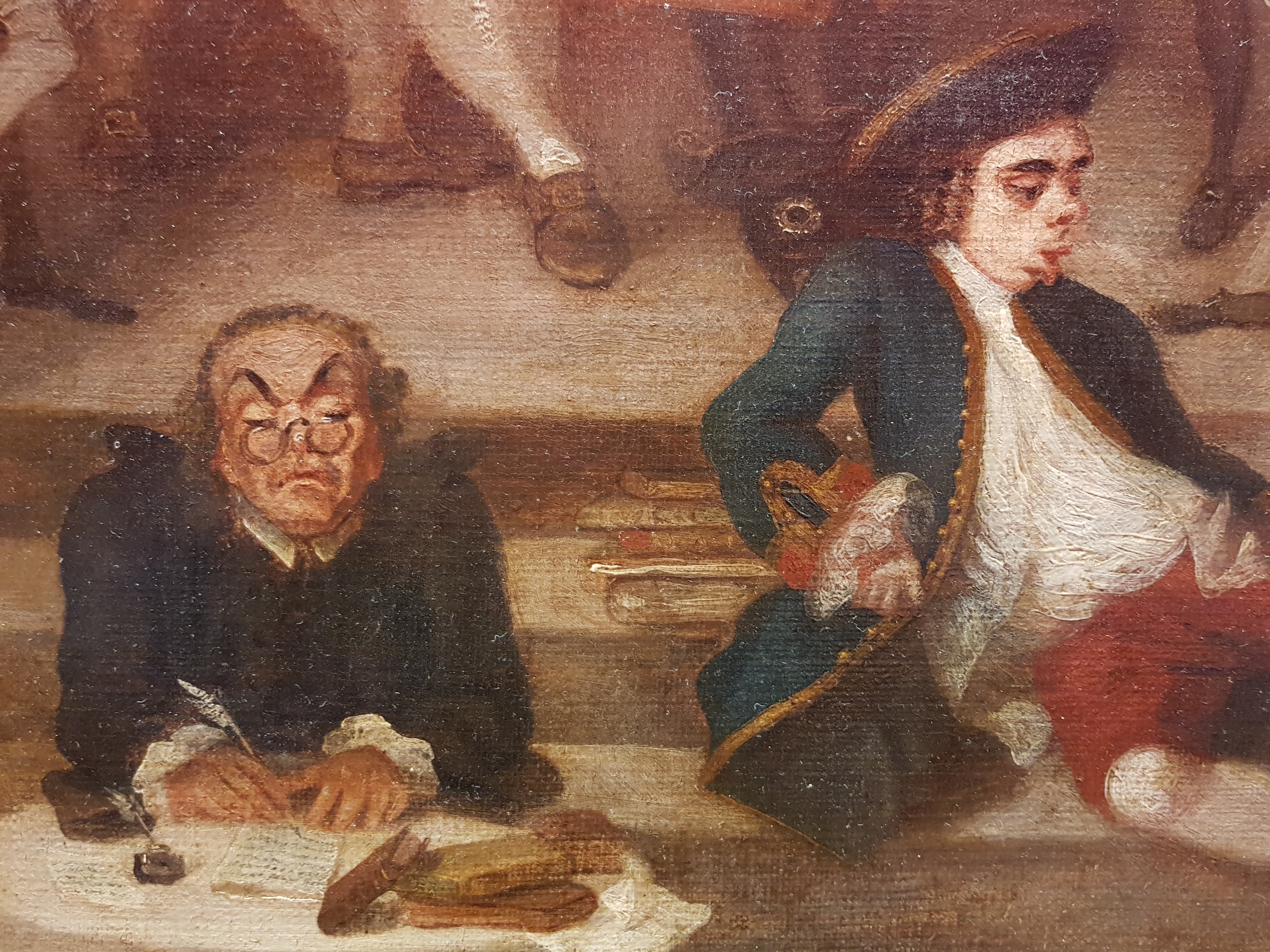
I admired Reynolds’s early parody of the School of Athens, when he was a student in Rome:-

image

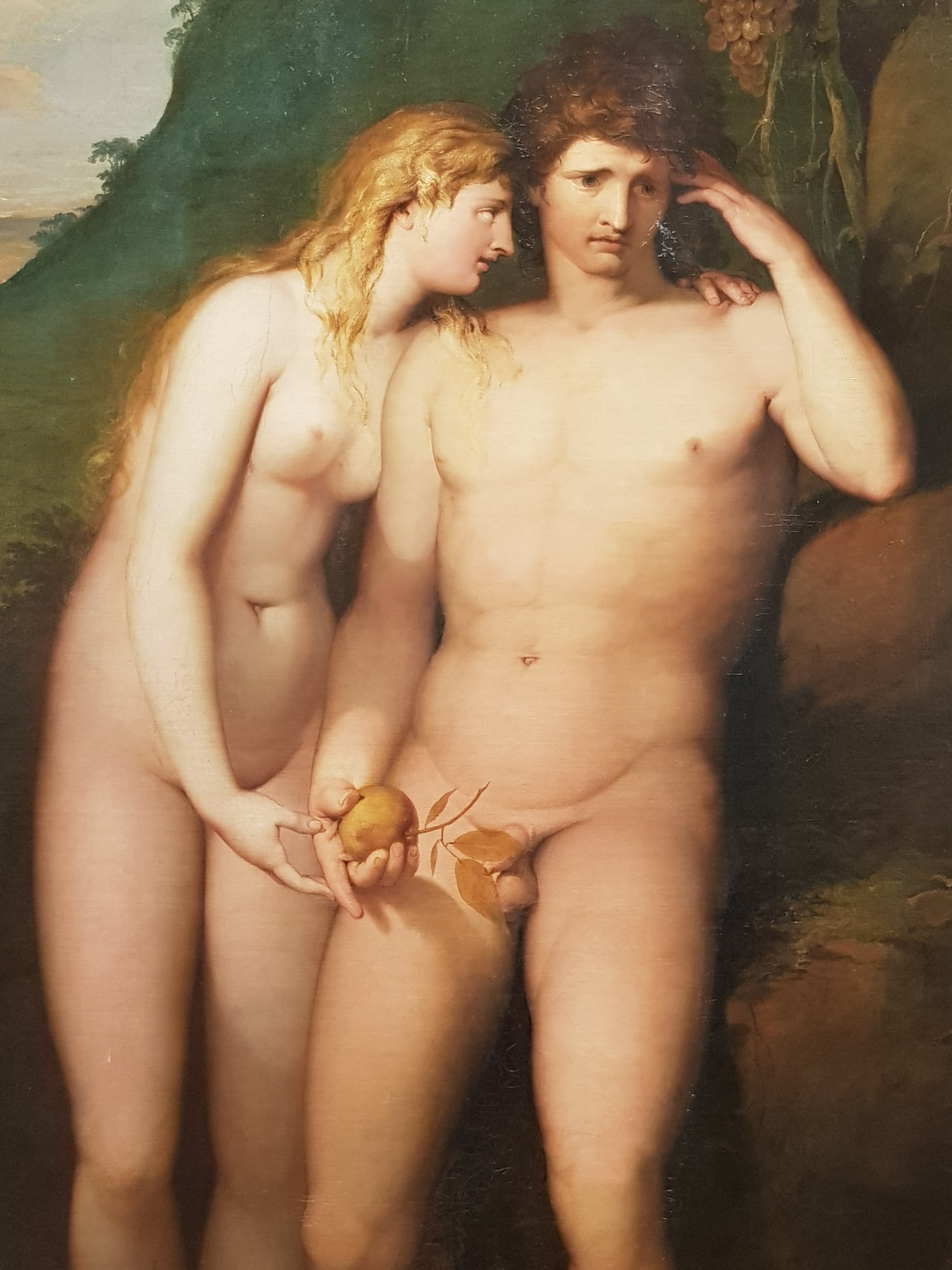
James Barry’s Temptation of Adam (c.1770), based on Milton, which he painted while in Rome:-

image

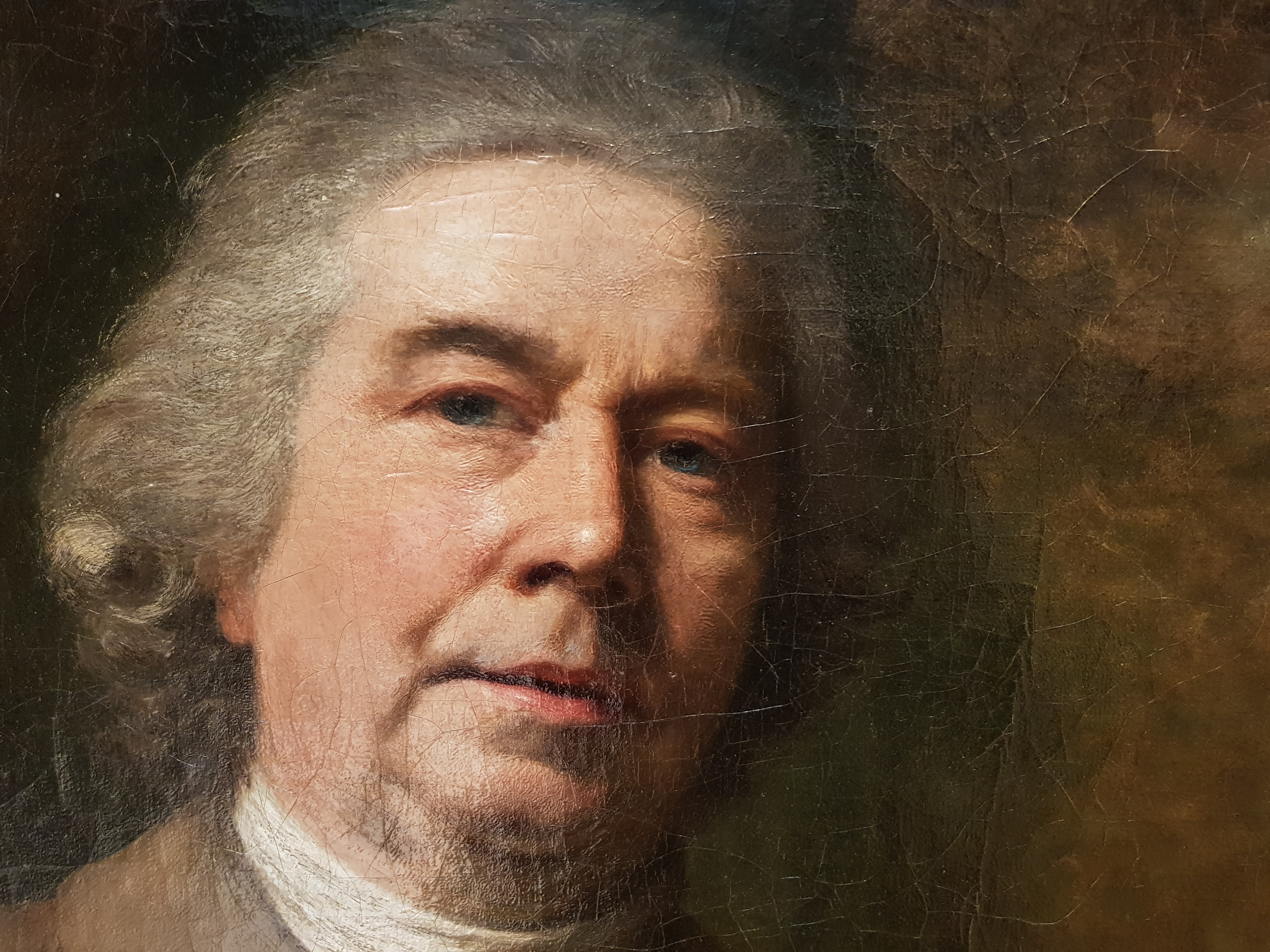
Nathaniel Hone’s Self-Portrait (c.1780):-

image

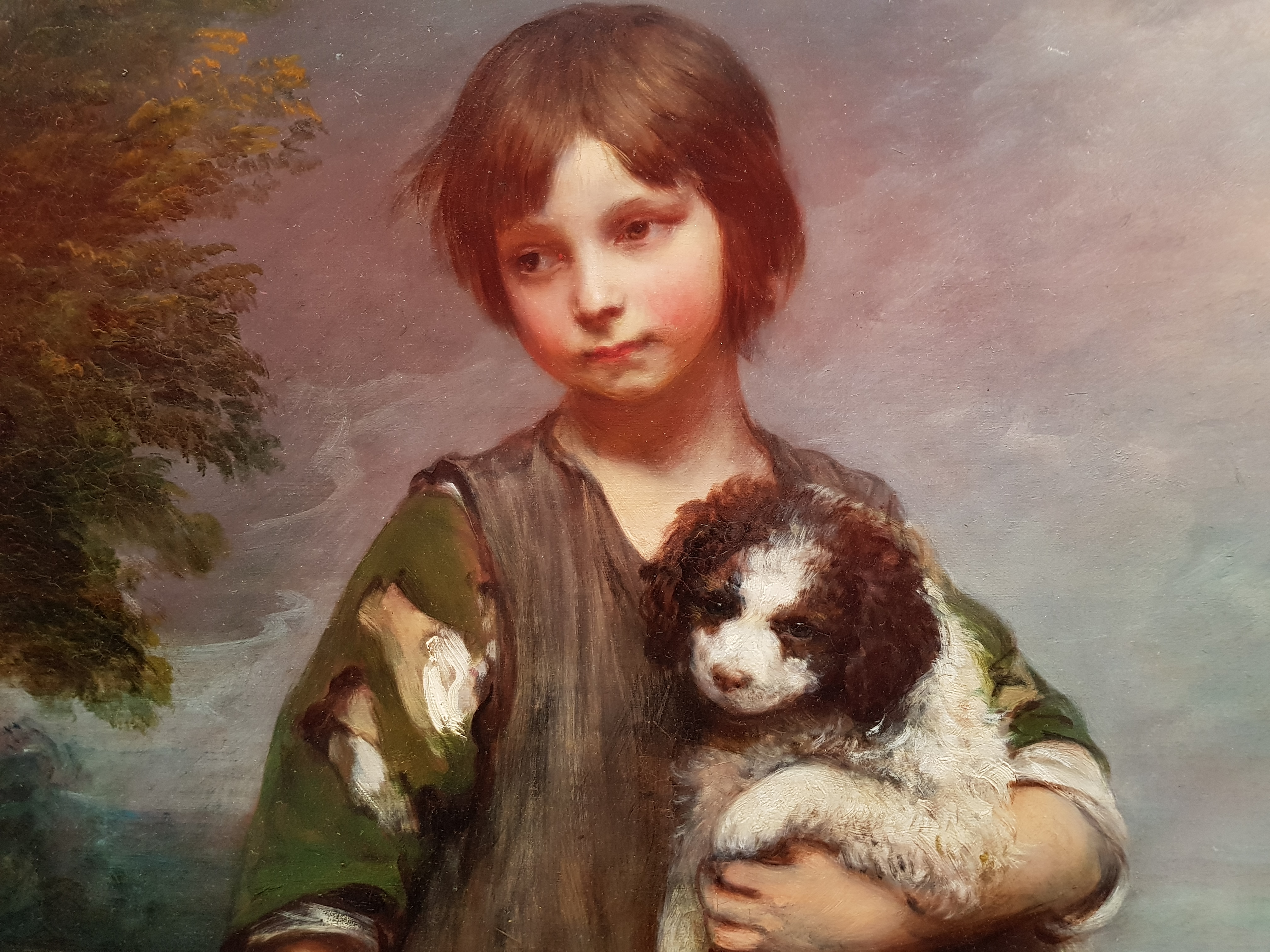
And Gainsborough’s Cottage Girl (1785), which looks saccharine in reproduction, but less so when you see the quality of the painting:-

image

image

Standard

Uranus

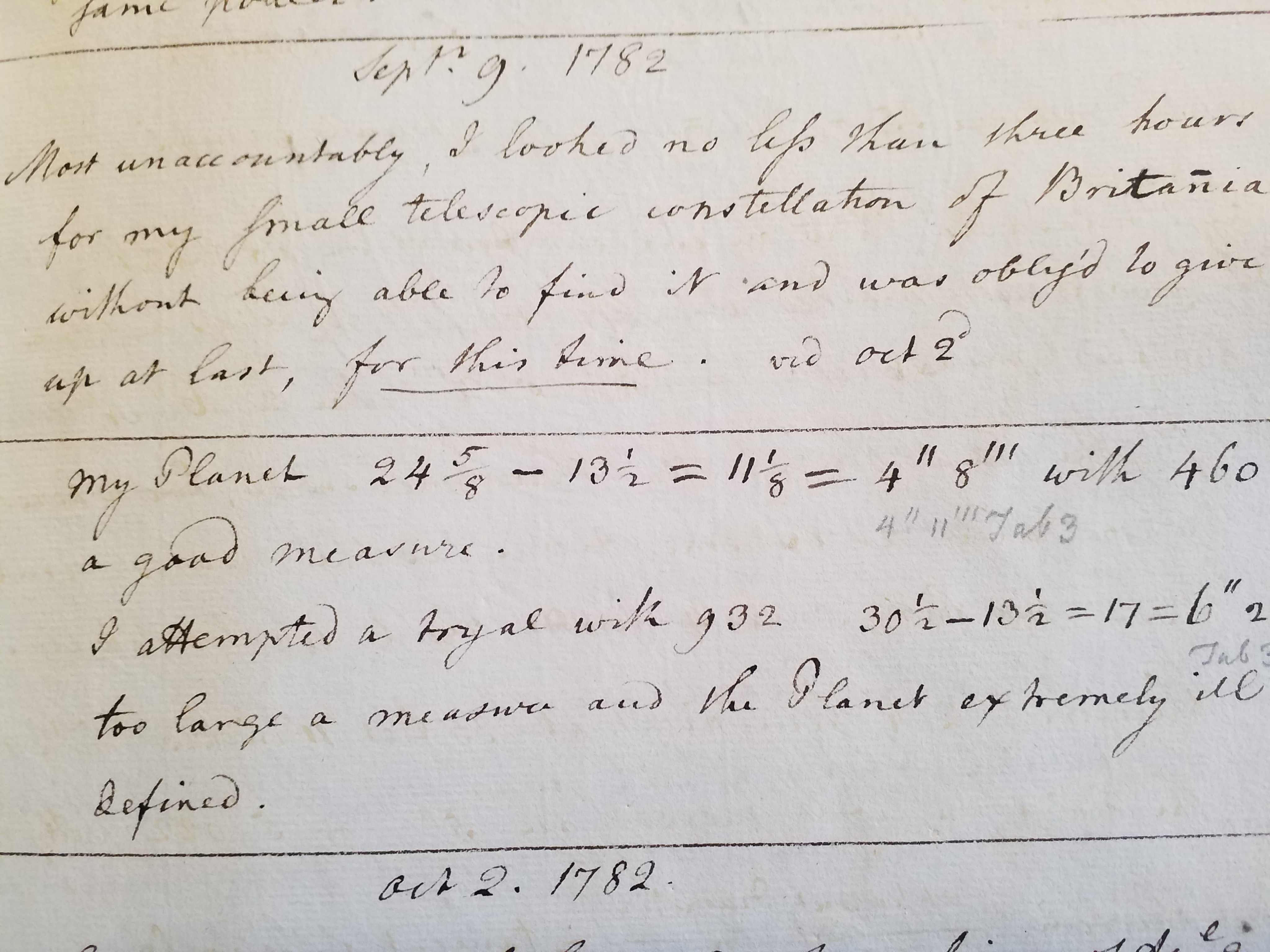
The other thing that I was really impressed by in the Royal Astronomical Society’s Library was the manuscript ‘observing book’ in which William Herschel described his observations of the planets, including the entry on 9th. September 1782 in which he sighted ‘My Planet’, which was Uranus – ‘the Planet extremely ill defined’.   He is the one and only person to have discovered a new planet from his observatory which he had recently moved from Bath to Slough:-

Standard

Spitalfields Mathematical Society

I was invited this afternoon to meet the new Executive Director of the Royal Astronomical Society, one of our neighbours in the courtyard, and to see some of the books in their library.   I was most struck by the fact that they have inherited books and manuscripts from the library of the Spitalfields Mathematical Society, a group which was established in Spitalfields in 1717 by Joseph Middleton to teach maths to sailors.   It met in a pub, the Monmouth’s Head, until 1725, when it moved to the White Horse in Wheeler Street.   Apparently about half its members were weavers – presumably Huguenot – and the rest were a motley crew of ‘brewers, braziers, bakers, bricklayers’. The Society existed until 1845 when its membership lapsed and was absorbed into that of the Royal Astronomical Society, founded in 1820.

Standard

Toasts

I was asked on Tuesday evening at our lenders’ dinner for Charles I about the origins of the two very distinctive Royal Academy toasts – the first to Our Patron, Protector and Supporter, Her Majesty the Queen and the second, more unusually, ‘Honor and Glory to the Next Exhibition.

Of course, I didn’t know.   But Mark Pomeroy, our excellent archivist, has been able to supply the answer:-

The earliest recorded list of toasts comes from Council minutes in 1785:  The King, The Queen, Prince of Wales & rest of the Royal Family, The Duc de Chartres & the rest of the Noblemen & Gentlemen who have honoured us with their presence , Lord Mayor and the City of London, Sr. Jos. Banks and the Royal Society, Lord Leicester and the Antiquarian Society, Prosperity to the Royal Academy, The Council.  References to Patron, Protector & Supporter and Honor & Glory in the secondary literature often append the term “ancient” and there is little reason to doubt that the formulation predates written evidence.  The King describes himself as ‘Patron, Protector and Supporter’ at the head of the Instrument of Foundation and this terminology is likely to have been adopted for the King’s toast at early Academy dinners.  As for ‘Honor & Glory’, this may well pre-date the Academy itself.   It is bi-partisan in tone, privileging neither the Academist party nor the Hogarthians and could, perhaps, date from the Society of Artists of Great Britain’s St. Luke’s Day dinners.

Standard