
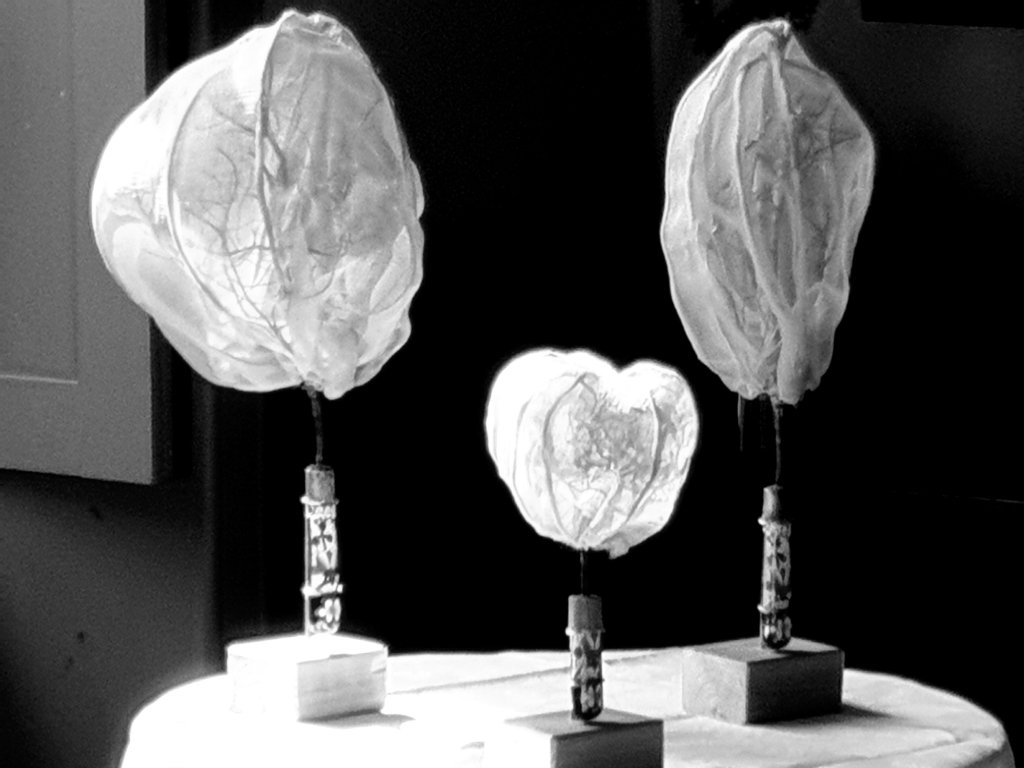
I’ve learned a new architectural term today: bowellism, as a way of describing Richard Rogers’s tendency to turn buildings inside out, with their mechanics on the exterior. First used, apparently by Nikolaus Pevsner of a 1957 student project by Michael Webb, later a member of Archigram, for the Furniture Manufacturers Association in High Wycombe, which was described by Pevsner in a lecture on the return of historicism at the RIBA as looking ‘like a series of stomachs on a plate. Or bowels, connected by bits of bristle’. It was then adopted by Reyner Banham to describe an interest in visible circulation.
Category Archives: Uncategorized
Changes in museums
I got an unexpected call from a friend who is a trustee of a smaller museum in which he asked me what I thought were going to be the big changes in museums as a result of COVID-19. I had to think on my feet, because although I’ve been reading a lot about what’s happening, I haven’t really had to structure my thoughts on the topic. So, these were my immediate thoughts:-
- It’s pretty obvious that there is likely to be a reduction in the number of big blockbuster exhibitions. They are so expensive to organise, they require a great deal of international travel, they only work if there are lots of visitors. I noticed that the V&A’s exhibition of Kimonos was pretty well drawn from its own collection and I can imagine that this will be a more general pattern: packaging up work from the existing collection and work in store in order to save on costs.
- Much activity is surely bound to migrate online, and already has. After nine months of working much more actively online – online seminars, online conferences, online teaching, staying at home and having meetings on Zoom, it’s a bit implausible that the pattern will change back to the old normal, however much people may yearn to be back in the galleries.
- Visitor numbers are down all over Europe. We’re now in a second wave of COVID and it looks as if there may be a third wave and a fourth wave. We’re not going to get back to normal anytime soon and that includes less international travel, less cultural tourism, fewer visitors, less visitor income, so museums are going to have to change their financial projections not just this year, but for the next five years at least.
- Deaccessioning is gathering pace in American museums, not just in order to help provide necessary income, but also in order to re-shape the character of collections and which artists are represented.
- In the UK, trusts and foundations and indeed the government have stepped in with grants to help museums survive this year. But what happens next year ? This was the question I was asked and I would love to have an answer.
Jeremy Dixon and Edward Jones
I have tried to attach a news report from the Architect’s Journal, but it resists all my attempts. It is a very mournful piece of news so far as I’m concerned, announcing the closure of the architectural practice of Jeremy Dixon and Edward Jones.
I first met Jeremy and Ed in the summer of 1994, when John Wykeham, the then Head of Administration, and I were going round meeting architects who we might consider to re-design the National Portrait Gallery. They had an office in Percy Street and were working together on the plans for the Royal Opera House, a young practice as they described themselves even though they were both in their mid-fifties, having known one another at the Architectural Association, worked together at Milton Keynes, collaborated on the design of Northampton Town Hall and then gone their separate ways for over a decade until Ed wanted to come back to London from Canada and Jeremy needed help on the Royal Opera House. I worked with them for ten years or so: on the design of the Ondaatje Wing and the reshaping of the ground floor of the National Gallery. They have had a good run and have done an amazing amount of intelligent, well considered and important work, for which they don’t always get the credit they deserve.
Romilly Saumarez Smith (4)
I have spent a happy afternoon listening to the talks and interviews which I only half overheard last night connected to the exhibition Of Time and Place organised by the new online gallery ‘Living Object’ (www.livingobject.co.uk). Not least it gave me a much better sense of the gallery and the artists it represents, set up only in March as a way of giving artists specialising in three-dimensional media – ceramics, textiles, jewellery – an online presence, talking about their work, not just as a way of selling it, but as a vehicle of international communication.
Romilly appears after 55 minutes, talking about the relationship between our house and her work, her interest in the structure of medieval bookbindings, the discovery of copper wire and soldering, our trip to Newfoundland and starting to make work with Lucie Gledhill, a journey of collaboration. The talks are currently on WeTransfer, but not necessarily for long:-
Vikingur Ólafsson (2)
For those who are not already familiar with the playing of Vikingur Ólafsson and perhaps more especially for those who are, I very strongly recommend his current series of radio programmes, which not only gives a very clear and illuminating description of his musical interests, but also an indication of the differences between those who believe in a presumed authenticity of interpretation and those like Olafsson who advocate a much freer use, adaptation and transcription of the original score, particularly Bach:-


Romilly Saumarez Smith (2)
Although Romilly’s current exhibition is only online, the house has been turned into a museum, with small precious objects laid out on the dining room table, as if they are fresh discoveries from the crypt:-


https://www.livingobject.co.uk/of-time-and-place/romilly-saumarez-smith
Arnold Circus
As the sun was shining, I went to investigate what was happening in Arnold Circus, the beautiful centrepiece of the Boundary Estate, where there was a low-key, local demonstration about the fact that the Council has sent contractors in to rip up the pavements in order to introduce a new scheme of pedestrianisation. Dan Cruickshank was there, talking knowledgeably, as ever, about the history of paving stones, how wooden setts were used in the west end to reduce the noise of the coach traffic, cobbles in Calvert Avenue, and the quality of the York stone paving stones and granite kerbs laid out by the LCC and which are at risk of being lost:-


Howard Hodgkin
On a very rare trip into the west end, partly to deposit books at the London Library, I was able to catch the beautiful, choice exhibition Memories, devoted to the work of Howard Hodgkin. They are nearly all small works – deeply intense and atmospheric recollection of things seen, mainly while travelling in Venice, America and Tangiers, the distillation of the ways in which they are half remembered and half abstracted in the mind.
Leaves (1987-88):-

Venice Sunset (1989):-

Italian Landscape (1990-91):-

After Degas (1993):-

Chinoiserie (1994-7):-


Whitechapel Bell Foundry (67)
I am posting a formal letter I have just received from Professor Toshio Kusamitsu in Tokyo who has been following the plight of the Bell Foundry from afar. I knew that he was deeply knowledgeable as to what the Bell Foundry represents in terms of its industrial history, but I was moved by the amount of feeling which has gone into his plea to the Inspector to save it at all costs:-
To whom it may concern,
Sir Charles Saumarez Smith has asked me to write to you an appeal for the future of the Whitechapel Bell Foundry. I am very happy to express my deep concern about the building of the oldest manufacturing company in Great Britain. Charles has been a very good friend for nearly thirty years and I have been following his blog in order to catch up what’s going on in Britain. Recent posts have been rather discomforting, namely about the future of the Whitechapel Bell Foundry. I am a historian of the British Industrial Revolution and received a PhD from Sheffield University which discussed the relationship between crafts and industrialisation. I lived most of my stay in the U.K. in London and three years out of six I lived in Spitalfields in the East End of London. I used to explore in the near by area, and I came across the dignified and a little austere building and admired its historically heavyweight presence. I think that Britain is a country which values and protects the historically important monuments together with the private sector organisations such as the National Trust. I remember during my period in Britain that the Ironbridge Gorge Museums won the Museum of the Year Award in 1977 and the same award went to the Quarry Bank Mill in Styal in 1984. I am stressing this because Britain has been a pioneer of preserving and protecting the heritage of industrial sites and buildings. When I was at the University of Tokyo I took about twenty students on a tour to industrial and literary places including both the Ironbridge Gorge Museums and Quarry Bank Museums. I am happy to say that the students were very impressed by their histories and in particular the way they were preserved. As a student myself of John Ruskin (I am a councilor of the Ruskin Library in Japan) and William Morris, I am a strong believer in protection and preservation of historical relics and especially important legacy that would teach the future children of their pride in history.
The Whitechapel Bell Foundry is significant historical evidence which will teach us and future people how the history was made, although bell making may be a small-scale industry. But you should listen to the bells ringing at the Big Ben and other places where the products of the Whitechapel Bell Foundry are still living examples of the superb quality. It is my belief and indeed desire that the Whitechapel Bell Foundry should retain its building as a whole and should be retained by the worthy hands to create its manufacturing function as well as museum like facility to those who are interested to observe the process and crafts of British manufacturing industry. I sincerely hope that the strong voice against American company’s ugly redevelopment on the site of Grade II building should be heard and the future of the building would be saved. I ask you to consider that the saving of the historical building would benefit the appreciation from the people in future.
Yours faithfully
Professor Toshio Kusamitsu PhD (Sheffield), FRHistS, Emeritus Professor of the University of Tokyo


You must be logged in to post a comment.