
We were incredibly pleased by the attached good news that a cottage somewhere in North Wales has won the Architects’ Journal small projects award for the skill and sensitivity with which which Martin Edwards has added a bedroom extension to the existing nineteenth-century cottage, using the materials of an agricultural building to disguise it. I am particularly pleased that the judges could see the quality in something so low key, so carefully unostentatious, doing everything in its power to sit harmoniously in the landscape, but with it’s own integrity, independently of the existing cottage:-
Category Archives: Uncategorized
Michael Craig-Martin on Coronavirus
Apart from the recent interview in the Financial Times with Emmanuel Macron which I did not repost because it’s behind a paywall, this is the single most thoughtful and reflective – and damning – piece that I have read so far about the political response to Covid-19 in this country:-
Víkingur Ólafsson (1)
Over the last couple of years, we have been hypnotised by Víkingur Ólafsson’s playing of Bach, which I have found it very hard to analyse: very light, oddly otherworldly, as if it is being played from another planet, not early eighteenth-century Leipzig. More recently, we have been listening to his new recording of Debussy and Rameau. But I haven’t dared write about it, because I’m not confident of my musical judgment, so was pleased to read the attached piece in the New Yorker, which describes the quality of his playing authoritatively:-
Ventilators
I realise that by now we’ve probably all read more than enough about Covid-19, how to avoid it and what it’s likely effects are, but I was still struck by the extreme lucidity of the attached presentation and the quality of its graphics, demonstrating just how bad it can be and why ventilators make the difference between life and death.
https://graphics.reuters.com/HEALTH-CORONAVIRUS/VENTILATORS/oakvekyxvrd/index.html
Richard Bram Photographer
As readers of my blog will know I have a more than passing, although still amateur, interest in photography, which has been much encouraged by Richard Bram, a professional street photographer. This week he was due to talk at the Italian Street Photo Festival which, not surprisingly, hasn’t been possible, but they have posted a talk by him in which he reflects interestingly about his attitude to Street Photography and his career.
Tyvek
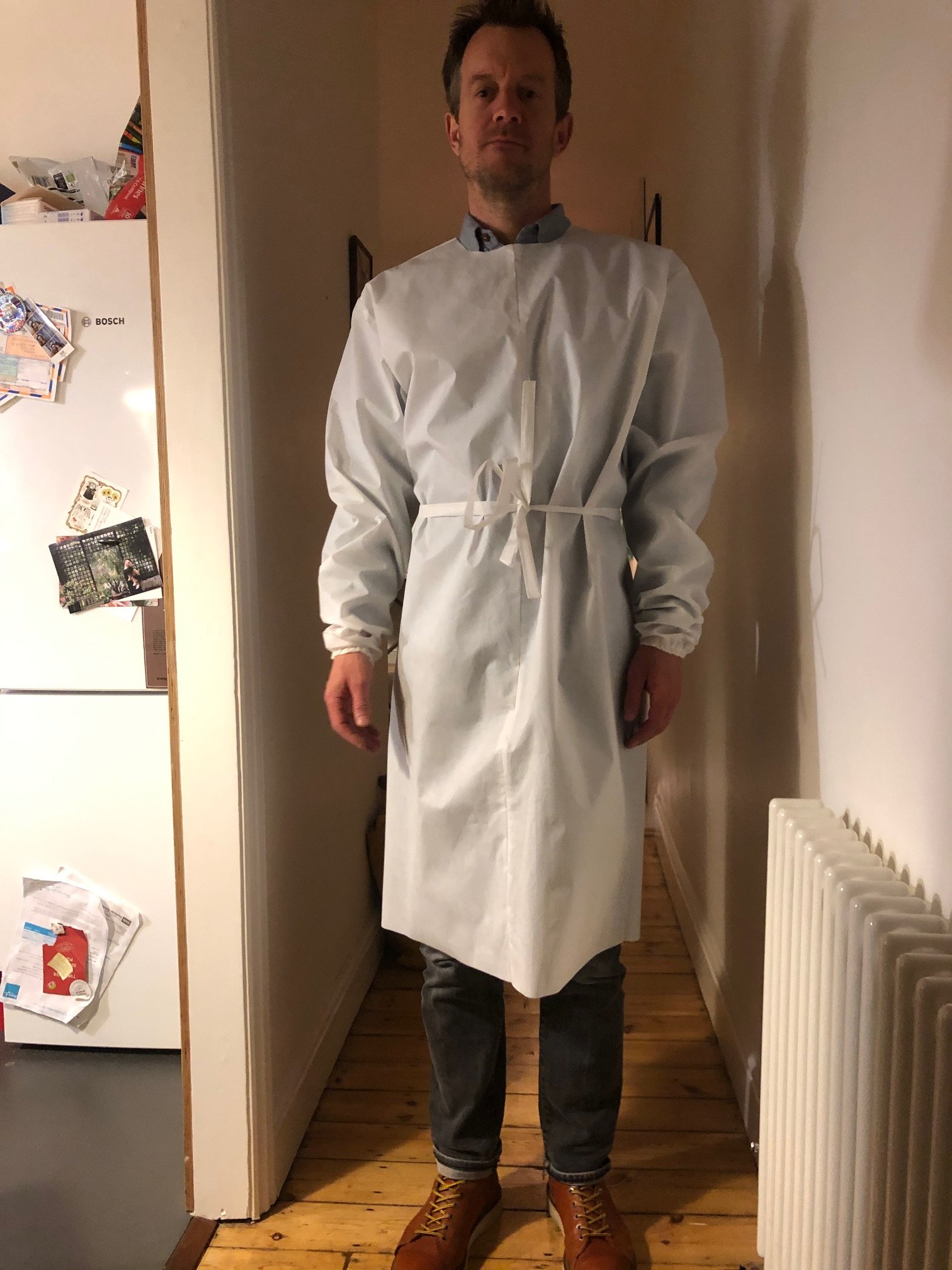
I have written previously of the work being undertaken by Bella Gonshorovitz and a group of friends in Hackney to make gowns for hospitals. But it is far from straightforward because of problems in the supply of the appropriate material. So, she is now starting to make them from material called tyvek, which has been approved by the Royal Brompton Hospital. It is apparently much used for purposes of art storage, so she is putting out a call in case anyone knows of stocks of it. If so, please contact her at halfbel@gmail.com. It’s the only way of knowing how to help her, other than giving money, which many of you already have done.
Accidie
I remembered in the middle of the night the medieval disease of Acedia, in which the Benedictine monk succumbs to a form of listlessness and torpor, unable to work or pray; and looked it up this morning to check that it was indeed, as I had thought, the disease we are all suffering from collectively, unable to focus or concentrate because of the state of the world and the lack of motivation to complete tasks – ‘the noonday demon’ as it was described.
Museums and Coronavirus (3)
I have been following online what the expectations are of what will happen to museums if and when they are able to reopen. I came across the attached piece by Andras Szanto when it first came out on artnet and have now reread it after it was reposted on AEA’s excellent bulletin, The Platform. It seems to me to make a cogent case for what is likely to happen: a much reduced dependence on blockbuster exhibitions which will be impossibly expensive; a shift towards constructing narratives – and possibly exhibitions – out of permanent collections; and an increasing tendency, which is already happening, to contract in expertise, rather than growing it in-house. None of these are necessarily desirable, but probably inevitable.
https://news.artnet.com/opinion/andras-szanto-op-ed-reopening-museums-1832439
Gowns for the NHS (3)
I am struck by the question which has been asked in a Comment on my previous post on this subject as to why it is that an inventive country, which we have traditionally been, should have been so hopelessly unable to respond efficiently and at speed to a national emergency, with obvious exceptions, such as the re-equipping of the ExCel Centre into an emergency hospital in the space of ten days. But hospital gowns ? These are not apparently a particularly sophisticated piece of equipment, but make the difference between life and death. Lots of manufacturers have apparently offered their services, including individual makers, as in Hackney, but National Health England seems to have been slow to respond, maybe too centralised, unable to allow independent initiative. Or is it an issue of scale ? An over-dependence on the cheap labour of Turkey and China ? This surely is an issue which bears non-judgmental investigation if and when we ever come out of this crisis and are to learn from it.
Coronavirus (3)
I find that the most straightforward way of following how we are doing in terms of coping with Coronavirus is not by listening to the daily news bulletins, but by studying the daily graph published (helpfully) by the Financial Times. I can’t help but notice that the weekly number of deaths has now overtaken both France and Spain, which shows that we have demonstrated our exceptionalism by the exceptional arrogance and stupidity of our response: not listening to the WHO when it first warned us of the dangers; not joining in with conversations with our European neighbours as to how best to respond to the threat; not ordering PPE as required. Pretending that all was well when it wasn’t; ‘taking it on the chin’ as the Prime Minister recommended in contrast to all the best advice.


You must be logged in to post a comment.