
We had a study day today to discuss the Waterloo Cartoon which has been on display for the last month or so as a way of commemorating the Battle of Waterloo. What struck me on looking at it again is its documentary realism. Most of the works commemorating Wellington are, not surprisingly, heroic. But Maclise, in undertaking the task of depicting the aftermath of the battle for the House of Lords, is surprisingly impassive, concentrating on accuracy in the detail and the scale of death without glorifying it. I also did not know that it was bought by the RA in 1870, following Maclise’s death, put on display in the new diploma galleries until 1922 when its ardent Victorianism went out of fashion. So it was sent on loan to Sandhurst where it was displayed in a gymnasium.
Category Archives: Uncategorized
Melbury Road
I walked up Melbury Road this evening to the sound of fireworks exploding in Holland Park. Past the street which leads to Leighton House, past the Tower House, past where Michael Winner used to live, to No. 8 with its grand oriel windows, designed by Norman Shaw as an artist’s’ home for Marcus Stone, a rather obscure RA, but immensely wealthy because of his work as a book illustrator. G.F. Watts was at No. 6 next door. And No. 11 (now No. 31) was built for Luke Fildes, also by Shaw, not long afterwards:-

Alvin Langdon Coburn
I am immensely indebted to the reader of my blog who compared my photograph of Tate Modern from the roof of St. Paul’s to the work of Alvin Langdon Coburn. It has compelled me to look at his work and read about his career. Of course, she is right in that Coburn became famous partly for his misty view of cityscapes, views of New York seen from the top of a skyscraper, Fifth Avenue from the St. Regis (1905) and The Octopus (1909) showing Madison Square abstractly from above, published in his book New York in 1912. In London, he photographed St. Paul’s from the bottom of Ludgate Hill with the steam train going past, and again from across the river, and the dome of the National Gallery occluded by the Landseer lions. I am not conscious of being influenced by his aesthetic of intense pictorialism, but am flattered that someone should think there might be a relationship.
Mayfair
We have just had a seminar on the future development of Mayfair, run by Peter Murray, the chairman of New London Architecture. Much of what is happening is potentially exciting: the conversion of the old US Embassy building into a hotel and the renovation of Grosvenor Square; the reduction in traffic roaring down Bond Street and the widening of pavements; the creation of a new arcade of art galleries connecting Cork Street to Old Burlington Street; a David Adjaye scheme immediately opposite the Ritz. The question is how to maintain the existing layering of different uses, including art, culture, hotels, shopping and – I was reminded – clubs. How to pay for the public realm developments which are needed when public funding is being cut. And what role will the new Mayor play in all of this.
Pentagram
We had a meeting at the headquarters of Pentagram this afternoon in what was once an old dairy off Westbourne Grove where the horse-drawn milk carts would load up. It was bought by the original partners of Pentagram in the late 1970s as their offices, meeting rooms, workshops and archive on the ground floor, open plan on the top. I saw the workshop where Kenneth Grange designed the Intercity 125 and the later London taxi and sat in a meeting room opposite some of their classic logos, not just Alan Fletcher’s design for the V&A of 1990 (it was required to be ‘functional, dateless, memorable’) and Harry Pearce’s logo for the RA, but also Berry Bros & Rudd.
Francis Bird (2)
Having done a post on Francis Bird, I thought the least I could do would be to inspect his work in situ.
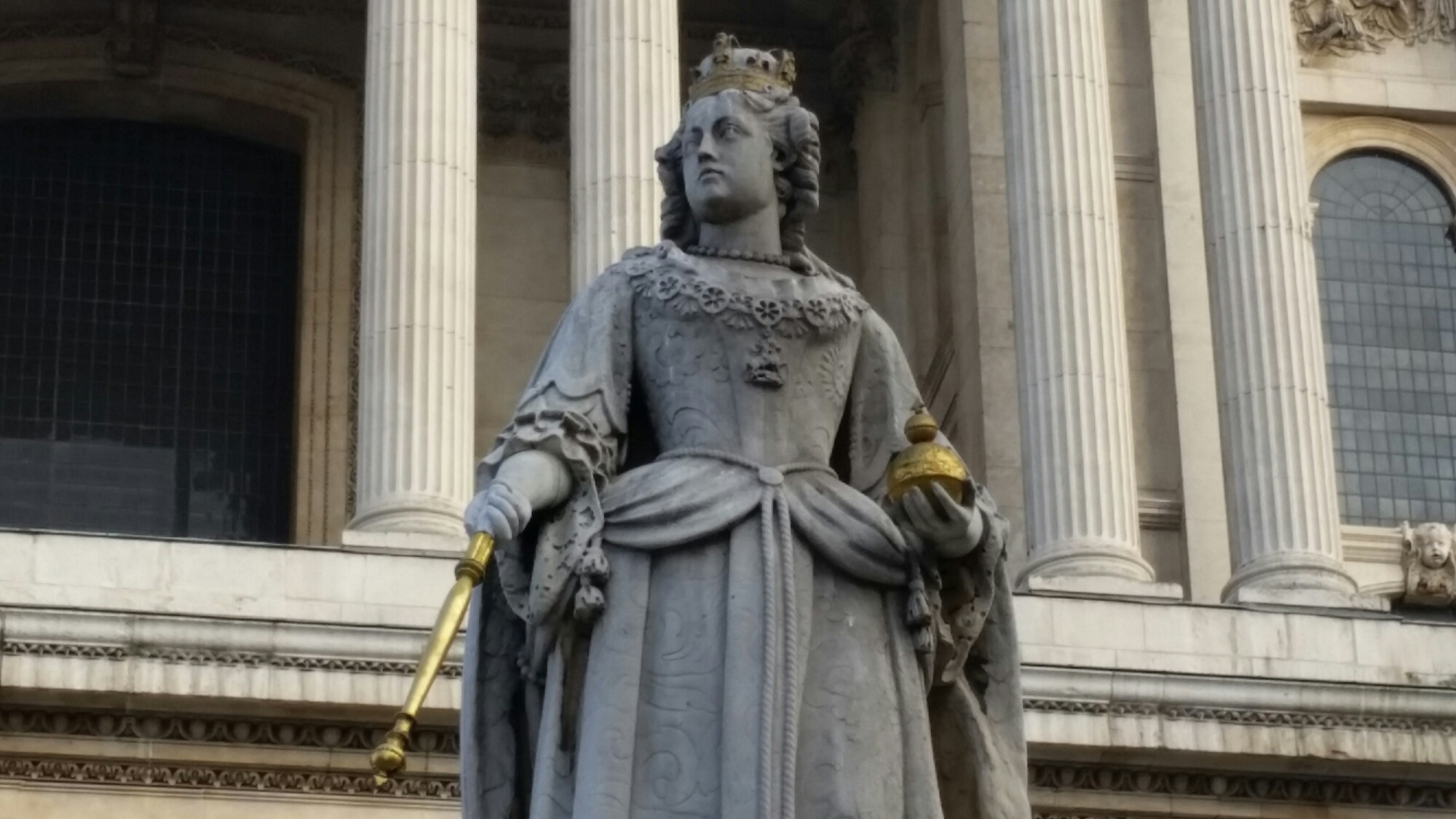
Queen Anne still presides in front of all the tourists taking photographs of the west front, but she’s a copy dating from the 1880s by which time the original had been much vandalised:-
Goya Portraits
We went to Goya: The Portraits. It was a strange sensation seeing portraits so apparently lacking in artifice, so direct and humane, showing sitters in ways which are ostensibly unflattering, which they not only tolerated but admired, beginning with his great group portrait of The Family of the Infante Don Luis de Borbón, where Don Lois is old and grumpy while his wife is having her hair done. Goya painted for a relatively small group of inter-related liberal aristocrats. He painted their face first, then dashed in their clothes at speed back in the studio. Great group portraits. We liked the Self Portrait with the hat which he put candles in to finish off the highlights. And the last Self Portrait, which shows him with his doctor, Eugenio Arrieta, who was responsible for his survival.
Francis Bird (1)
I was intrigued as to who had been responsible for the statues of the apostles standing on the parapet of the north transept of St. Paul’s, nearly invisible from the ground. The answer is Francis Bird, described by George Vertue as ‘the most famous statuary, that this Nation ever bred’. I should have known about him. He was trained both in Flanders, where he was apprenticed aged 11, and in Rome, where he worked under Pierre Legros, learning to carve the ornaments of baroque churches. His first work for St. Paul’s was a relief of St. Paul preaching to the Bereans over the west door and he was then invited to do the carving of the Conversion of St. Paul in the tympanum of the west front. Then he did the statue of Queen Anne to celebrate the completion of St. Paul’s. The statues on the transepts belong to a later phase of work when a New Commission was appointed using John James as architect, not Wren. In fact Wren vehemently objected to their work, as recorded in a letter to the Commission dated 28 October 1717, not long before his death: ‘I never designed a balustrade. Persons of little skill in architecture did expect, I believe, to see something they had been used to in Gothic structures; and Ladies think nothing well without an edging…My opinion, therefore, is, to have statues erected on the four pediments only, which will be a most proper, noble and sufficient ornament to the whole fabric, and was never omitted in the best ancient Greek and Roman architecture’. They went ahead and commissioned the sculptures nonetheless, even though Bird was a Catholic.
Southwark
Years ago, we lived in Southwark, in an attic flat in Trinity Church Square, painted bright blue, with paint from a shop just north of the Elephant and Castle. The surrounding area was deeply dingy, little known streets, cheap housing, sandwiched under the railway tracks between London Bridge and Waterloo. Today I crossed Blackfriars Bridge at lunchtime, visited Purdy Hicks in Hopton Street, saw the exhibition by Julian Stair at Contemporary Applied Arts (pots for £36,000) and had lunch at The Table in Southwark Street, designed, I presume, by Allies and Morrison.
Eva Jiřičná RA
We went to a lecture tonight by Eva Jiřičná. Although I have followed her career fairly closely and have always admired her glass staircases and precision engineering – she designed the Royal Academy’s shop – I hadn’t realised the full range and depth of her career, including a great deal of work at the V&A, the doors at the entrance, the desk and the shop, as well as the Bollinger jewellery gallery, shops, including work for Joseph (she did the original design for the Caprice), as well as work in Prague and Zlin, her home town in Czechoslovakia. Best of the work she showed was a house she has designed for a property developer in Czechoslovakia, which looks like a sputnik and is mostly underground, but demonstrates her amazing neo-modernist sense of space age geometry.


You must be logged in to post a comment.